



Enhanced Local Development with GitHub Copilot: A New Era of Intelligent Coding
Empowering Developers: Choice and Control
The demand for flexibility in development processes has led to the emergence of sophisticated tools that allow developers to choose between various model options. GitHub is at the forefront of this innovation, presenting users with access to frontier models provided by major players in the AI space. Among its offerings is Project HydraFusion, which orchestrates the tasking between one or multiple models, optimizing performance, cost, and latency effectively.
Furthermore, Microsoft has introduced Microsoft Execution Containers (MXC) to enhance security during both interactive and non-interactive coding sessions, providing developers with a robust framework for building applications.
GitHub Copilot: Seamless Integration of Local and Cloud Intelligence
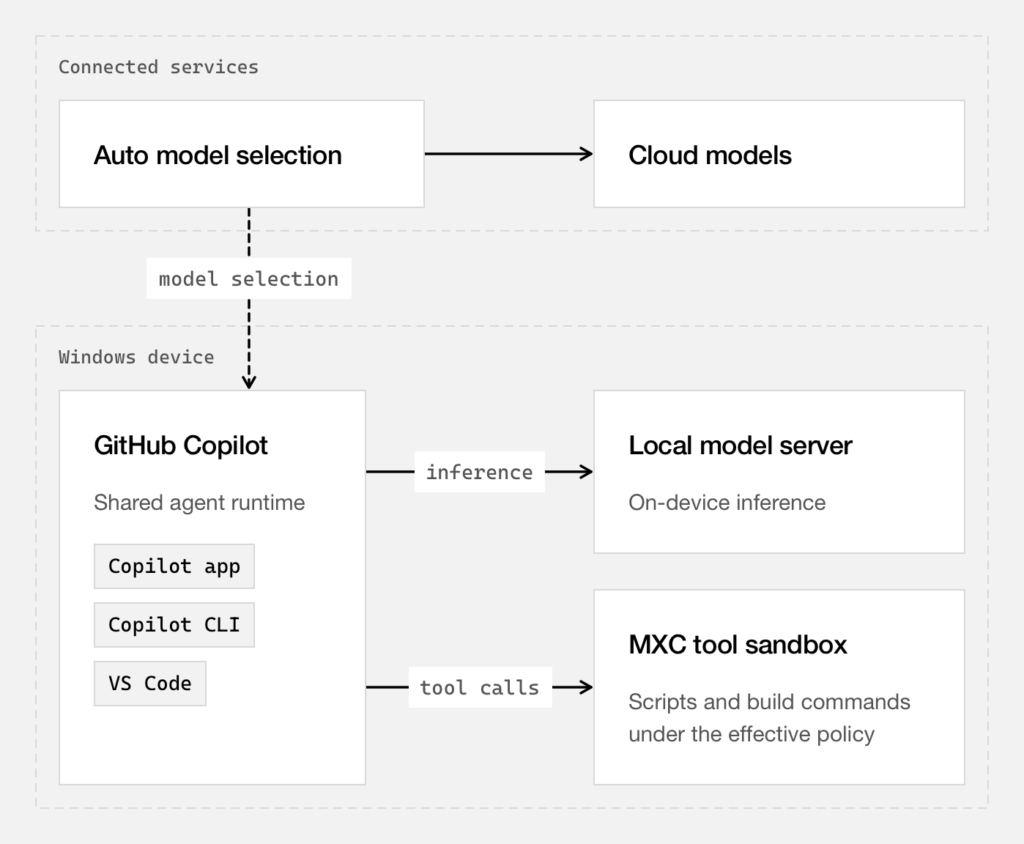
Anticipated by the end of this month, GitHub Copilot will intelligently discern when a task can be optimally executed using local intelligence versus leveraging powerful cloud models. This innovative feature will relieve developers of the complexities associated with infrastructure management by managing local and cloud inference seamlessly.
Specifically designed for high-performance devices such as NVIDIA RTX Spark Windows PCs, including the Surface Laptop Ultra, Copilot enhances local development, pairing robust on-device inference models with cutting-edge hardware for an optimized user experience.
Memory Management for Local Coding Agents
A pivotal aspect of local inference is memory management. The Surface Laptop Ultra harnesses the capabilities of NVIDIA RTX Spark, featuring up to 128 GB of unified memory and 1 petaflop of AI computing power.
Utilizing unified memory allows both the CPU and GPU to access a shared pool, significantly enhancing workload capacity. Nevertheless, it is crucial to acknowledge that the operating system, applications, and inference runtime also require memory allocation. Moreover, the key-value cache storing the model’s attention state must be accounted for as the context grows during task processing.
MAI Code 1.1 Flash: A Breakthrough for Local Development
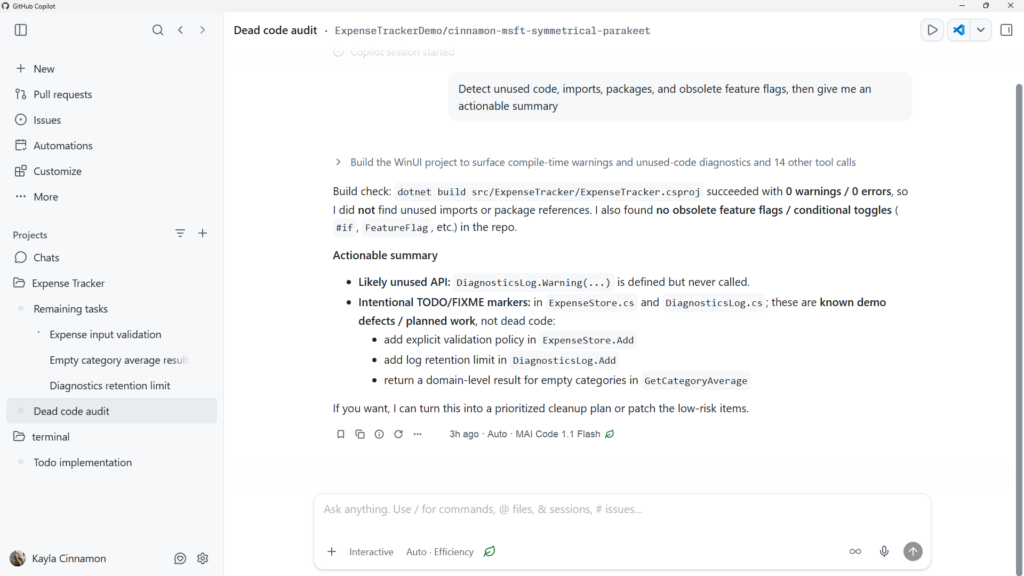
Microsoft AI has unveiled MAI Code 1.1 Flash, a locally optimized coding model designed to enhance the local coding experience. This model comprises a mixture of experts, featuring a total of 137 billion parameters, with optimized usage focusing on 6.8 billion active parameters. Techniques such as quantization and speculative decoding have been applied to reduce its footprint and enhance responsiveness while ensuring the quality of code generation.
Operational Versatility: Utilizing Local Models in GitHub Copilot
Developers can now access local models through GitHub Copilot in several ways, enhancing their control over coding tasks. Whether relying on automatic orchestration or manually selecting a local model, Copilot provides options tailored to developers’ needs. The intelligent Auto orchestration allows for dynamic decision-making on task execution, while explicit local model selection accommodates specialized workflows requiring specific resources.
Enhancing Security with Sandboxing Techniques
As coding agents interact with system processes, security remains a priority. Sandboxing strategies safeguard the execution of shell commands, preventing unauthorized access across files and network resources. By employing Microsoft Execution Containers, Copilot ensures that agents operate within securely defined parameters while maintaining usability.
A Practical Application: Automating Daily Repository Dashboards
To illustrate the utility of these technologies, consider an automation task designed to read local repository data and generate an HTML report each morning. These processes can run in a controlled sandbox, maintaining the necessary read-only access to source repositories while ensuring network security during test executions.
Configuring a New Automation
By leveraging GitHub Copilot, users can create a new automation task set to activate daily at 9 AM, guiding the agent through the required steps to maintain a triage dashboard for ongoing projects with controlled data outputs.
Finalizing and Running the Automation
Upon setting parameters and saving the automation, users can initiate the task for immediate execution, with Copilot ensuring a locally and securely generated dashboard while protecting the overall system architecture.
Conclusion: The Future of Development with GitHub Copilot
The integration of local models and secure sandboxing capabilities represents a significant advancement for developers, offering a sophisticated blend of intelligence and user control. As GitHub Copilot continues to evolve, it sets the stage for a new paradigm in local software development.
Acknowledgements
Project Managers: Ryan Hecht, Tucker Burns, Lei Xu, Pierce Boggan, Nhu Do, Greg Woo, Ramya Krishna Akula, Demetrius Nelon, Harald Kirschner.
Engineering Team: Andrew Feller, Devraj Mehta, Mackinnon Buck, Roman Bulanenko, Chris Dern, Daniel Pagan, Keith Mahoney, Vicente Rivera, Austin Hodges, Anis Mohammed Khaja Mohideen, Stuart Schaefer, Sha Viswanathan, Carlos Alexandro Becker, Logan Ramos.
Scientific Research: Ani Balasubramaniam, Shengyu Fu, Aashna Garg, Aakash Goel, Karthik Vijayan, Jennifer Zhu, Vivek Pradeep.
Marketing Contributors: Katie Liu, Alyanna Castillo.
