


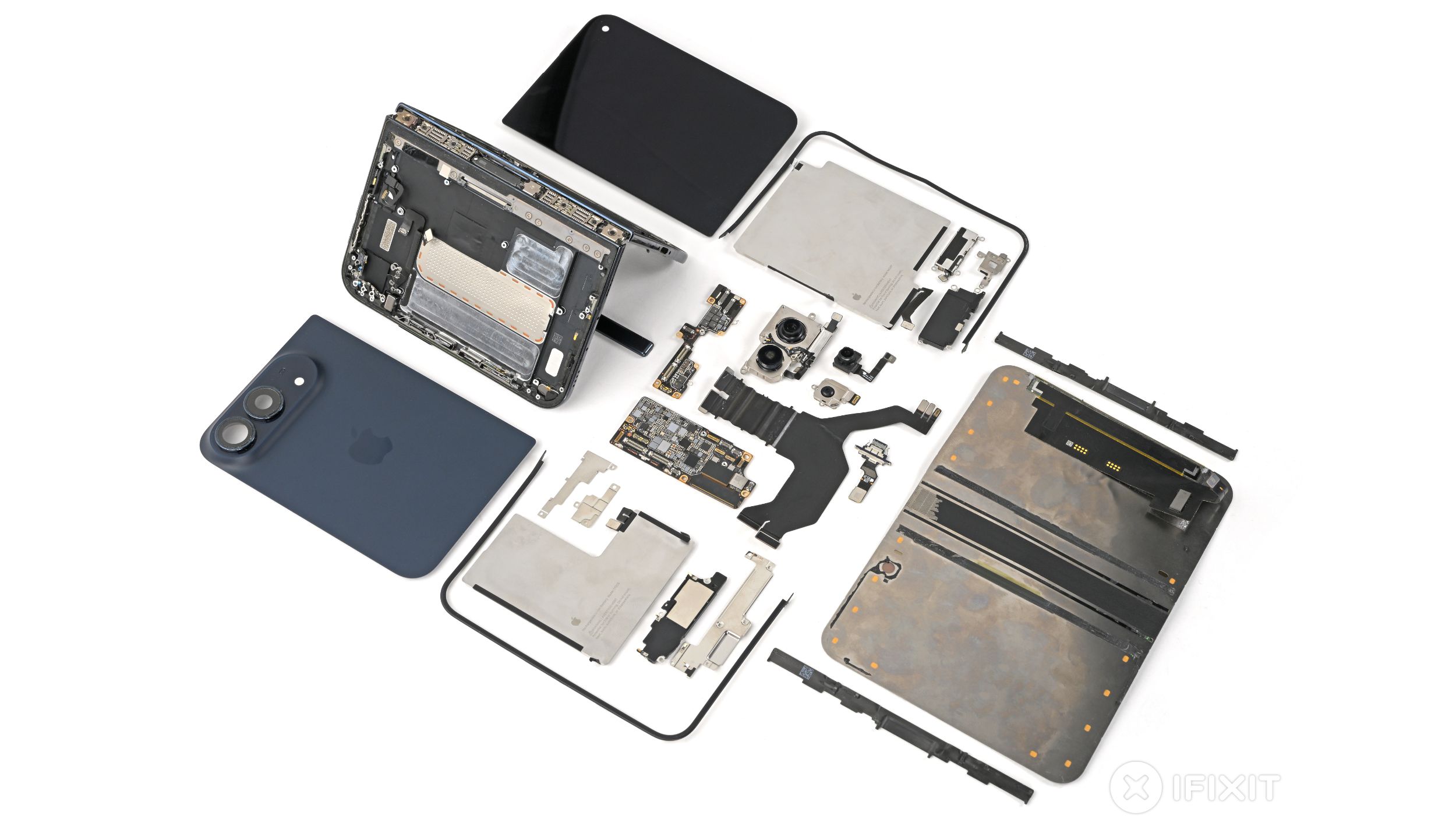
iFixit Teardown Analysis: Inside the iPhone Duo
Teardown specialists at iFixit conducted a comprehensive analysis of the iPhone Duo, unveiling its internal components, assessing its resilience against dust and water, and evaluating its repairability. The findings offer significant insights for potential buyers and repair enthusiasts alike.
Dust and Water Resistance Assessment
Prior to disassembling the device, iFixit subjected the iPhone Duo to an intense exposure of fluorescent dust. Given its IP68 rating, which suggests robust dust and water resistance, the iPhone Duo managed to fend off most particles effectively. However, some dust infiltrated certain areas:
- USB-C port
- Speaker mesh
- Device bezel
While minimal internal contamination was observed, dust accumulation within the hinge raised concerns, particularly as it caused a crunching sound during operation, possibly leading to screen damage. Comparatively, the iPhone Duo performed better in dust protection than both the Galaxy Z Fold8 and the Pixel 11 Pro Fold. Still, caution is advised against using the device in sandy environments, as some particles did reach sensitive moving parts. YouTuber JerryRigEverything corroborated these findings through similar tests, reporting issues with hinge magnets caused by dust ingress.
Repairability Insights
The process for accessing the iPhone Duo’s internal hatch proved to be straightforward. Notably, Apple designed the nano-texture cover layer for ease of removal, allowing for cost-effective replacements. Users with AppleCare+ can replace the cover layer for $19, while the out-of-warranty cost stands at $49.
Following the innovative battery adhesive technique introduced with the iPhone 16, the batteries in the Duo can be detached smoothly after applying a small electrical charge. This method has been recognized as the most effective experience for battery removal from any foldable device to date.
Display Structure and Vulnerabilities
The outer display of the iPhone Duo is robust, ensuring that most repairs can be carried out without disruption. However, the inner display presents significant challenges. It consists of a complex 10-layer stack, which iFixit was able to analyze microscopically during the teardown.
The logic board within the iPhone Duo deviates from previous models as it adopts an unstacked design—an approach not seen since the iPhone 8. This single-layer configuration facilitates a slimmer profile for the device.
iFixit also explored recent display failure reports, suggesting issues could arise from several causes: pressure, trapped dirt, habitual bending, or manufacturing defects. Observations indicated that failure points commonly occur near the hinge’s flex cable area, potentially due to accumulated stress where multiple components intersect. The teardown team developed a 3D model to examine stress concentrations within the hinge assembly, providing further perspective on potential problem areas.
Final Assessment and Repair Score
With the launch of a comprehensive repair manual coinciding with the release of the iPhone Duo, ease of display removal intact, and the innovative battery release feature, iFixit provisionally rated the iPhone Duo with a repairability score of 5 out of 10. Although it ranks as the most reparable foldable smartphone to date, significant vulnerabilities remain around the inner display and hinge assembly.
In comparison, the Galaxy Z Fold8 and Pixel 11 Pro Fold received lower scores of 4 out of 10. iFixit concluded that while the Duo shows promise in its design regarding repairability, maintenance still poses considerable challenges for users.
