


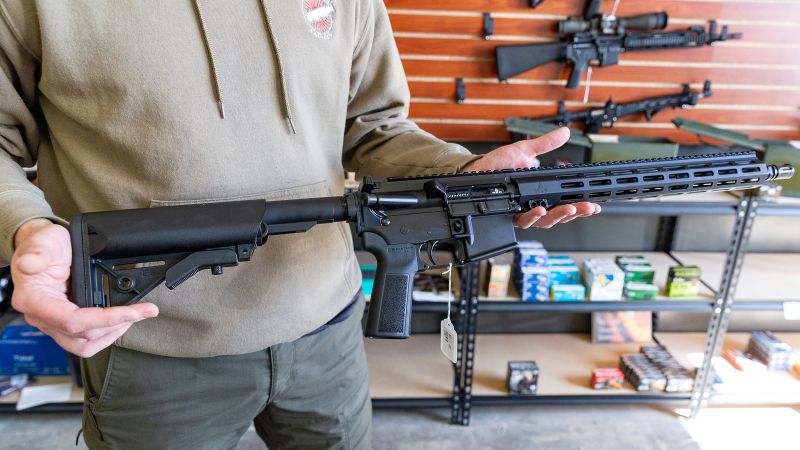
Supreme Court to Address Assault Weapon Bans in Landmark Case
As the 14th anniversary of the Sandy Hook Elementary School tragedy approaches, the U.S. Supreme Court gears up for a significant legal battle over the authority of states and localities to ban specific types of firearms, notably semi-automatic rifles like the AR-15. This case represents a critical moment in the ongoing discussion about gun rights and public safety in America.
Background: The Context of the Legal Dispute
In a historic move for Second Amendment jurisprudence, the Supreme Court will evaluate the implications of various state and local bans on “assault-style” weapons. These restrictions are largely in response to the prevalence of mass shootings, a reality that has intensified since the tragic events at Sandy Hook, where 20 children and six adults lost their lives in late 2012.
Government officials and gun control advocates are leaning heavily on the memory of these violent incidents. Cook County State’s Attorney Eileen O’Neill Burke highlighted the gravity of the situation, asserting, “The basic function of government is to keep its citizenry safe, and these guns are so incredibly dangerous in a densely populated area like Chicago. One hundred percent of the children who were hit with this weapon at Sandy Hook died.”
Changing Dynamics in Gun Ownership and Regulation
Amid rising concerns over gun violence, two significant trends warrant attention:
- Increased Ownership: Current estimates indicate that around 26 million Americans own AR-15 rifles, which have surged in popularity over the past decade. The Supreme Court acknowledged in previous rulings that such weapons are “widely legal” and owned by “many ordinary consumers.”
- Judicial Interpretation of the Second Amendment: The Supreme Court’s conservative justices have broadened the interpretation of Second Amendment rights, affirming individuals’ rights to both possess firearms within their homes and carry them in public. This has tightened the criteria governments must meet when defending gun control laws.
Key Legal Precedents and Arguments
Critical to the current lawsuit is the 2008 Supreme Court ruling in District of Columbia v. Heller, which posited that the Second Amendment protects weapons that are in “common use.” This phrase features prominently in the arguments made by plaintiffs challenging the AR-15 bans in Connecticut and Cook County, appearing 56 times in their brief.
The Trump administration has similarly invoked the phrase numerous times in support of gun rights. Advocates for gun rights contend that even though AR-15s possess risks, all firearms carry a level of danger, and the framers of the Constitution intended to protect the right to own them.
The Concept of “Dangerous and Unusual” Weapons
The Supreme Court’s evaluation will not be unprecedented. The fundamental question revolves around whether AR-15 rifles can be categorized as “dangerous and unusual.” Connecticut and Cook County cite historical precedents, arguing that there is a longstanding tradition of regulating particularly perilous weapons, stretching back to medieval English laws.
Officials argue that the AR-15’s military heritage distinguishes it from ordinary firearms, emphasizing its design for accuracy and lethality. Burke stated, “It was designed for the military. It was designed to take out enemy combatants at the greatest distance possible.” Such assertions underscore the perceived risks associated with allowing widespread ownership of these firearms.
Arguments for Gun Rights
On the flip side, proponents of gun rights emphasize the widespread acceptance and ownership of AR-15s across the country, with only 11 states implementing bans. According to legal representatives for the plaintiffs, the weapon is viewed as the “paradigmatic American rifle,” with surveys indicating that approximately 30% of American gun owners possess an AR-15 or a similar firearm.
Challengers maintain that the caliber frequently used in AR-15s is smaller than that in many traditional hunting rifles, arguing that the warnings about their danger may be exaggerated. They assert, “These are ordinary rifles, not phasers from Star Trek.”
Judicial Landscape and Implications
As arguments commence, skepticism lingers among several justices regarding the bans. Justices Thomas and Alito have previously critiqued lower courts for endorsing restrictive gun laws, suggesting the dangers of relegating Second Amendment rights. Kavanaugh, noted for a more centrist approach, has shown openness to arguments favoring the challengers, hinting that they pose a “strong argument” for protection under the Second Amendment.
The outcome of this case may hinge substantially on Chief Justice Roberts and Justice Barrett given the current ideological split on the court. While pro-gun groups show optimism, gun reform advocates maintain hope that the unique context of AR-15s may yield different outcomes compared to previous cases focused on handguns.
As the date approaches for the Supreme Court hearing, both sides prepare to present compelling narratives that will shape the future of gun legislation and rights in the United States.
