


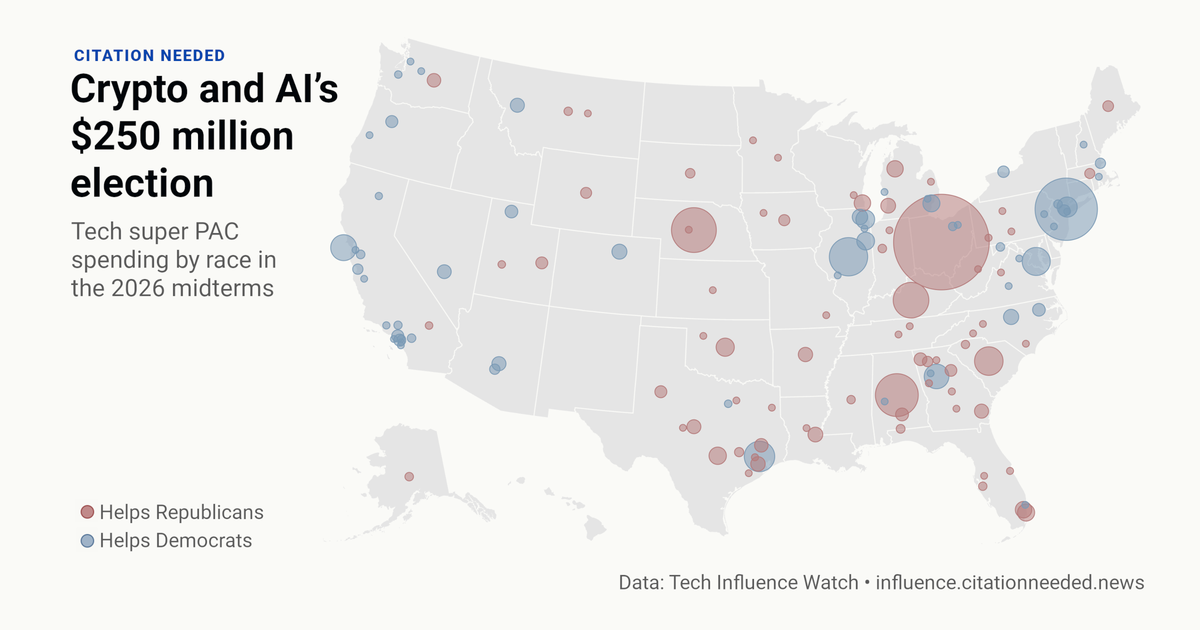
A comprehensive financial overview of the cryptocurrency and artificial intelligence landscape on election night.
Overview of Industry Spending
In the current federal elections, super PACs representing the cryptocurrency and artificial intelligence sectors have invested a staggering $250 million. This spending far exceeds the $130 million contributed during the 2024 elections, marking a pivotal moment where the crypto industry emerged as one of the largest players in political financing.
Spending Analysis
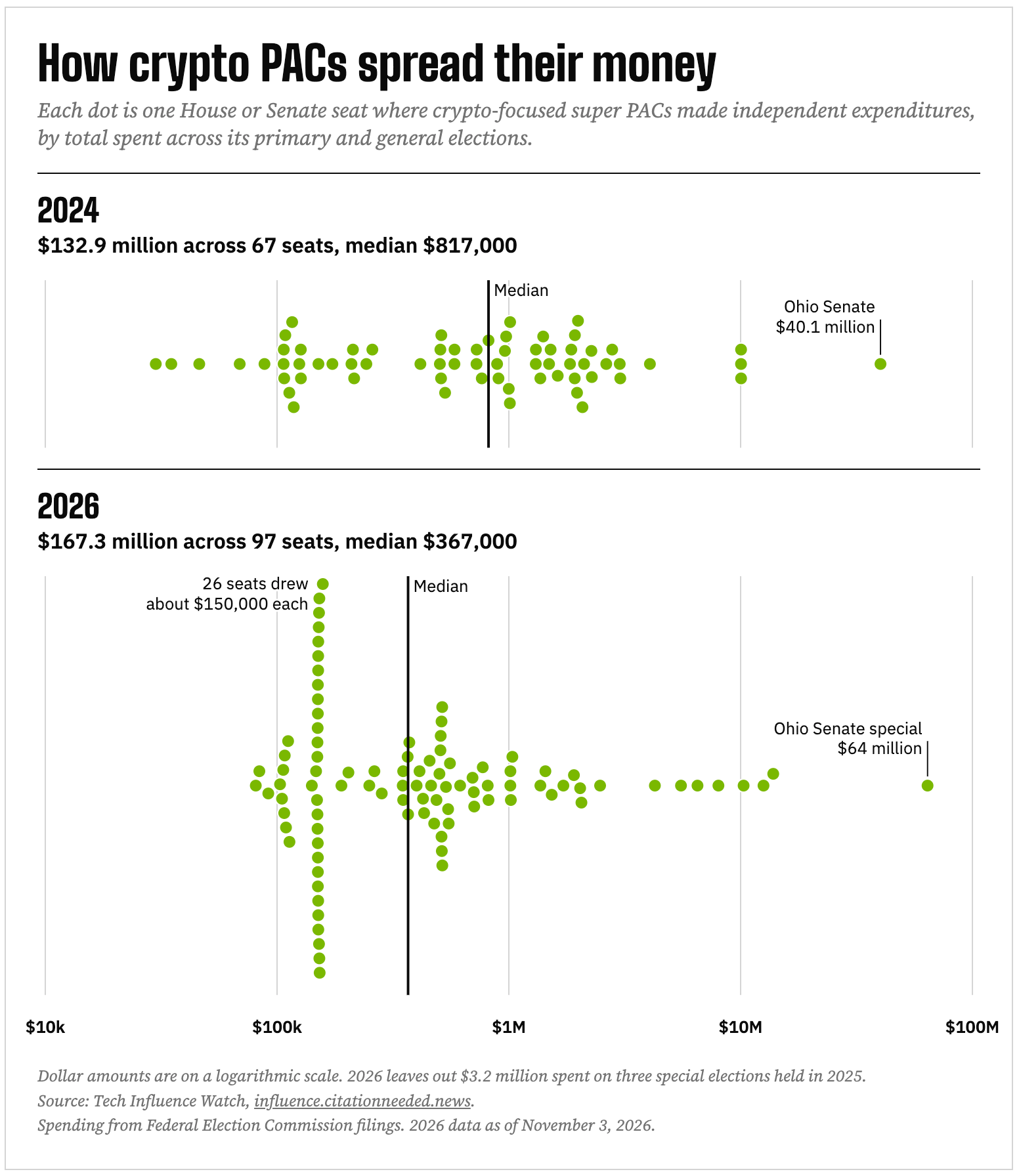
To date, crypto PACs have allocated $170.5 million across 100 electoral seats, with the majority favoring Republican candidates at $125.5 million, while $45 million went to Democratic candidates. Despite the substantial total, the average expenditure per competitive seat has significantly decreased from $817,000 in 2024 to $367,000 in 2026. Notably, there are 26 seats that received similar funding levels of approximately $150,000 each.
Support for Democrats
In the realm of general elections, spending on Democratic candidates has markedly diminished. For instance, in 2024, crypto industry PACs invested around $10 million each in support of Democrats like Elissa Slotkin and Ruben Gallego. However, this cycle, funding has been mostly limited to intra-party primaries, with notable instances such as $10 million spent targeting Illinois’s Juliana Stratton, who ultimately won her race despite the opposition funds.
AI PAC Contributions
Contrastingly, PACs associated with the AI sector have contributed $79 million across 68 electoral contests, with $50.2 million directed to assisting Democratic candidates and $28.8 million to Republicans. This distribution illustrates a broader bipartisan interest in the AI industry, emphasizing strategic investment depending on candidate alignment with industry interests.
Competitive vs. Safe Races
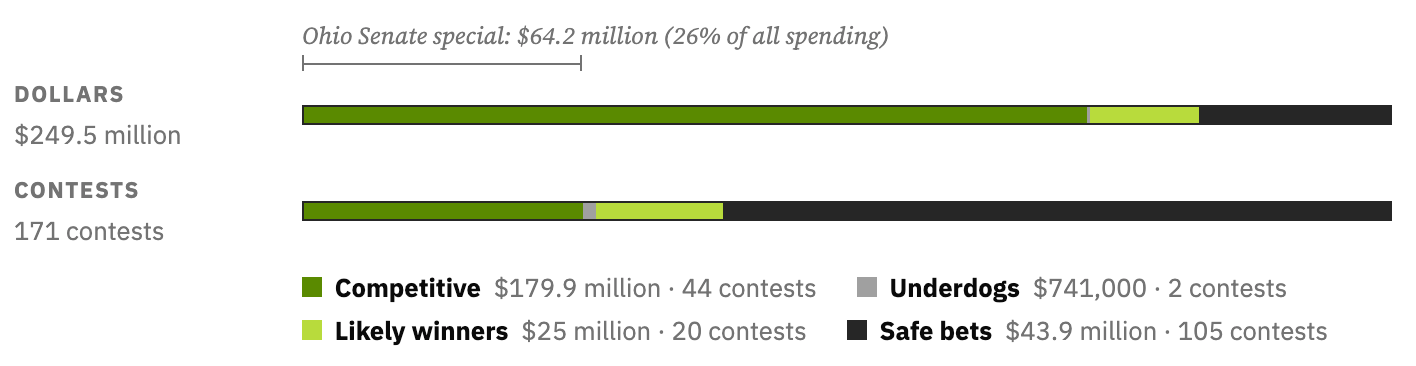
Almost 72% of the funding is routed to just 44 highly contested races, categorized by Cook Political Report as Toss-up or Lean. The bulk of this expenditure, approximately $105.6 million, is concentrated within a few races including the Ohio Senate election, the Democratic primary in New York’s 12th district, and Nebraska’s Senate race. In sharp contrast, over 60% of the total races backed were those deemed safe, where funds were less about influencing outcomes and more about securing loyalty from incumbent candidates.
Key Races to Monitor
Ohio Senate Special Election: Jon Husted (R) vs. Sherrod Brown (D)
An impressive $64.2 million has been funneled into the Ohio Senate special election, largely from cryptocurrency PACs. The incumbent, Jon Husted, who was appointed to fill JD Vance’s position, faces significant opposition from Sherrod Brown, a seasoned Democratic senator. Only weeks after the failure of the Clarity Act in the Senate, crypto-backed PACs increased their contributions, hoping to alter the political landscape against an incumbent they perceive as a threat.
Nebraska Senate: Pete Ricketts (R) vs. Dan Osborn (I)
In Nebraska, crypto-related PACs have invested $14.1 million, predominantly targeting Democrat Dan Osborn, with incumbent Ricketts maintaining a strong pro-crypto stance. This race exemplifies the crypto industry’s determination to preserve allies in political spheres that are favorable to their interests.
Michigan Senate: Mike Rogers (R) vs. Abdul El-Sayed (D)
The Michigan Senate race showcases a competitive dynamic as the cryptocurrency sector shifts its backing from previously supported candidates to new Republican entrants. The Democratic challenger, Abdul El-Sayed, advocates for stringent regulations on both AI and cryptocurrency, while his opponent, Mike Rogers, has evolved from a critical stance on crypto to one of moderate support.
Conclusion
The influence of cryptocurrency and artificial intelligence PACs in the electoral process underscores the growing intersection of technology and politics. As we continue to monitor these trends, understanding how financial contributions shape candidate positions and race outcomes becomes crucial.
References
“The Crypto Industry Aims to Crush One of Democrats’ Top Senate Candidates,” The New York Times.
“In Ohio, Crypto Revenge Spending Runs Into a Data Center Backlash,” The American Prospect.
Summary of aggregate polls, “2026 United States Senate special election in Ohio,” Wikipedia, November 2, 2026.
For further insights or information, please reach out via email.
