


Asian Stock Markets Decline Amid AI Investment Concerns
Market Overview
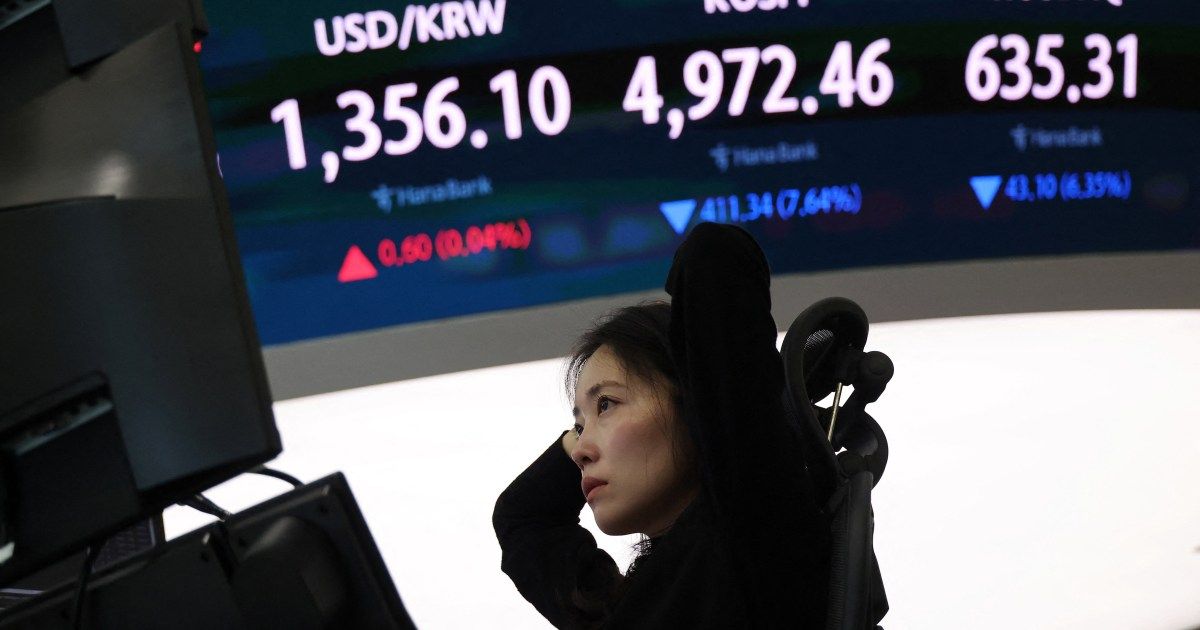
Asian stock markets experienced significant downturns on Monday, exacerbating a tech-sector slump that originated on Friday. This decline is primarily attributed to rising concerns surrounding the sustainability of investments in the artificial intelligence (AI) sector.
South Korea and Hong Kong React
The Korea Composite Stock Price Index (Kospi) in Seoul fell sharply, declining 3.3 percent after reaching a low of 5.8 percent during the trading day. Key tech players like Samsung Electronics and SK Hynix saw share drops of 3.1 percent and 2.5 percent, respectively, reflecting the broader tech market trends.
Hong Kong’s Hang Seng Index saw a slight decline of 0.1 percent post a pre-market drop of nearly 2 percent, indicating a cautious sentiment among investors. In contrast, China’s CSI 300 Index nudged up by 0.1 percent after initially falling over 1 percent, reflecting mixed signals within regional markets.
Wall Street’s Potential Rebound
Across the Pacific, expectations are high for Wall Street to recover from last week’s significant losses. The S&P 500 and Nasdaq futures showed an upward trend of 2.2 percent and 2.9 percent, respectively, suggesting optimism for a potential recovery as markets reopen on Monday.
Understanding the Decline
The tech-heavy Nasdaq Composite notably lost 5.3 percent on Friday, effectively wiping out its gains for 2026, while the S&P 500 entered a correction phase after a drop of 3.7 percent. Analysts are now assessing whether the recent market correction has been excessive.
Rajat Agarwal, an Asia equity strategist with Société Générale, commented, “Markets are trying to find some ground after a massive sell-off in [the] US on Friday, a more than three-standard-deviation event in tech indices.”
Investor Sentiment and Future Outlook
The current decline has raised questions about whether the AI investment boom can be sustained. Gartner, a tech insights provider, has projected that global AI-related investments could reach $2.7 trillion in 2026 and increase to $3.6 trillion by 2027. Nonetheless, there are growing debates about potential market bubbles reminiscent of the dot-com crash of 2000.
Political and Regulatory Factors
Recent political developments, particularly the Democratic Party’s success in the US midterm elections, are anticipated to slow down data center construction due to stricter regulatory measures. Additionally, an espionage scandal involving Nvidia’s former CEO is likely to prompt tighter restrictions on advanced chip technology access, particularly concerning China.
Market Recovery Insights
Khoon Goh, head of Asia research at ANZ, noted, “AI-related concerns will continue to dominate this week, as investors try to determine if the bottom is near.” He also indicated that strong export figures from South Korea could serve as a silver lining, particularly an impressive year-on-year increase of 294.4 percent in semiconductor exports for the first 20 days of November.
As investors navigate these tumultuous times, the markets remain poised on the edge of optimism, awaiting the unfolding of new economic data and regulatory developments.
