


The Evolving Landscape of Bitcoin Trading: Insights on Call Overwriting
Understanding Call Overwriting
In the realm of cryptocurrency investment, a prevalent strategy known as call overwriting has gained traction. This approach involves investors selling call options on Bitcoin holdings, allowing them to generate consistent income at the cost of limiting future profit potential. Alexander S. Blume, co-founder and CEO of Two Prime, an SEC-registered investment advisory firm, sheds light on this popular trade. He notes that while it can lead to steady income streams, it also creates a crowded trading atmosphere.
Market Dynamics and Derivative Trading
Blume indicates that despite a general decrease in volatility, the significant growth in derivatives market involvement continues to impact price swings. “I believe that, despite tempered volatility on the whole, the heavy increase in derivatives markets positioning allows for large moves to still occur somewhat frequently. At present, call overwriting is a highly crowded trade. When we see a move up, like the past month, it creates a short squeeze that amplifies the moves,” he stated.
Resiliency in the Bitcoin Market
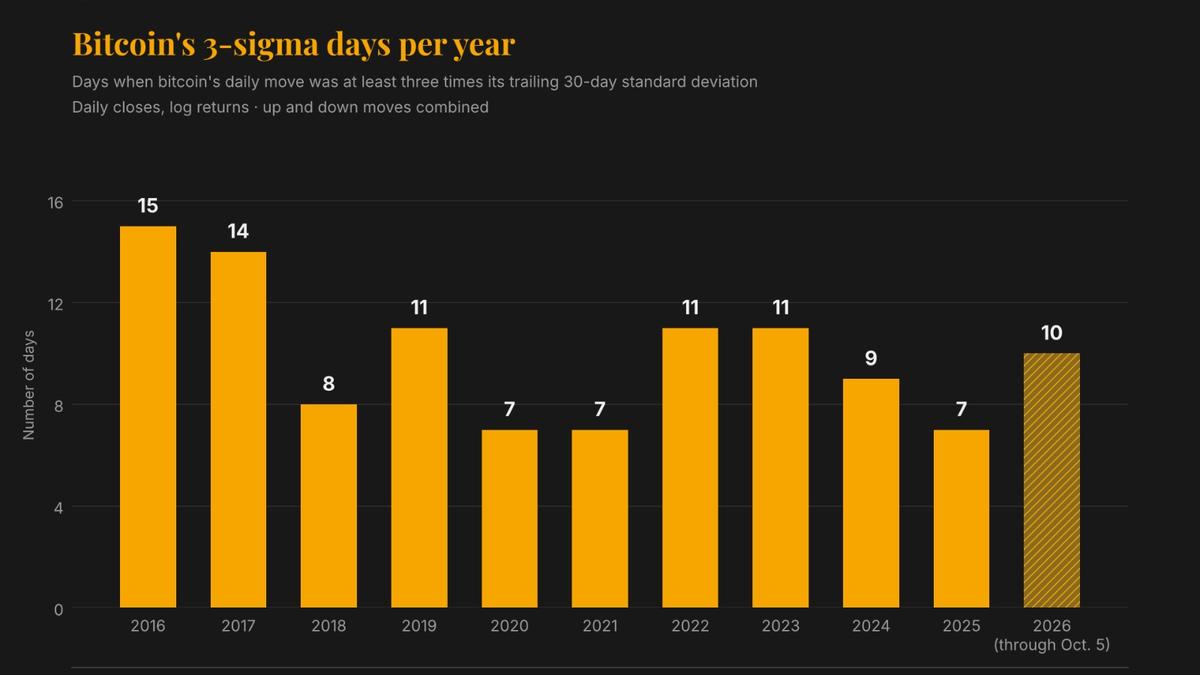
One notable positive aspect of the current market is its ability to handle price fluctuations more effectively than in the past. For instance, on September 21, a significant 3-sigma increase in Bitcoin price coincided with Paradigm facilitating a record $6.7 billion in options trades. According to Quatravaux, a notable market analyst, “This time we haven’t seen or heard of any desk taking a bad hit.”
This heightened stability can be attributed to the improved sophistication of market participants, enhanced risk management strategies, and increased institutional investment. Quatravaux emphasizes, “Participants are much more sophisticated than a few years ago, risk management has improved a lot, and there’s more institutional money in the market, so a tough month stays a tough month.”
Anticipating Future Market Volatility
While the market exhibits greater resilience, fluctuations are likely to persist in the future. Quatravaux cautions that, “They’ll stick around. Ten years of data shows these days haven’t gone away as the market matured, because macro shocks aren’t going anywhere.” Hence, investors should be prepared for ongoing volatility in this evolving landscape.
