


Strengthening Your Core: Five Effective Exercises
The significance of core strength cannot be overstated; it plays a crucial role in maintaining good posture, balance, and functional movement. This perspective is shared by Jill Brown, a 59-year-old board-certified health and wellness coach, personal trainer, and Pilates instructor who emphasizes the importance of core stability due to her own experience with degenerative disc disease.
The Importance of Core Stability
As someone diagnosed with degenerative disc disease at 35, Brown understands firsthand how critical it is to cultivate a strong core. “Having the strongest core muscles possible and creating as much stability as I can is crucial to putting off a spinal fusion,” she explains. This insight led us to ask her for the essential exercises she incorporates into her routine to achieve and maintain core strength.
Top 5 Core Exercises Recommended by Jill Brown
Brown’s exercises incorporate both the fundamentals of core stability and progressions to keep the movements interesting. Below are five core-strengthening exercises that are beneficial for all fitness levels.
1. Weighted Bird Dog
This exercise enhances the traditional bird dog by adding a weight component, making it more challenging. Brown recommends using light dumbbells between 3 to 5 pounds.
Instructions:
- Start on all fours, hands beneath your shoulders and knees beneath your hips, holding a light dumbbell in your right hand.
- Engage your core muscles.
- Simultaneously extend your right arm forward and your left leg backward, keeping your hips stable.
- Return to the starting position synchronously with both your arm and leg.
- Complete all repetitions on one side before switching to the other side.
2. Dead Bug with Pilates Ring or Ball
The dead bug exercise targets core strength while providing stability. Incorporating a Pilates ring or small exercise ball means you can increase the challenge by adding tension.
Instructions:
- Lie on your back, arms pointed straight up, and knees directly above your hips bent at 90 degrees.
- Place a Pilates ring or small ball between your right hand or elbow and left knee.
- Maintaining core engagement, lower your left arm and extend your right leg simultaneously without lifting your back off the floor.
- Return to the starting position and repeat, then switch sides.
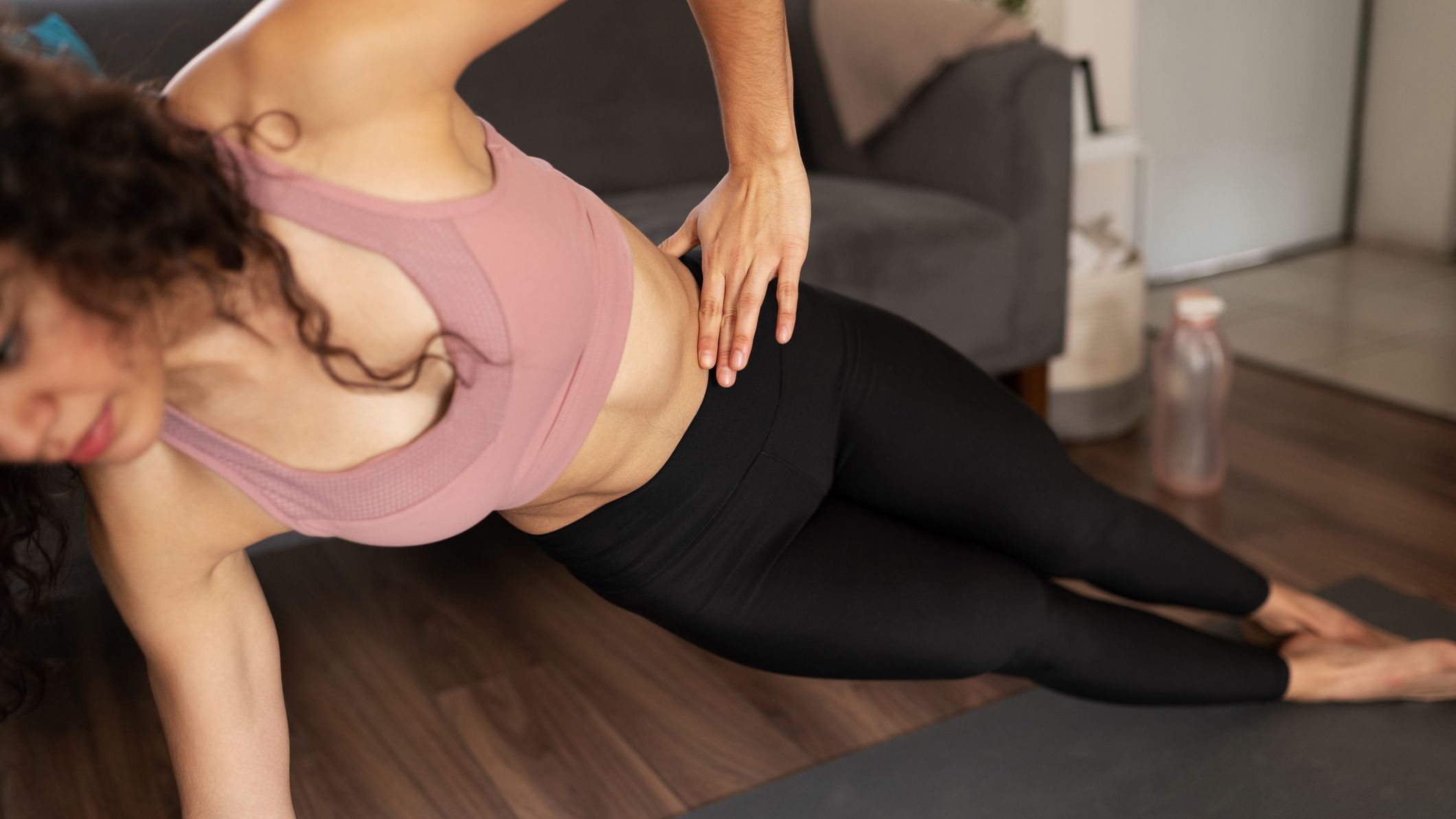
3. Side Plank Leg Lift
This variation of the side plank strengthens the obliques and helps correct spine imbalances, making it particularly advantageous for those with spine issues.
Instructions:
- Lie on your right side, propped up by your right forearm with the elbow beneath your shoulder and legs stacked.
- Lift your hips off the ground to form a straight line from head to feet.
- While holding your position, slowly raise your left leg, ensuring your core is engaged.
- After completing the leg lifts, switch sides.
- Modification: Keep your bottom knee on the floor for support if needed.
4. Banded Clamshell
This exercise is essential for strengthening the hips and stabilizing the knees, making it especially useful for individuals dealing with hip or knee discomfort.
Instructions:
- Lie on your right side with knees bent and a resistance band just above your knees.
- With feet together, lift your left knee while keeping the hips aligned.
- Lower your knee back to the starting position and switch sides after completing the desired repetitions.
5. Bear Pose with Shoulder Tap
An adaptable bodyweight exercise that can be performed anywhere, this move activates the entire core while improving stability.
Instructions:
- Begin on all fours, hands under shoulders and knees under hips, lifting your knees slightly off the ground.
- Engage your core and tap your left shoulder with your right hand without shifting your hips.
- Return your hand to the floor and alternate the shoulder taps, maintaining knee elevation throughout.
Conclusion
Integrating these core-strengthening exercises into your routine can greatly enhance overall strength, stability, and posture. By following the expertise of professionals like Jill Brown, individuals can effectively work towards stronger core muscles, benefiting their functional movements and reducing the risk of injuries.
