


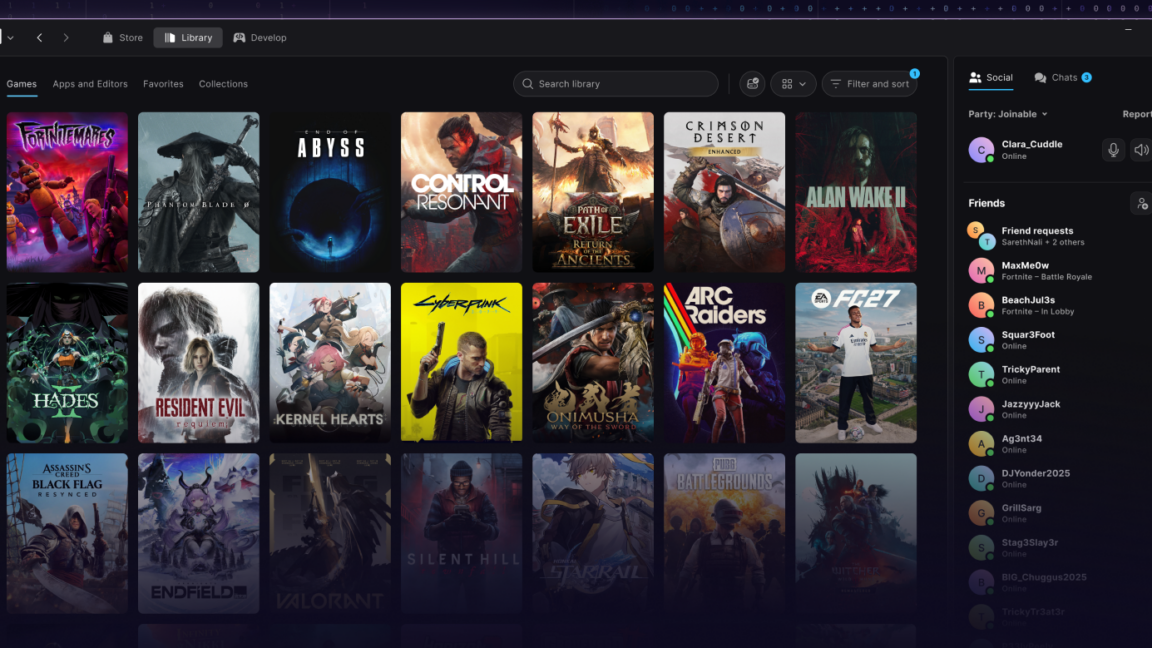
Epic Games Launches AI-Enhanced Epic Games Launcher
Following nearly eight years in competition with Steam, Epic Games has unveiled a new tool aimed at enhancing performance and user experience for its Game Store and launcher: the newly developed Epic Games Launcher.
What’s New in the Epic Games Launcher?
In a recent announcement, Epic Games described the concept behind the reimagined launcher with a playful approach, stating, “programming is hard. So, instead of doing that, we vibe coded a new Epic Games Launcher that’s way faster and more responsive than the current one, and has a new look.” This innovative saying highlights the company’s effort to simplify its development process.
Martin Keely, General Manager and VP of the Epic Games Store, clarified in an interview with PC Gamer that the team essentially started from the ground up. Utilizing AI as a supportive tool, the team was able to draft, review, and implement new features with an entirely new technology stack. The main objective was to maintain the functionality of the previous launcher while avoiding the reuse of its underlying code.
Efficiency Through AI
In a follow-up discussion with IGN, Keely explained the advantages of utilizing AI during the development process. He stated that it enabled the small team to rewrite the codebase more efficiently, allowing for a quicker rollout across platforms, including support for Windows and Mac. A Linux version of the launcher is also in the pipeline.
Performance Comparisons
The enhancements focus on improving startup speed, and this message is reinforced in Epic’s promotional efforts. The company claims, “we vibe coded the Epic Games Launcher to be faster than the other guy,” implying a direct comparison with their primary competitor, Steam.
Initial testing conducted by Ars Technica suggests that the new launcher indeed demonstrates a quicker start-up time, reaching the store page several seconds faster than Steam under similar conditions. However, the difference in recovery time from the system tray to the Library screen was noted to be marginal—approximately 0.06 seconds—which may not be easily perceptible to most users.
