


DHS Initiates Door-to-Door Investigations on Voter Eligibility
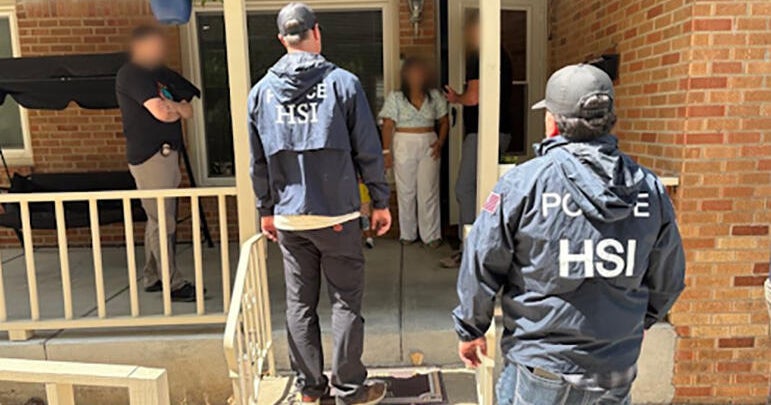
Federal agents from the Department of Homeland Security (DHS) have recently increased their operations, knocking on doors in various states to question residents about their immigration status and voting history, according to a CBS News investigation.
Objective of the Operation
The recent door-knocking campaign is part of a broader strategy to identify potential instances of voter fraud ahead of the midterm elections. The DHS claims that as many as 250,000 individuals may be illegally registered to vote; however, many election experts have challenged the validity of this estimate. Since the beginning of the Trump administration, only 156 individuals have been charged with voting-related offenses, while the total number of registered voters in the United States stands at approximately 227 million.
Concerns About Intimidation and Legal Voters
Critics argue that the presence of armed federal agents at residential doorsteps could pose intimidation to voters who are legally entitled to participate in elections. Jessica Marsden, an attorney with Protect Democracy, a left-leaning advocacy organization, expressed concern, stating, “What we’re seeing now is the federal government is inserting itself into the state process for verifying their voter roles in an unprecedented way.” She contends that the method employed by the DHS appears to be primarily aimed at discouraging lawful voters from partaking in elections.
Details of Recent Operations
These home visits intensified starting in September, coinciding with the height of the midterm campaign. Over the past weekend, the Justice Department reported that Homeland Security agents apprehended over 20 individuals in California, all of whom hold green cards and face accusations of illegal voting activity. This included a notable case involving a 72-year-old man from Belize, who was arrested under allegations of voting illegally in the last four elections.
Historical Context and Methodology
Eric Balliet, a former agent with Homeland Security Investigations (HSI), noted that this door-to-door initiative marks a significant departure from traditional practices in law enforcement. In his two decades of service with HSI, he had never witnessed such a proactive approach to verifying voter eligibility in private residences.
Broad Scope of Investigation
The DHS has previously directed U.S. Immigration and Customs Enforcement (ICE) to assist in the identification and deportation of alleged noncitizen voters. Internal documents have indicated that hundreds of agents were reassigned from ongoing investigations to pursue noncitizen voters as part of a “surge” initiative targeting specific states, including California, Georgia, and Pennsylvania.
Community Reaction and Fear of Chilling Effects
The show of force has raised alarms among civil rights advocates regarding its potential chilling impact on legitimate voters. Dr. Carol Anderson, a professor at Emory University, stated, “It is sending a signal to a much broader community: do not show up at the polls. Do not vote.” She emphasized the fear this instills in naturalized citizens who may erroneously believe they are at risk of reprisals, thus dissuading them from voting.
Investigative Tactics Employed
Agents have been observed utilizing documents labeled “Target List,” indicating a systematic approach to data collection that draws on voter rolls and citizenship records. A whistleblower from USCIS revealed that employees aimed to sift through the voting data of thousands nationwide, facing the pressure of quotas that required them to investigate up to 40 subjects each day.
Defending the Initiative
In response to the growing scrutiny, DHS has defended its practices, insisting that the data-matching efforts are performed with diligence and professionalism. A DHS spokesperson remarked, “There is no quota on criminality. DHS will pursue each and every illegal voter to the fullest extent of the law.”
Conclusion
As investigations proceed, concerns continue to mount regarding the implications of federally backed voter inquiries on public participation in elections and the integrity of the electoral process itself.
