


Harnessing the Power of Local AI with the Nvidia RTX Spark Architecture
Overview of Nvidia RTX Spark’s Advantages for AI Tasks
Recent advancements in technology have made PCs built on the Nvidia RTX Spark architecture exceptionally proficient at performing artificial intelligence tasks. These systems can run local open-weight models, enabling users to execute tasks without incurring per-token fees or usage limitations.
Privacy and Cost-Effectiveness of Local AI
One of the most significant benefits of utilizing a local AI model is enhanced privacy. This advantage is paramount for individuals handling sensitive data, as processing doesn’t require uploading information to external servers, thus reducing exposure to potential data breaches.
The Legacy of Machrone’s Law in Computing Costs
The concept established by Bill Machrone in the early PC era, often referred to as “Machrone’s Law,” suggests that the ideal machine will typically cost around $5,000. Today’s inflationary pressures may elevate that figure, yet the underlying principle remains relevant. For example, a laptop priced at $7,000 can still invoke that same desire for cutting-edge technology.
The HP OmniBook Ultra: A Powerhouse for AI Tasks
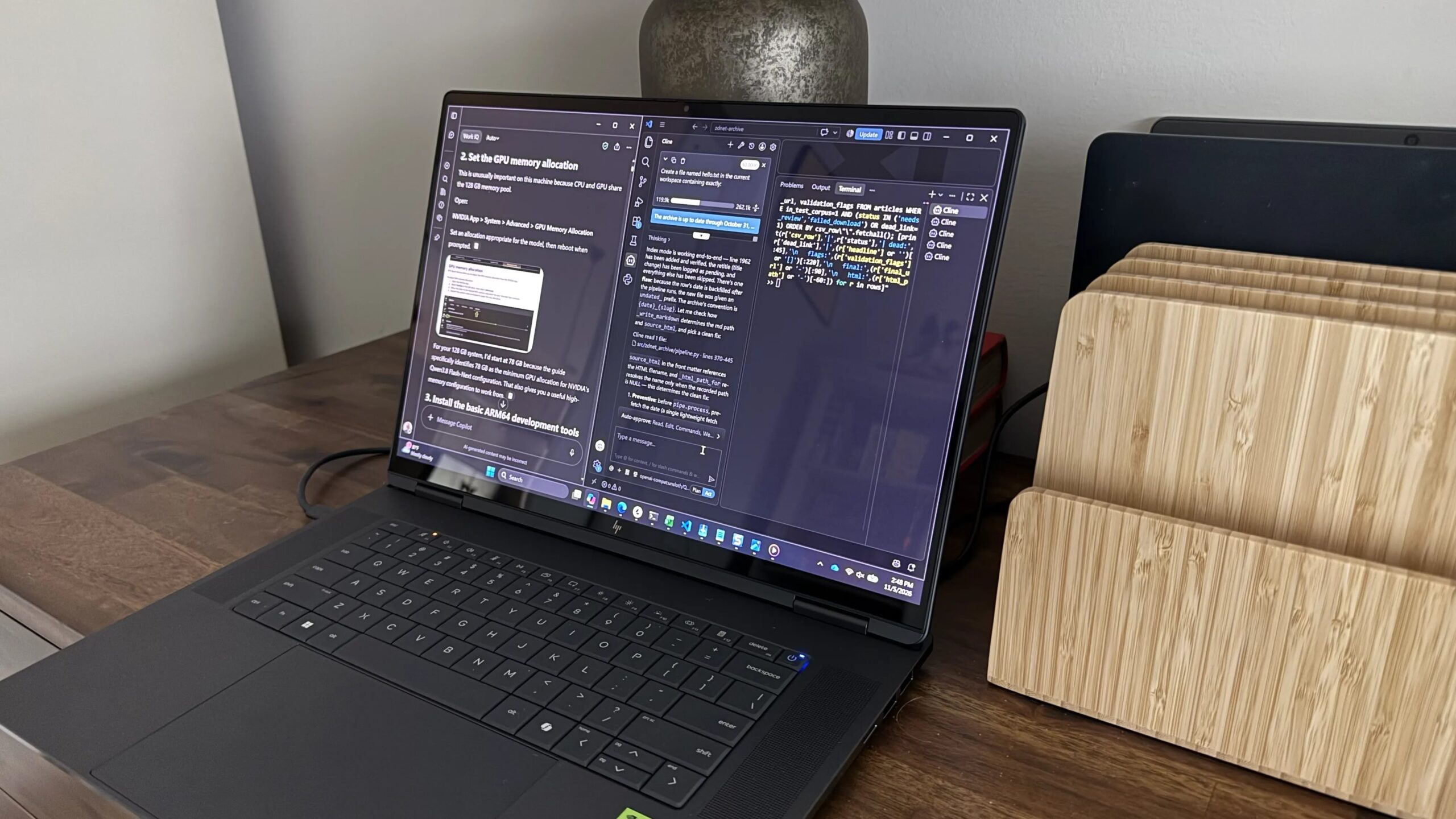
Among the top contenders in the market is the HP OmniBook Ultra, which boasts impressive specifications including:
- Powered by Nvidia’s RTX Spark architecture
- 128 GB of unified memory
- 2 TB of high-speed Gen5 NVMe storage
- 16-inch OLED display
With a remarkable processing capability of 1 petaflop of FP4 AI performance, this machine is not just a laptop; it is essentially a personal data center designed for heavy AI workloads.
Efficiency in Project Execution with Local AI
Utilizing the local AI capabilities significantly expedited project completion. The author employed Copilot alongside a set of tools including the open-source llama.cpp inference runtime and the Qwen3.8-27B language model. This combination allowed for a streamlined coding experience that would traditionally take much longer to set up and execute.
PowerShell scripts generated by Copilot facilitated quick project configuration, with the entire setup completed in approximately thirty minutes—markedly faster than conventional methods.
Monitoring AI Performance in Real Time
As the AI processed information, it demonstrated the ability to “reason.” The AI generated code, executed tests, and adjusted its approach based on the results, showcasing a practical application of “human-in-the-loop” coding. The experience was enhanced by hearing the system’s fan work in the background, indicative of its performance load without excessive heat production.
Cost Analysis of Local AI Operations
The completed project made 479 LLM inference calls while processing nearly 50 million logical tokens, resulting in a net cost of $0.00. This absence of charges underscores a notable advantage when compared to commercial AI solutions, which involve unpredictable costs that can escalate based on usage.
For instance, software subscriptions like ChatGPT Plus, Claude Code Pro, or GitHub Copilot typically charge between $10 and $20 monthly, but those could quickly lead to usage limits that would interrupt workflow.
Financial Implications of AI Coding Subscriptions
For intensive coding projects, subscription fees can accumulate rapidly. Notably, top-tier users of AI coding tools may incur annual costs nearing $18,000, while average non-users spend significantly less, often under $75 monthly. This disparity highlights the potential financial burden associated with high-frequency use of commercial services.
Key Advantages of Utilizing Local Models
The integration of free, open-weight models with an open-source coding framework empowers developers to explore without financial constraints. Additionally, the workflow remains secure, as the potential for sensitive data to traverse external servers is eliminated. This is particularly critical for applications involving confidential or proprietary information.
Conclusion and Future Perspectives
The question remains whether investing in a high-end system like the $7,000 HP OmniBook Ultra is justified for occasional coding tasks. While the author acknowledges the psychological allure of such technology, practical considerations, such as return on investment, play a crucial role in decision-making.
As technology continues to advance, the prospect of accessing more powerful machines at lower price points is promising. Innovations inherent in both Machrone’s Law and Moore’s Law suggest that within a few years, high-performance computing will become more accessible, transforming what is currently viewed as premium into standard industry offerings.
