


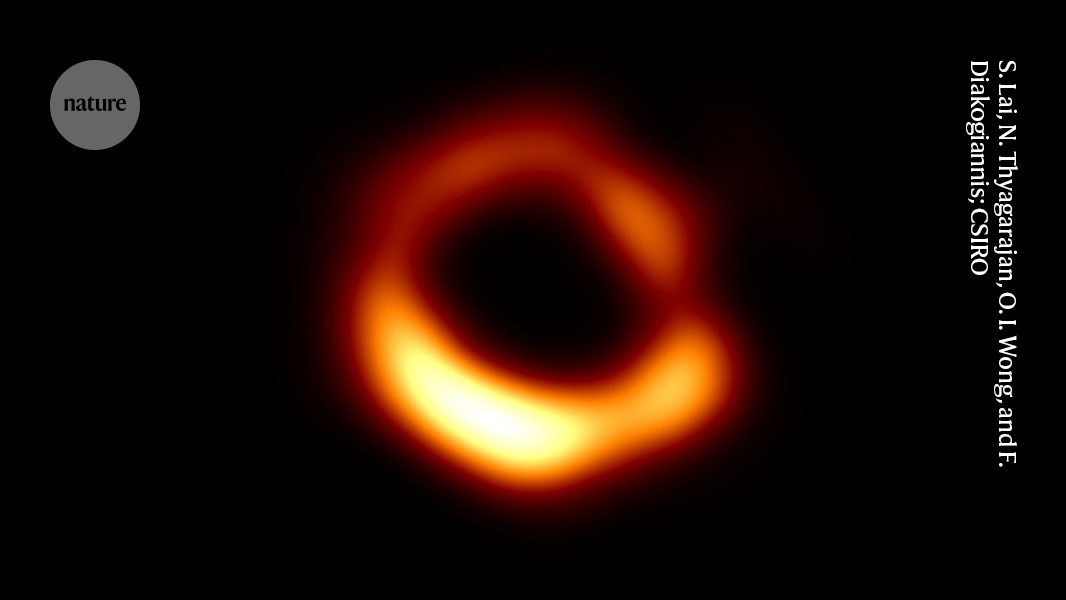
Independent Analysis Confirms Initial Findings of Black Hole Imaging
Credit: S. Lai, N. Thyagarajan, O. I. Wong, and F. Diakogiannis; Commonwealth Scientific and Industrial Research Organisation
The Event Horizon Telescope’s Historic Achievement
In 2019, the Event Horizon Telescope (EHT) collaboration achieved a groundbreaking milestone by capturing the first-ever image of a black hole’s shadow. This landmark photograph of the supermassive black hole in the galaxy M87 was met with both excitement and skepticism. Critics suggested that the circular pattern observed might be a byproduct of the image reconstruction methods employed by the EHT team.
New Findings from Independent Researchers
On November 11, 2023, an independent group of researchers published new analyses in the journal Nature that provide additional images of the black hole and largely validate the original EHT findings. This fresh approach utilized an algorithm to process the telescope measurements differently from the EHT’s methods, resulting in corroborative conclusions.
The Image Reconstruction Challenge
The EHT utilizes a network of radio telescopes located across different continents to collect data simultaneously. This ambitious project aims to create an image with the level of detail equivalent to a single, Earth-sized radio dish. Despite the inherent challenges, the resulting image from the EHT was consistent with theoretical models rooted in Albert Einstein’s general theory of relativity.
The image depicted a luminous ring corresponding to the predicted radius of the black hole, encircling a darker central region.
Rethinking the Black Hole’s Image
In 2022, questioning emerged from Junichiro Makino, an astrophysicist at Kobe University in Japan, and his research team. By applying a similar data-analysis technique to that of the EHT, but under different assumptions, they produced an image that represented a collection of radio emissions rather than a distinct ring. This development stirred a renewed discussion regarding the nature of black hole imagery and analysis methods.
Conclusion
As new data continues to emerge from studies of black holes, the dialogue between independent research and established findings remains crucial. The recent analysis not only reinforces the EHT’s original results but also illustrates the ongoing complexity and intrigue surrounding astronomical observations of enigmatic cosmic phenomena.
