


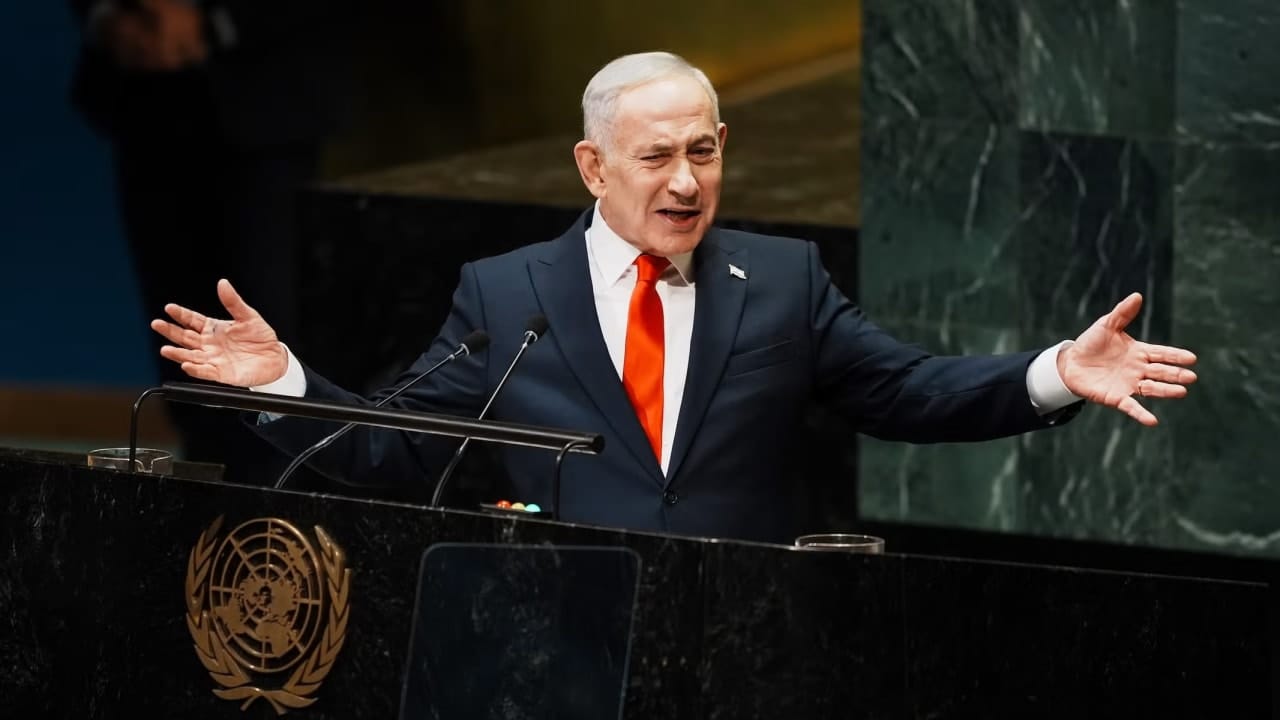
Netanyahu’s UN Address: A Political Gambit Against Zohran Mamdani
Prime Minister Benjamin Netanyahu’s recent speech at the United Nations General Assembly coincided with a pivotal moment for Israel. With ongoing negotiations concerning conflicts in Gaza, Lebanon, and Syria, and pending outcomes from U.S.-Iran ceasefire discussions, the address carried significant weight. Compounded by sanctions imposed by 12 nations—led by Britain—over Israel’s West Bank policies, the setting burned with urgency.
A Focus on Mamdani
In an unexpected twist, Netanyahu’s harshest critique was directed not at foreign leaders or policies but at Zohran Mamdani, the New York City mayor. In a striking move, Netanyahu labeled Mamdani an antisemite, accusing him of aligning with Hamas, with connections to sympathizers of the October 7th attacks and 9/11 supporters.
Campaigning with Controversy
Leading up to the Israeli elections scheduled for October 27, Mamdani became a central figure in an unusual campaign strategy for Netanyahu’s Likud party. An election billboard showcased Mamdani alongside figures like Turkish President Recep Tayyip Erdogan and Iran’s Supreme Leader Mojtaba Khamenei, with the motto, “They want Netanyahu to lose, don’t let them win.”
Online Battles
The tumultuous back-and-forth between Netanyahu and Mamdani also played out on social media, with Mamdani calling for Netanyahu’s arrest—albeit acknowledging his limited power to enforce such a demand. In retaliation, Netanyahu accused Mamdani of fostering antisemitism.
Reactions and Implications
While Mamdani holds minimal influence over Israeli affairs, his unpopularity resonates with many Jewish Israelis. Since taking office, he has been vocal about accusing Israel of genocide and ethnic cleansing—assertions that have sparked widespread rejection among Jewish politicians. Despite this unpopularity, analysts question whether concerns regarding Mamdani would genuinely impact voters’ decisions amid pressing domestic issues like national security and IDF service exemptions for ultra-Orthodox communities.
Strategic Political Moves
Caroline Glick, Netanyahu’s international affairs adviser, articulated that countering Mamdani’s statements was essential due to their perceived antisemetic undertones, suggesting that this rhetoric had instilled fear among the Jewish community in New York. Meanwhile, Israel’s Ambassador to the United Nations, Danny Danon, insisted Mamdani initiated the smear campaign against Netanyahu.
Netanyahu’s focus on Mamdani serves as more than a personal attack; it underscores larger themes within his campaign. Guy Levy, a spokesperson for the Likud party, characterized Mamdani as representative of a broader alliance between radical leftist ideologies and anti-Israel sentiments.
Election Dynamics
This intertwines with Netanyahu’s argument that any government without him would rely heavily on an Arab party and left-leaning groups, supposedly compromising Israel’s security interests. The campaign slogan, “It’s either the Right or Palestine,” reflects a deep-seated apprehension regarding Palestinian statehood, which many Israelis perceive as a threat.
Polling Insights
Political analyst Dahlia Scheindlin suggested that Netanyahu’s targeting of Mamdani might reflect a desperation fueled by sliding poll numbers, with Likud currently estimated at approximately 20-22 seats—vastly insufficient for a governing majority. She noted that while Netanyahu attempts to elevate his image through claims of combating Hamas and Hezbollah, rhetoric against Mamdani aligns with a negative campaigning strategy aimed at dissuading voters from the opposing coalition.
Conclusion: The Fallout and Future Implications
Yaakov Katz, a seasoned political commentator, viewed Netanyahu’s speech as a reflection of Israel’s broader struggles on the international stage. He suggested this type of rhetoric could bolster Netanyahu’s base, as many Israelis conflate figures like Mamdani with global threats. As Israel continues to wrestle with domestic and international challenges, the ongoing rivalry between Netanyahu and Mamdani is likely to reemerge, especially if Netanyahu remains in power.
For now, Mamdani’s critiques extend beyond Netanyahu; a complex relationship with Israel and growing movements toward democratic socialism—whether under Netanyahu or other administrations—may continue to shape their dialogues in the future.