


OpenAI Leverages AI to Address Security Vulnerabilities in Linux
| November 05, 2026
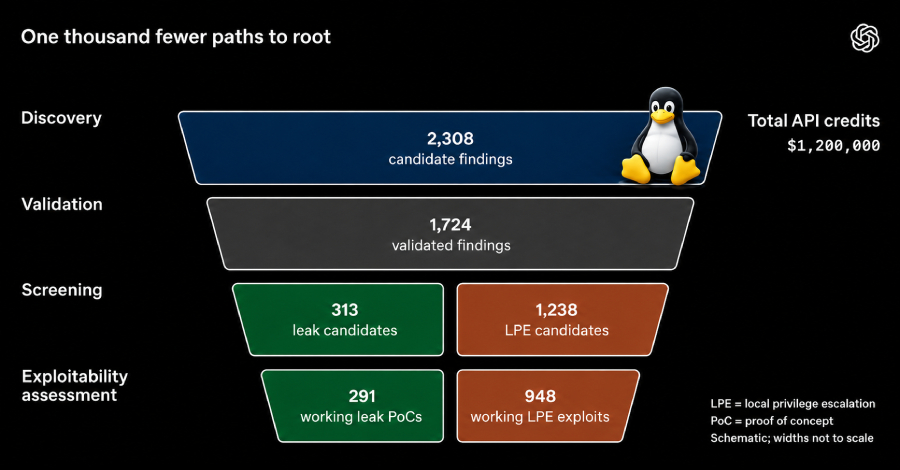
On November 2, 2026, OpenAI revealed the results of its latest initiative where a cutting-edge AI model focused on cybersecurity successfully identified and patched 948 local privilege escalation (LPE) vulnerabilities within the Linux operating system. The total cost for the API usage during this project reached approximately $1.2 million.
The AI company reported that their prototype managed to scrutinize 2,308 potential findings related to the Linux kernel. Among these, 1,724 vulnerabilities were dynamically reproduced, resulting in 948 LPE exploits capable of granting unprivileged users root access to the system.
The Stages of the AI Vulnerability Pipeline
This groundbreaking discovery stems from an agent-based pipeline structured in five primary phases:
- Vulnerability Discovery: Agents target significant parts of the code that could be accessed by low-privileged users to identify potential vulnerabilities.
- Dynamic Validation: Reproducing each candidate defect in a secure, sandboxed environment and gathering runtime evidence follows this.
- Exploitability Assessment: Validated vulnerabilities are tested for possible malicious exploitation, and proof-of-concept (PoC) exploits are devised.
- Patch Generation: Once vulnerabilities are confirmed, the AI generates relevant patches.
- Human Review: Finally, security experts evaluate the exploits and patches for accuracy prior to reporting to the system maintainers.
In a test conducted in mid-October 2026, this advanced pipeline managed to reproduce 1,724 vulnerabilities within just 30 hours, culminating in 291 PoCs for information leaks alongside the 948 LPE exploits across a widely-used Linux distribution. The average expense for each LPE exploit was noted to be around $1,279.
Innovative Exploitation Techniques Identified
Diving deeper into the findings, the initiative uncovered at least ten novel Linux exploitation techniques. These included:
- Two new persistent elastic objects designed to manipulate kernel cache objects.
- Two page grooming techniques that enhance the reliability of exploits.
- Five unique data-only techniques for achieving privilege escalation through arbitrary write access.
- One method revolving around arbitrary type confusion.
This advancement showcases how AI is fundamentally changing cybersecurity, speeding up the processes of vulnerability detection and exploitation while also aiding defenders in effectively managing system security flaws.
The Risks and Challenges Ahead
According to recent assessments by VulnCheck, the rise of AI-enabled vulnerability discovery poses a “growing risk category,” particularly empowering novice hackers with virtually no technical expertise to find software vulnerabilities rapidly. Consequently, this accessibility extends beyond defenders; cybercriminals can exploit similar AI capabilities to discover and leverage zero-day vulnerabilities with minimal effort.
Data from the Google Threat Intelligence Group illustrates a concerning trend, with vulnerabilities disclosed monthly climbing from 5,045 in January 2026 to 10,740 by August 2026. High-risk vulnerabilities also increased significantly from 131 to 350 during the same period—representing a 167% growth rate.
Following suit, the U.K. National Cyber Security Centre (NCSC) reflected that the advent of AI-driven cyber tools has likely resulted in a marked increase in the identification of zero-day vulnerabilities. Defensive AI solutions have shortened the timeline from zero-day vulnerabilities to N-day vulnerabilities, allowing for swifter patching processes. However, without proper configuration, many systems remain susceptible to attackers using these AI-fueled tools.
The NCSC emphasizes the urgent need for organizations to revamp their patching and testing protocols to keep pace with the accelerated vulnerability discovery rate. Attackers have shown reduced caution regarding operational risks, as rebuilding access has become less costly.
As OpenAI accurately states, it is imperative that the speed of vulnerability discovery by advanced AI models is paralleled by equally effective automated patch generation strategies to enhance software security and minimize exploitation windows. The organization is optimistic that with guided human expertise, AI-generated patches can achieve functional accuracy and resilience against potential attacks.
