


Bitcoin Holdings and Cryptographic Risks: An Outline
Current Bitcoin Supply Situation
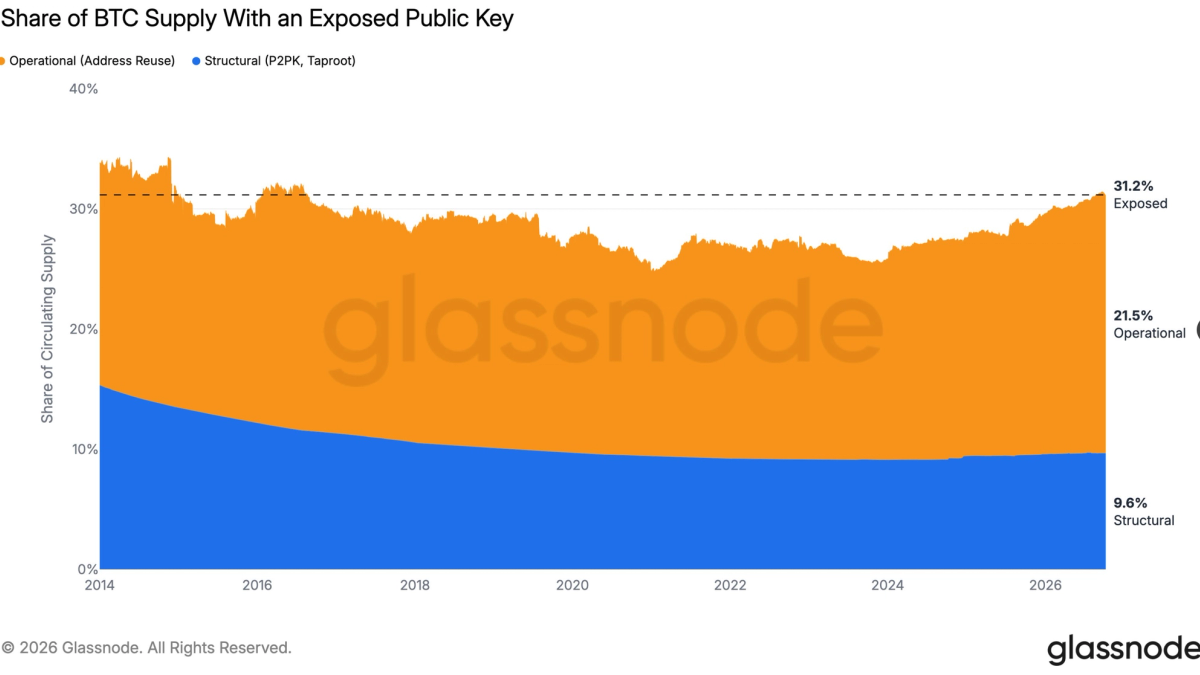
As of now, over 6 million bitcoins are linked to public keys that are visible on the blockchain. This situation highlights a significant risk: advancements in artificial intelligence (AI) or quantum computing may potentially compromise Bitcoin’s cryptographic security.
According to data from Glassnode, these exposed bitcoins account for approximately 31.2% of the total circulating supply, reflecting a modest increase of 5 to 6% from the low observed in 2023.
Recent Trends in Exposed Bitcoin Supply
Rafael Schultze-Kraft, co-founder of Glassnode, states that the amount of exposed bitcoins has risen by 222,000 BTC (valued at about $18.2 billion) since their last report in May. This contrasts sharply with the broader growth of the total Bitcoin supply, which has only increased by 64,000 BTC during the same period.
Exchanges play a significant role in this increase, with 123,000 BTC now held behind visible public keys, bringing the total held by exchanges to 1.79 million BTC. Different exchanges exhibit varying levels of exposure:
- Coinbase: 10% exposed
- Binance: 83% exposed
Institutional Bitcoin Holdings
Beyond cryptocurrency exchanges, several major financial institutions also hold substantial amounts of Bitcoin, albeit with varying exposure levels:
- Fidelity: ~375,000 BTC with 2% exposure
- Grayscale: 49% exposed
- Revolut: 99% exposed
- Robinhood: 100% exposed
- Governments (U.S., U.K., El Salvador): No exposures detected under this methodology
Potential Risks from Quantum Computing and AI
Public key visibility can result from address reuse or specific Bitcoin output types, including early pay-to-public-key outputs and the newer Taproot feature. If an advanced quantum computer were developed or a revolutionary mathematical breakthrough occurred, it could enable an attacker to derive the matching private keys.
These concerns about cryptographic vulnerabilities are highlighted by Ethereum researcher Justin Drake, who has cautioned that the industry ought to enter “bunker mode.” He posits that AI might uncover methods to break wallet cryptography in a matter of months, potentially preempting the arrival of quantum computers.
