


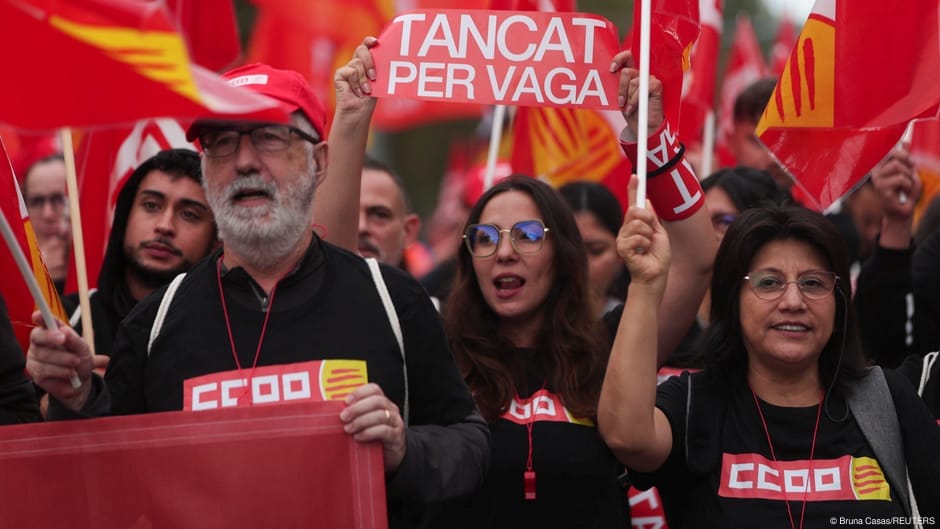
Historic General Strike in Spain Amid Housing Crisis
On Wednesday, workers nationwide in Spain united for a general strike, marking the first such event in 14 years. Despite stormy weather affecting various regions, participants marched and established picket lines to voice their frustrations amid the escalating cost of living and a severe housing crisis.
A Tragic Catalyst for Change
The housing crisis was brought into stark relief by the tragic eviction and subsequent death of 87-year-old Maricarmen Abascal in Madrid earlier this year. This incident has ignited widespread concern and urgency, leading to an upcoming snap election scheduled for November 29, as the public seeks solutions.
Government Response and Legislative Challenges
The administration led by left-wing Prime Minister Pedro Sanchez attempted to introduce legislation aimed at alleviating the struggles of renters. However, these efforts faced opposition in parliament, hindering the government’s ability to enact change. In response, Sanchez has called for early elections to potentially gain further support for housing initiatives.
In an effort to address these urgent issues, Sanchez’s government has enacted two extraordinary decrees, introducing measures akin to the proposed housing reforms that were previously blocked by opposition parties.
“We won’t stop until we transform this country’s housing model from top to bottom so that houses are for living instead of being at the service of the [landlord] minority,” stated Alicia del Rio, spokesperson for the Madrid Tenants’ Union.
Impacts of the Strike
While the majority of protests remained peaceful, some tensions escalated near Madrid’s Mercamadrid wholesale market where police employed pepper spray against demonstrators, resulting in at least 13 individuals requiring medical attention. Additionally, travel disruptions were reported by airlines due to the participation of airport and airline workers in the strike.
Understanding the Housing Crisis
Spain faces a significant housing shortage, currently estimated at around 750,000 homes, a figure projected to exceed one million by 2028 according to the central bank. As home ownership becomes increasingly unattainable for many, the proportion of renters has surged. Recent data reveals that the average rent stands at approximately €1,176 ($1,315), constituting nearly 99% of the average salary for young individuals.
Political Reactions to the General Strike
The government has expressed support for the strike, framing it as an initiative “in favor of rights” rather than one targeting any specific group. However, sources close to Sanchez’s circle suggested that the strike may implicitly oppose the current opposition.
Alberto Nunez Feijoo, leader of the conservative People’s Party, criticized this notion, describing it as “an absurdity the likes of which does not exist in any other European Union country.”
Public Sentiment Regarding the Strike
Nicole Ris, reporting from Madrid, observed mixed reactions among the populace regarding participation in the general strike. Some individuals expressed skepticism about its efficacy, even as they acknowledged the impact of the cost-of-living crisis:
“I’m not taking part in this. It’s nonsense. The government is supporting it because they hope they’ll get enough votes on the 29th so they can carry on,” said a doorman in Madrid.
Conclusion
The general strike in Spain represents a crucial moment in the country’s ongoing struggle with a housing crisis that has left many feeling vulnerable. With the upcoming elections, the stakes have never been higher as the government faces scrutiny over its response to these pressing challenges.
