


U.S. Stock Futures Decline Amid Mixed Market Reactions
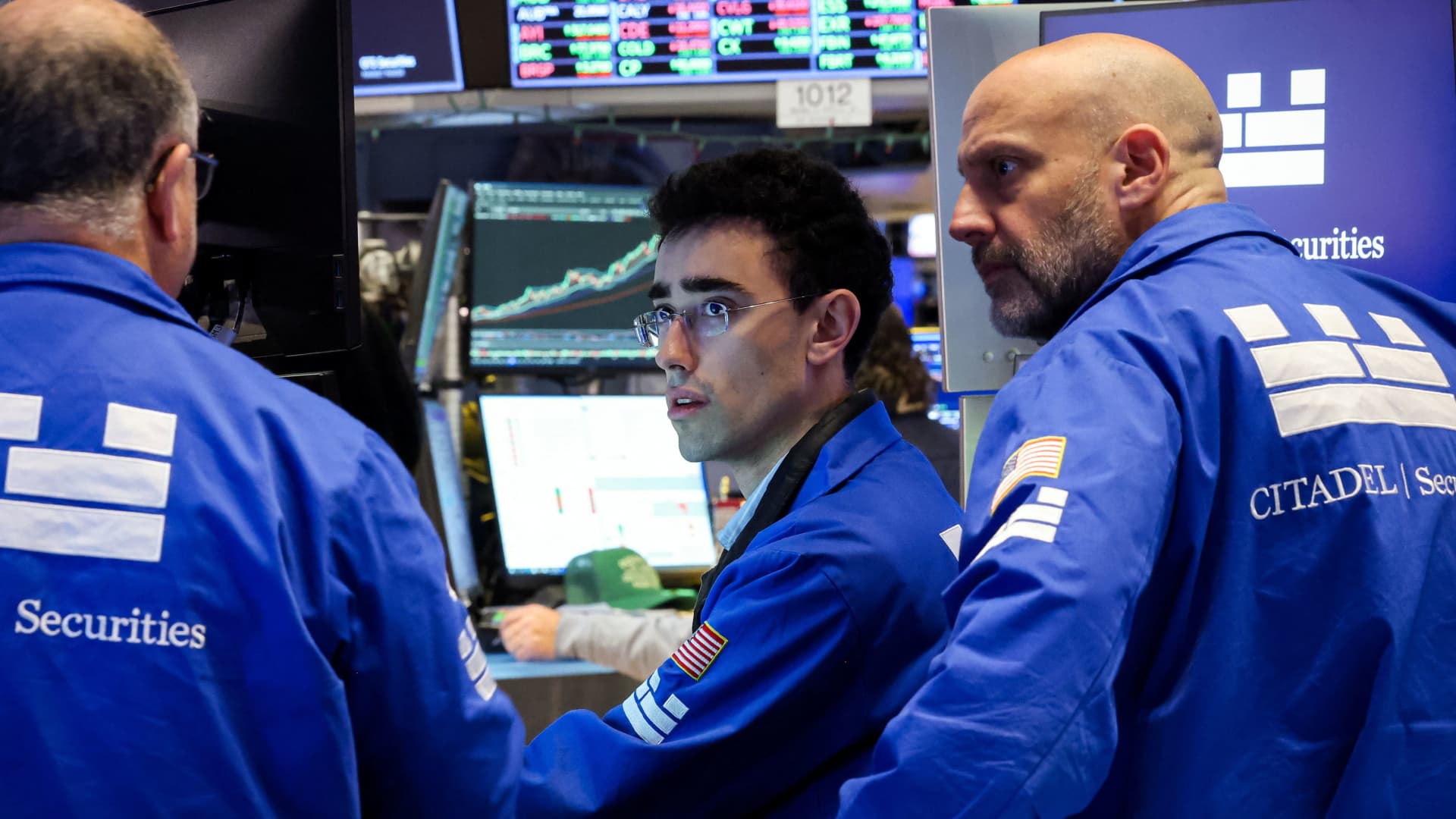
Traders at the New York Stock Exchange observed significant market movements as U.S. stock futures turned lower on November 20, 2026.
Brendan Mcdermid | Reuters
Current Market Outlook
In the early hours on Wednesday, U.S. stock futures witnessed a downward trend, largely influenced by a sharp decline in technology stocks during the preceding trading session. The S&P 500 and Nasdaq Composite experienced notable drops, signaling investor apprehensions.
Dow Jones Industrial Average futures declined by 318 points, approximately a 0.64% decrease. Similarly, S&P 500 futures fell by 1.2%, and Nasdaq-100 futures reported a significant slump of 2.11%.
Tech Stock Volatility
The technology sector faced heavy losses, particularly with companies such as Ambarella, which plummeted by 37% in extended trading. The company announced fourth-quarter revenue forecast of $70 million to $75 million, which fell notably short of the $112 million anticipated by analysts from LSEG.
Secondary impacts were seen across Wall Street, where the broader S&P 500 index experienced a decline of 0.5%, and the Nasdaq’s decrease reached 1.5%. Conversely, the Dow Jones, which has lower exposure to tech vulnerabilities, advanced by over 400 points—an approximate 0.9% gain.
Global Market Reactions
International markets echoed the uncertainty. In Asia, South Korea’s Kospi index fell over 6%, Japan’s Nikkei 225 experienced a decline of 2.88%, and mainland China’s CSI 300 faced a 1.49% drop. Other regional indexes, including Australia’s S&P/ASX 200, declined by 0.39%.
Focus on Inflation Data and Tariffs
As traders look forward to new economic data releases, attention is particularly directed toward the personal consumption expenditures (PCE) price index scheduled for release on Wednesday morning. Economists surveyed by Dow Jones predict a 0.3% rise for the month and an annual increase of 3.8%.
Additionally, reports from the Financial Times and Bloomberg indicate that the U.S. is likely to announce a set of new tariffs on major trading partners later today, including countries like China and those in the European Union. However, existing trade agreements made over the previous years are expected to remain intact.
Market Conditions and Future Outlook
This current volatility in the tech sector is juxtaposed with ongoing concerns regarding capital expenditures and the broader economic outlook. Liz Ann Sonders, chief investment strategist at Schwab Center for Financial Research, noted, “The concerns about capex, the data center build-out, the spread between the cost of capital and return on invested capital, the bifurcation that’s happening in the market now between sort of profitable segments of the market and unprofitable.”
With a keen eye on jobless claims set to release one day earlier than usual, traders continue to brace for impacts from the impending Thanksgiving holiday, when U.S. markets will be closed.
