


New Insights on Quantum Fields and the Stability of the Universe
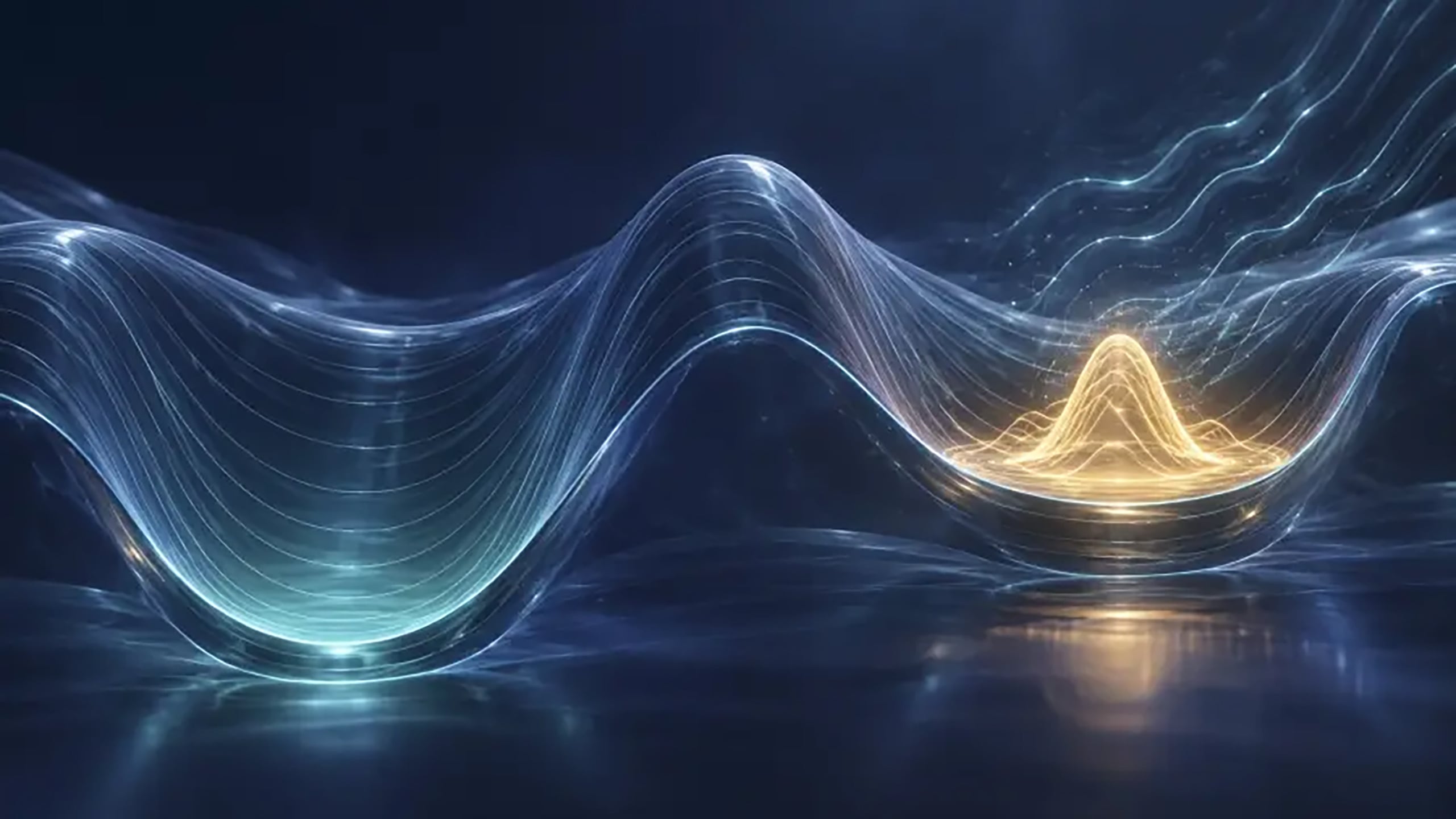
Recent research highlights a growing concern in fundamental physics: the potential instability of the Universe may not be as dire as previously feared. Published in the Journal of Cosmology and Astroparticle Physics, a study spearheaded by a team from the University of Portsmouth, UK, provides new insights into the quantum fields that underpin our reality. These fields, which continuously vibrate and generate particles, are theorized to exist in various energy states, each resembling marbles at the bottom of different valleys.
Quantum Fields and Energy States
The central premise of the study revolves around quantum field theory. This theoretical framework posits that fields, including the Higgs field—responsible for providing mass to elementary particles—are currently resting in what may be termed a ‘false vacuum.’ This state implies that there could be lower energy states that the fields can potentially transition into, leading to significant changes in the Universe’s structure and the governing forces.
“In principle, a transition to that deeper minimum would take the Universe into a radically different state, in which the structure of matter and the forces that govern it would be altered,” says physicist Robson Christie from the University of Portsmouth.
Modeling Cosmic Stability
The researchers utilized a mathematical model simulating the Universe’s expansion and the interaction of various quantum fields. This model represented hypothetical energy states as valleys of unequal height. A critical aspect of their investigation involved understanding how a quantum field, influenced by its surrounding fields, could remain stable over time. This concept relates to a phenomenon in quantum computing known as decoherence, where environmental interactions affect quantum states.
According to computer scientist Greg Kaplanek from Syracuse University, “Perfect isolation is an idealization.” He emphasizes the importance of shielding quantum information from environmental interference to maintain stability.
Introducing “Cosmic Lockdown”
The research team introduced the term “cosmic lockdown” to describe how the surrounding quantum fields could help suppress the likelihood of undesirable transitions, like quantum tunneling, that physicists had previously cautioned against. This concept suggests that the potential for catastrophic shifts in energy states may be strongly reduced, although not entirely eliminated.
Moreover, the study acknowledged the influence of the mass of a quantum field in relation to the Hubble scale—the rate at which the Universe is expanding. A heavier field, compared to the Hubble scale, has a greater ability to adapt to expansion, consequently leaning towards a more stable true vacuum state.
Further Implications and Future Research
Christie elaborates on the findings, stating, “If the expansion is too rapid compared with the dynamics of the field, the system cannot keep up with the changes. In this case, there can remain a significant probability that the field will also end up in the false vacuum.” The researchers also draw parallels with the quantum Zeno effect, which suggests that constant observation can prevent a system from changing its state.
These findings instill a measure of reassurance regarding the stability of the Universe, yet the researchers agree that more intricate models are essential for exploring these concepts further, particularly in relation to the Higgs field itself. As cosmologist David Wands from the University of Portsmouth notes, “If a mechanism of this kind were relevant in more realistic cosmological situations, then it could help stabilize a field that is already sitting in a false vacuum.”
