


YouTube Music Introduces AI Labeling for Enhanced Transparency
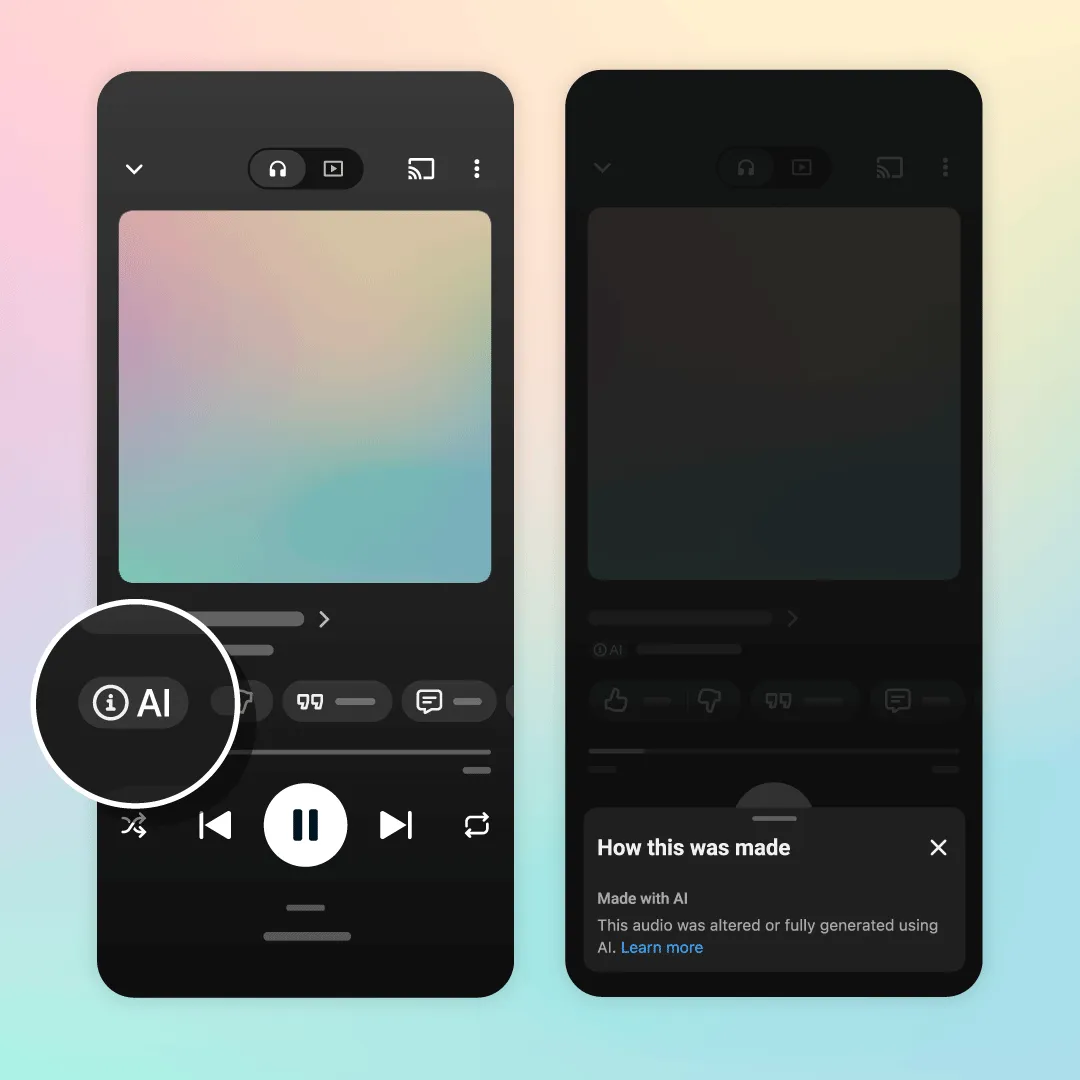
YouTube Music has recently taken a significant step towards enhancing transparency with the introduction of a new labeling system designed to inform listeners about the use of generative AI in music creation. Effective immediately, this system allows users to clearly identify tracks that have been created using AI technologies, encompassing both composition and vocal generation.
Details of the New Labeling System
The AI labels will appear prominently on the track’s player page. By clicking the label, listeners can access detailed information about the specific ways AI contributed to the creation of the music. This initiative is also set to extend to the main YouTube application, allowing for a broader reach.
YouTube’s deployment of this system involved collaborations with various music industry partners and the use of proprietary detection tools to identify AI-generated music accurately.
Classification of AI Involvement
Artists working with YouTube will have the opportunity to categorize their music through one of three labels:
- Fully Gen AI: Tracks created entirely by AI.
- Partly Gen AI: Works that integrate AI-generated elements along with live artist contributions.
- No Gen AI: Tracks that do not utilize generative AI, such as those modified with pitch-correction tools like Auto-Tune.
Context within the Music Industry
This move from YouTube comes in the wake of a notable increase in the prevalence of AI-generated music across various streaming platforms. In response, other services are also implementing their own strategies. For instance, Apple Music plans to launch “Made With AI” labels as part of its upcoming AI Transparency Tags. Similarly, Spotify has adopted AI labeling alongside a spam filter for music.
Deezer has taken a more stringent approach, reporting an influx of nearly 90,000 fully AI-generated tracks daily, and actively labeling and excluding this music from recommendations and royalty distributions. The platform is also considering features to allow users to filter out AI-generated content.
TIDAL has also joined the trend by identifying and labeling entirely AI-generated recordings, giving listeners the option to disable access to such tracks while ensuring these do not receive royalty payments.
YouTube’s Approach to AI Integration
Distinctively, YouTube’s focus on transparency contrasts with the restrictive measures taken by some competitors. The newly introduced AI labels are aimed at educating the audience about the role AI plays in music production, while the presence of AI does not automatically disqualify a track from monetization. Furthermore, YouTube is experimenting with its own AI capabilities, such as the Dream Track tool, which allows select creators to produce music featuring AI-generated versions of participating artists’ voices.
