


Youth-Led Protests Across Europe Demand Change Amid Rising Tensions
Protests Erupt in France Over Living Costs and Education
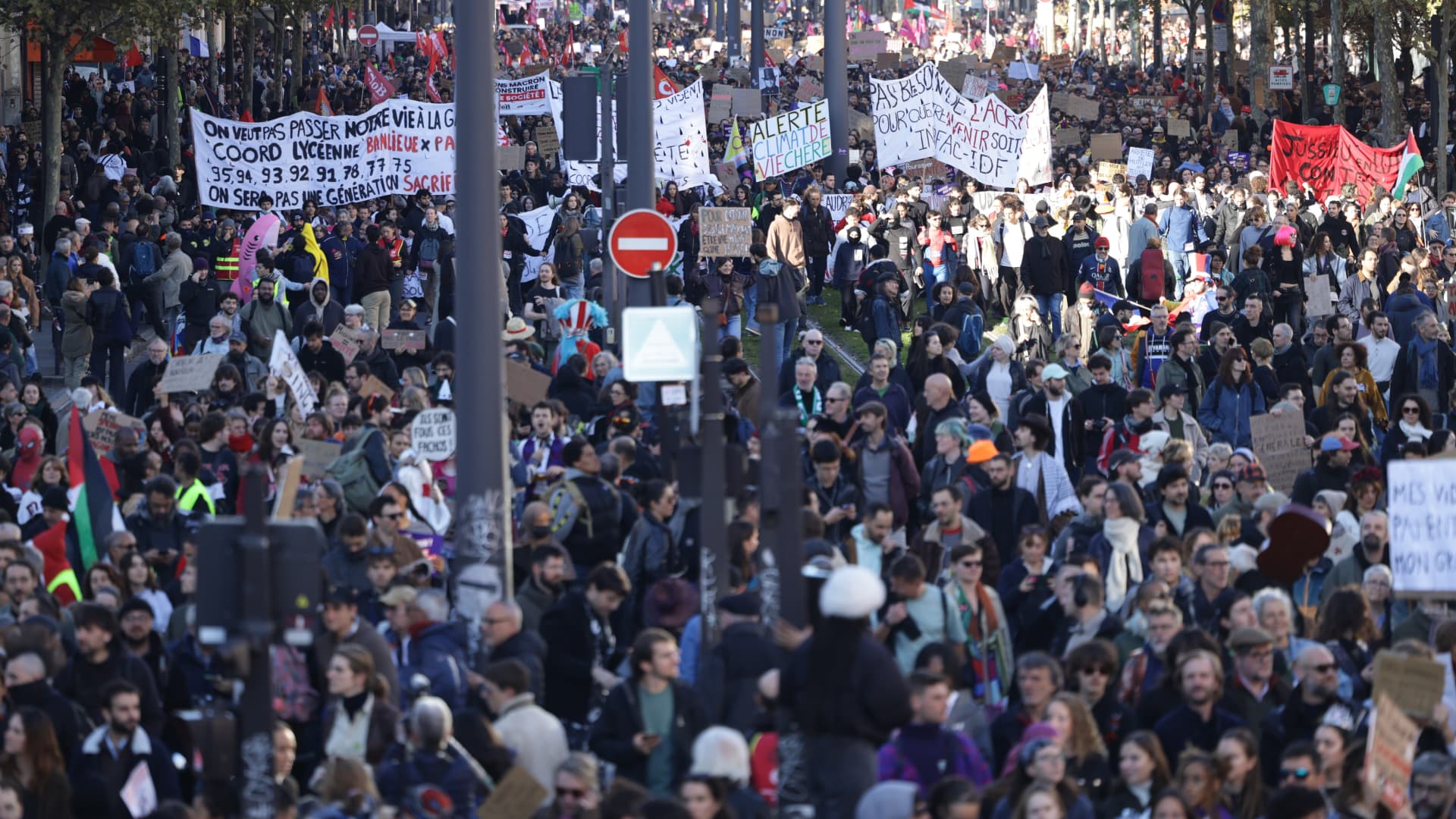
On October 31, 2026, a significant number of demonstrators took to the streets in France, participating in a new wave of protests initiated by high school students. This movement emerged amid growing frustrations about rising living costs and issues within the education sector.
Across the country, hundreds of thousands of people joined the rallies, which, while largely peaceful, were marred by violence in certain areas. In Paris, the festive atmosphere of Halloween was palpable, with many participants wearing costumes, but tensions escalated in the evening, leading to confrontations with the police.
French authorities deployed approximately 70,000 police and gendarmes in anticipation of potential unrest. Interior Minister Laurent Nuñez noted a “very high risk” of disorder, particularly after dark. As a result, marches were rerouted away from the city center to minimize disruptions to businesses and key tourist locations.
Estimates from the French government suggested that around 320,000 individuals participated in the protests, a decrease from earlier demonstrations that saw turnouts of up to 550,000 on October 17 and 410,000 on October 24, although organizers claimed higher numbers.
By the end of the day, authorities reported over 560 arrests, following a series of troubling incidents involving rioting and looting in previous weeks.
Varied Motivations Behind the Protests
The protests in Paris saw diverse groups, each voicing unique grievances. High school students focused on deteriorating school conditions and a perceived unfair university admissions process, while others highlighted broader issues such as the rising cost of living and climate change.
Among the demonstrators, Corentin Cabreux, a 21-year-old student, illustrated the dire conditions in student housing, mentioning damp walls and vermin infestations. Others joined in solidarity, expressing concerns about their own economic struggles.
Cultural references also emerged, with Cléo Farenc, a gallery assistant, dressing as Marie-Antoinette—a powerful symbol of the consequences of governmental disregard for the populace. “It’s about embodying a figure of power who was brought down by the people,” she remarked.
The protests began gaining momentum last month as high school students first rallied against poor school facilities and teacher shortages, drawing in labor unions and a wider demographic frustrated with President Emmanuel Macron’s administration.
Marchers filled the Boulevards des Maréchaux in Paris, accompanied by music and even some indulging in trick-or-treating. However, as night fell, some confrontations erupted near the march’s conclusion, where protesters clashed with police, resulting in the use of tear gas and stun grenades.
Authorities Implement Strict Measures
With violence at specific rallies, police increasingly turned to stringent measures. In Paris, access to prominent areas like Place de la République was restricted from 11 p.m. to 6 a.m. during the weekend, while separate curfews were enforced for unaccompanied minors around the Champs-Élysées. A court had recently suspended an earlier law that imposed stricter curfews on minors.
Extended Protests Across Europe
The youth movement was not confined to France; similar demonstrations occurred across Europe, including Germany and Portugal. In Germany, a youth initiative named “Gen Z regelt” organized protests in over 30 cities, advocating for increased funding for education, housing, and climate action. Reports suggested significant participation, although precise government figures were unavailable.
In Frankfurt, some protests turned violent with rioters damaging stores and clashing with the police, further heightened by disputes in other cities like Cologne and Hamburg.
Meanwhile, in Portugal, a peaceful protest took place in Lisbon against the housing crisis, showing solidarity with families demanding better living conditions. Participants carried placards with messages like “Houses or Fire,” drawing attention to the ongoing crisis affecting many European cities.
Concerns about property rights and social disparity resonated throughout these protests, as the youth of Europe voiced their ambitions for change and a better future.
