


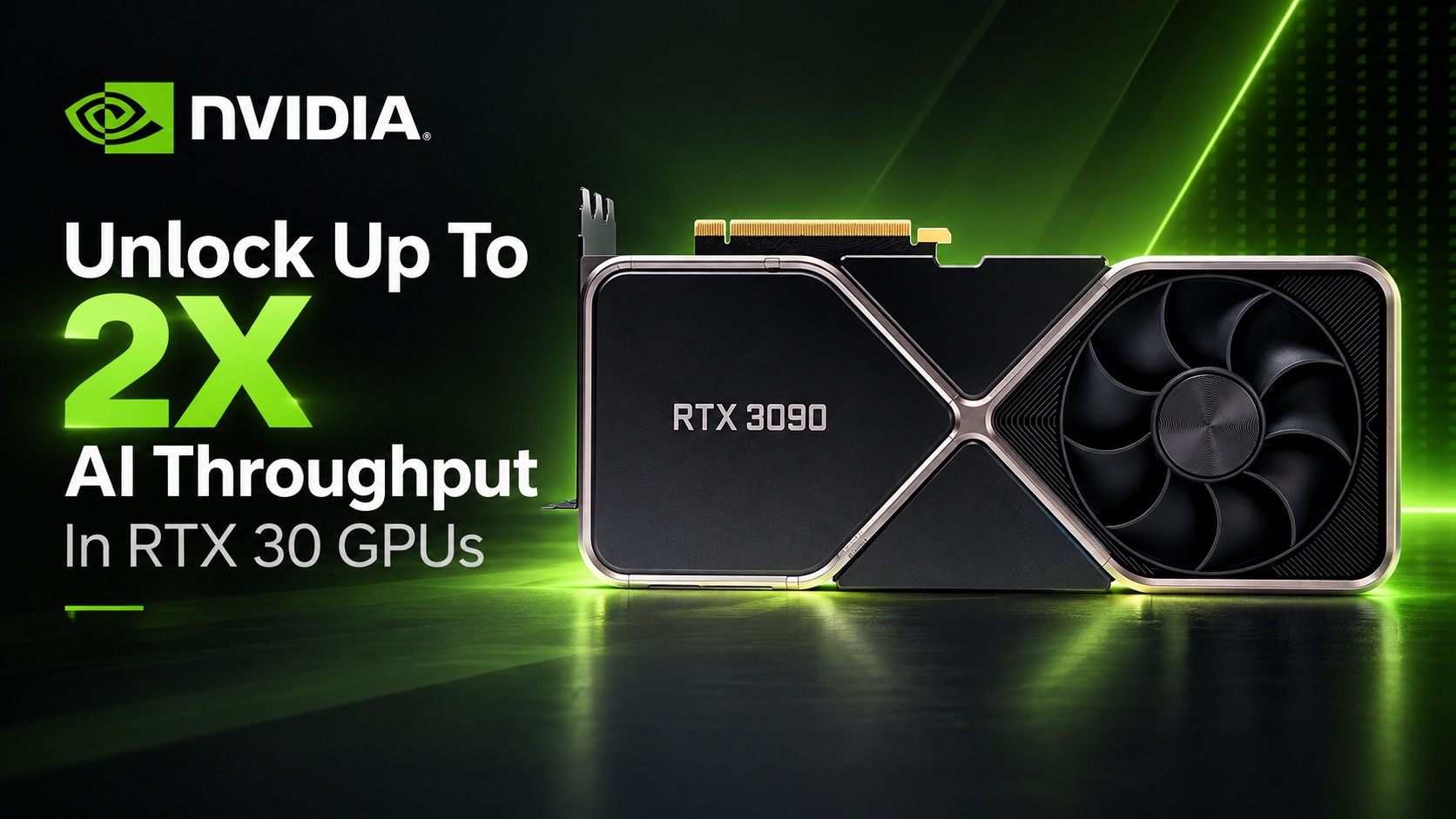
Unlocking Hidden Power: The GPU Unlock Project for NVIDIA RTX 30 Series
NVIDIA’s GeForce RTX 30 Series, known as Ampere, has been recognized for its performance, yet many users find themselves restricted by artificial limitations. A new open-source initiative called GPU Unlock, created by GitHub user Zagitta, seeks to liberate these GPUs from these constraints, nearly doubling their Tensor Core compute throughput in specific workloads. Remarkably, this improvement does not necessitate alterations to NVIDIA drivers or permanent modifications to the VBIOS.
Addressing Performance Limitations
The GPU Unlock project specifically targets the instruction-rate limitations for FP16/BF16 Tensor Core operations with FP32 accumulation that are present in consumer-grade Ampere graphics cards. By circumventing these restrictions, the tool unlocks additional performance potential that already exists within the hardware.
Methodology Behind GPU Unlock
The foundation of GPU Unlock builds on previous research into NVIDIA’s CMP (Cryptocurrency Mining Processor) GPUs. It ingeniously merges techniques for firmware unlocking from the CMP project with an early initialization method using a Linux kernel module. This module operates prior to the loading of the NVIDIA driver, modifying hardware speed selectors and executing a Function Level Reset (FLR) to prepare the GPU for normal initialization with the unmodified driver.
Compatibility and Installation Considerations
Users will benefit from this tool without the need to update their NVIDIA drivers repeatedly. The developer has confirmed support for a selection of GPUs including the GA102, GA103, GA104, and GA106, which constitute a significant segment of the GeForce RTX 30 Series. Nonetheless, users should note that performance enhancements may vary between different models.
Performance Benchmarks
Benchmarking data shared in GPU Unlock’s GitHub repository reveals impressive gains. For instance, an RTX 3090 Ti, running with a 450W power limit, showed the following results in dense matrix multiplication (GEMM) tests with FP32 accumulation:
| Precision | Stock | GPU Unlock | Improvement |
|---|---|---|---|
| FP16 | 87.46 TFLOPS | 118.39 TFLOPS | +35% |
| BF16 | 87.50 TFLOPS | 157.41 TFLOPS | +80% |
| TF32 | 42.58 TFLOPS | 82.61 TFLOPS | +94% |
These enhancements are not limited to the RTX 3090 Ti. Users of the RTX 3080 Ti reported an increase in BF16 throughput from 71.59 to 113.98 TFLOPS, along with a jump in TF32 performance from 35.65 to 65.28 TFLOPS. Similarly, the RTX 3080 (10GB) showcased improvements in FP16/BF16 performance from around 65 TFLOPS to approximately 110–113 TFLOPS within its original 320W power limit.
Real-World Applications and Feedback
Early real-world testing within AI workloads has yielded promising results. One RTX 3090 Ti user tested the GPU Unlock in various benchmarks, observing a throughput increase of 58.6% with MOSS-Image SFT BF16 and other significant gains with related AI tasks. Conversely, improvements in INT8 configurations were minimal.
Additionally, Large Language Model (LLM) inference tasks appear to be benefiting as well, although results can vary widely based on workload conditions.
Windows Implementation and Limitations
There exists an experimental Windows implementation of GPU Unlock that adopts a UEFI-based methodology rather than relying solely on the Linux kernel module. Although preliminary tests on the RTX 3090 indicated an approximate 82.5% increase in BF16 compute throughput, this version is still in the experimental phases and not universally compatible.
It’s crucial to note that while GPU Unlock does result in increased computation throughput, it does not enhance memory bandwidth or activate dormant CUDA cores. Additionally, not every workload will experience improvement; some users have reported unsuccessful attempts at unlocking performance enhancements, illustrating that results may not be universally applicable.
Conclusion
In summary, GPU Unlock presents an innovative avenue for NVIDIA GeForce RTX 30 Series users aiming to maximize GPU performance—especially for intensive applications like local AI inference and image generation. Although still at an experimental stage, the prospect of significantly amplifying existing hardware capabilities without permanent modifications is certainly a compelling development.
Source: GPU Unlock GitHub repository
