


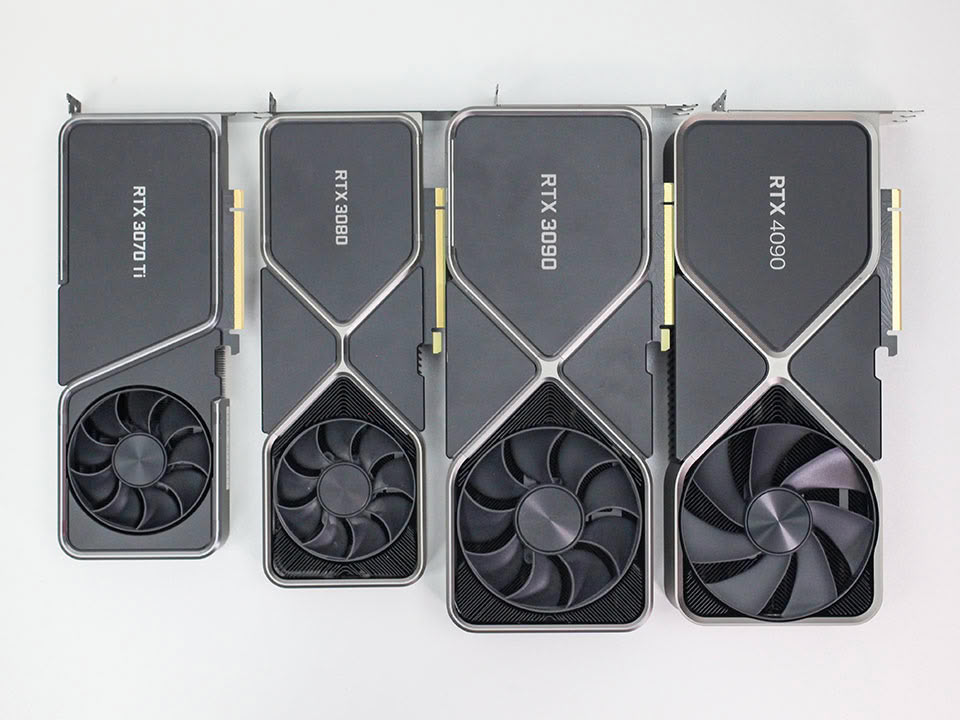
NVIDIA GeForce RTX Graphics Cards Unlock: Boosting Performance Beyond Expectations
NVIDIA’s GeForce RTX series has consistently impressed both gamers and professionals alike with its robust performance capabilities. With the advent of the RTX 30-series and 40-series, a significant opportunity has emerged for enthusiasts and modders to leverage the innate power of these graphics cards for advanced computing tasks.
Unlocking Compute Potential
The GeForce RTX 30-series, notably the “Ampere” architecture, and the 40-series, referred to as “Ada Lovelace,” share their underlying die designs with NVIDIA’s professional-grade GPUs. This similarity reveals that the potential compute performance of these consumer-oriented cards can be restricted by NVIDIA’s firmware. However, determined modders have succeeded in unlocking greater capabilities, effectively enhancing instruction issuing rates to match their professional counterparts.
Improvements in the RTX 30-Series
The unlocking innovation for the RTX 30-series was spearheaded by a researcher who devised a method to double the instruction issuance speed for FP/BF16 Fused Multiply-Add (FMA) into FP32 operations on various GA-series chips, including GA102, GA103, GA104, and GA106. This alteration has notable implications for computing performance:
- The GeForce RTX 3090 Ti, for instance, has demonstrated matrix multiplication speeds that are approximately 80% faster when using BF16, a format vital for effectively running neural network models.
Advancements in the RTX 40-Series
The following leap in performance comes from the RTX 40-series, where tests revealed that the GeForce RTX 4090 could achieve impressive FP16 tensor throughput parameters. The unlocking maneuver here has shown a remarkable 2× enhancement in FP16 and BF16 tensor throughput while performing FP32 accumulation. Key findings include:
- The RTX 4090 recorded a baseline performance of 165.6 TeraFLOPS for FP16 tensor throughput; after modification, this figure surged to an astounding 331.6 TeraFLOPS.
- This level of performance was historically confined to higher-end professional models like the NVIDIA RTX 6000, indicating that NVIDIA may have intentionally limited performance capabilities related to sensitive compute tasks.
How These Unlocks Work
Both the RTX 30-series and 40-series unlocks were introduced around the same timeframe. They allow users to bypass NVIDIA’s driver validation processes and override features such as PCIe Function Level Reset (FLR). Consequently, this enables the full utilization of stock NVIDIA drivers while maintaining successful CUDA benchmark results. For example:
- These modifications adhere to the original board power requirements, maintaining a consistent power draw of 450 W TGP pre- and post-unlock.
- Users who engage in compute-heavy tasks, like operating local large language models, may notice a remarkable increase in token throughput during prefill and decoding tasks.
It is essential for potential users to understand that while these GPU modifications can yield performance boosts, they also void warranties and necessitate enabling the modifications during boot time, prior to the NVIDIA drivers binding to the system kernel.
Impacts on the RTX 20-Series
Recent updates highlight that the unlocking technique is also applicable to the GeForce RTX 20-series “Turing” architecture, resulting in a similar 2× performance enhancement. This broadens the scope of users who can benefit from these improvements, further enhancing the overall performance landscape of NVIDIA’s consumer GPU offerings.
As the community continues to explore these modifications, the potential for significant advancements in computation power remains promising. Users must undertake these GPU adjustments carefully, balancing the benefits of enhanced performance against the risks involved.
