


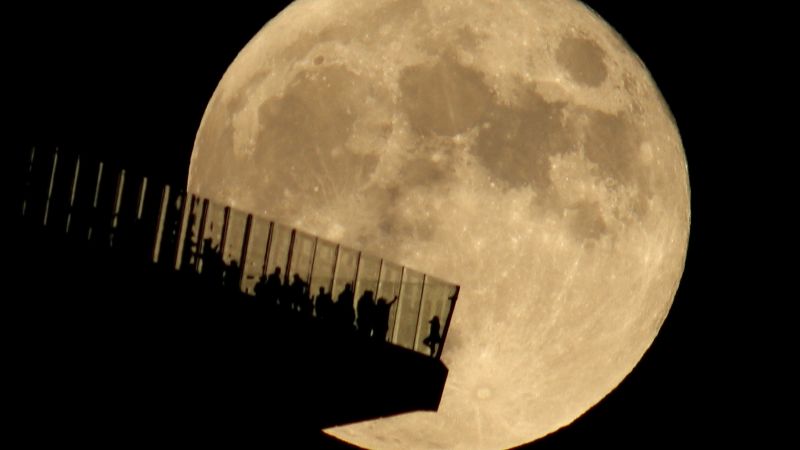
October’s Hunter’s Moon: Celestial Observations
This weekend, stargazers will be treated to a spectacular sight as October’s full moon, commonly known as the Hunter’s Moon, ascends into the night sky. Observers may also be fortunate enough to catch a glimpse of Saturn near the lunar orb.
Timing of the Full Moon
The full moon is set to rise early on Sunday evening, peaking at 12:12 a.m. Eastern Time on Monday, October 26, as reported by EarthSky. As dusk falls on Sunday, Saturn will be visible, positioned a few degrees south of the moon.
The Moon’s Appearance
Due to its low placement on the horizon, the moon may exhibit a more orange hue. This color change happens because the moonlight travels through more of the Earth’s atmosphere, which scatters shorter wavelengths of light, allowing the warmer tones to become more prominent, similar to the appearance of sunsets.
Significance of the Hunter’s Moon
Historically, the Hunter’s Moon was named by Native American cultures who utilized the bright light provided by the full moon for hunting and preparing for the winter months. It follows September’s harvest moon, which marked the end of the harvest season.
Noah Petro, chief of NASA’s Planetary Geology, Geophysics and Geochemistry Lab, notes, “These names were assigned to the moon because the moon has a meaning. I’d encourage folks, while they’re looking at the moon, to ask, ‘What does this time of year mean to me?’ Everyone should have a personal connection.”
Alternative Names
The Hunter’s Moon has been referred to by various names among Indigenous tribes, including the drying rice moon, the falling leaves moon, and the migrating moon. Some traditions even call it the blood moon, inspired by its reddish-orange appearance.
Future Observations
While the moon will predominantly display its silvery appearance in the coming months, keen observers may notice subtle shifts in its coloration due to surface variations. According to Petro, these color differences indicate historical geological activities on the lunar surface. “When you see color differences on the moon, that’s telling you that something has already happened there — either the rocks are made of something different, or it’s a younger or older surface,” he explains.
Optimal Viewing Conditions
Petro recommends finding a viewing location away from obstructions like trees or buildings, ideally in an open area. Cold nights can also enhance visibility, as warmer air tends to create atmospheric turbulence.
“The beauty of the moon is that you don’t need to have the most impressive telescope,” said Petro. “You need clear eyes and clear skies. With that, you can fall in love with the moon.”
Upcoming Celestial Events
If the sky is overcast on Sunday, observers can still enjoy the full moon on Saturday and Monday. Additionally, from Monday through Wednesday, the moon will approach and briefly eclipse the Pleiades star cluster, which is easily recognized as a group of six to seven stars.
Future Full Moons
- November 24: Beaver Moon
- December 23: Cold Moon
With October’s Hunter’s Moon set to illuminate the sky, it provides a perfect opportunity for both seasoned astronomers and casual viewers to engage with the beauty of our celestial neighbors.
