


Arkansas Senate Race: Hallie Shoffner’s Local Focus Amid Political Dissatisfaction
A Local Perspective
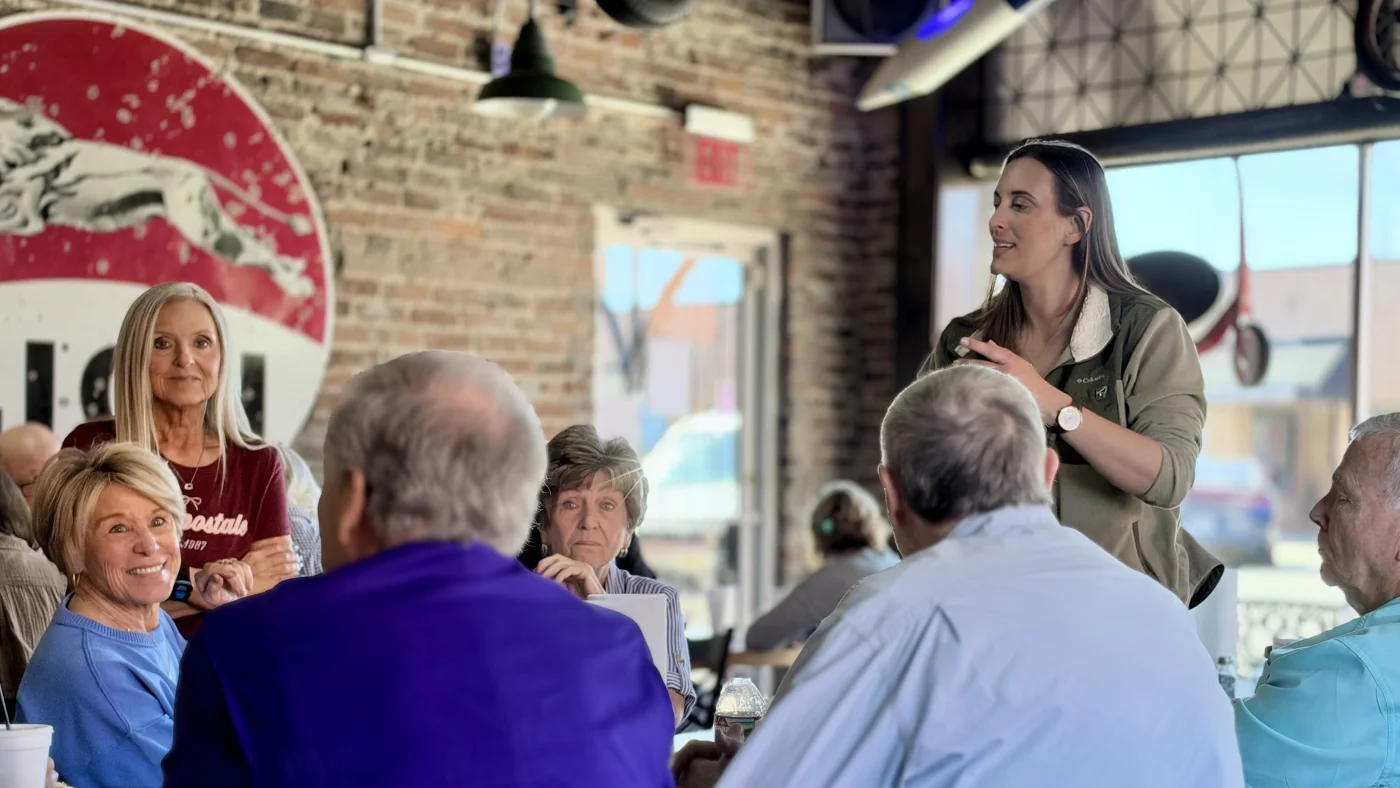
During a recent campaign stop at Tailgater’s Burger Company in Hope, Arkansas, Hallie Shoffner, the Democratic nominee for Senate, emphasized that her identity as an Arkansan transcends political labels. Expressing her disappointment with what she termed a historically ineffective Congress dominated by extreme partisan views, she positioned herself as a pragmatic alternative for voters.
Political Landscape and Challenges
Arkansas is traditionally one of the more conservative states in the U.S., with a significant majority having supported President Trump in the 2024 Presidential election and Republican Senator Tom Cotton in the 2020 race. Nevertheless, as the midterm elections approach in 2026, Shoffner and her fellow Democrats are on a mission to harness growing discontent with rising costs and dissatisfaction towards the Republican Party.
“We’re the sleeper race,” Shoffner told NPR. “I mean, we’re the race that no one’s noticed and that no one is going to see coming.”
Despite Democrats’ optimism, forecasters still view Arkansas as a challenging landscape for competitive elections. The Cook Political Report categorizes the Senate race as “Solid Republican,” while the 2nd Congressional District is deemed “Likely Republican.”
Community Engagement
Schoffner’s campaign strategy centers on engaging directly with the community. In her interactions, she focuses on addressing the common needs of Arkansans rather than the traditional party divide. During her visit to a family farm in Bierne, she connected with locals over shared concerns, reinforcing her belief that fundamental issues transcend party affiliation.
“When it comes down to basic needs or whatever, the ‘D’ or the ‘R’ after your name don’t mean a thing,” noted Vanilla Hannah, a local justice of the peace candidate supporting Shoffner. “We’re all suffering and all having the same issues, and everybody’s ready for a change.”
Personal Journey and Campaign Motivation
Shoffner is a multigenerational farmer who closed her family’s farming business in 2025 due to economic challenges exacerbated by the previous administration’s policies. Her journey, which transitioned from farming to nonprofit work and back home, shapes her campaign’s focus on real-world issues confronted by Arkansas residents, particularly in agriculture and trade.
“This race isn’t about Democrats or Republicans,” Shoffner asserted. “This isn’t some kind of weird political alignment. This is a values alignment.”
Wider Context of Frustration
Across Arkansas, the political climate is marked by a sense of frustration toward incumbents. Chris Jones, the Democratic nominee for the 2nd Congressional District, echoed this sentiment. By highlighting rising living costs and unmet expectations from the previous administration, he aims to capture the discontent pervasive among the electorate.
“They understand that people are in pain. Folks are hurting. They can’t afford gas. They can’t afford groceries,” Jones stated, emphasizing the urgent need for change.
The Role of Voter Engagement
This election cycle has seen a notable increase in Black voter turnout across several Southern states, a response to perceived threats against voting rights. Although Arkansas did not redraw its congressional maps significantly, the uptick in engagement could play a pivotal role in shaping electoral outcomes.
“Folks are literally hurting, and it’s to the point where they’re saying, ‘my life is so bad that I don’t care about party anymore’,” Jones remarked, underscoring the potential for voters to look beyond traditional party affiliations.
