


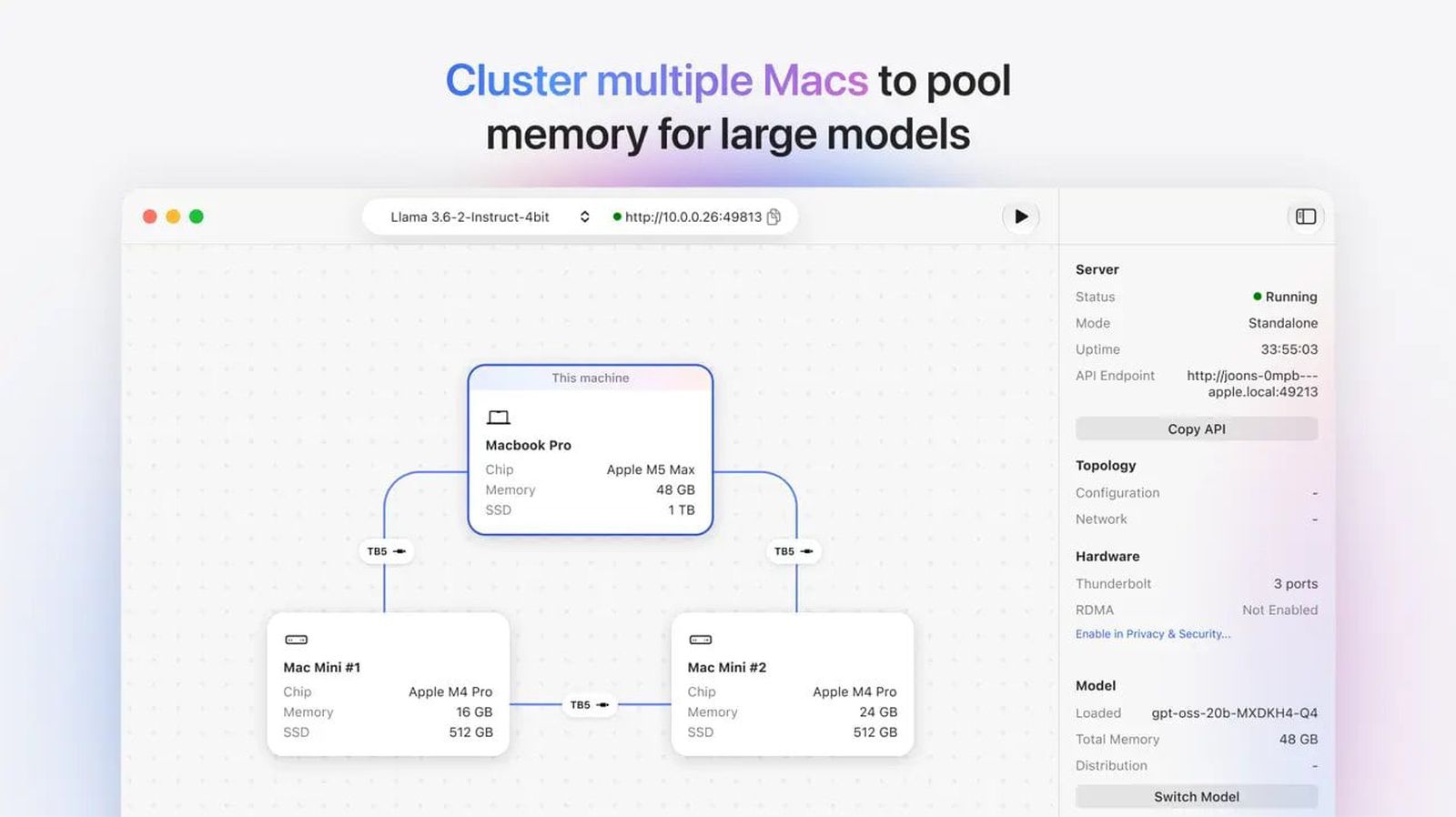
Introducing Harbor: Transforming Macs into Private AI Servers
Claris, a subsidiary of Apple, is currently testing an innovative application known as Harbor. This app allows users to convert Apple silicon Macs into private AI inference servers, effectively handling AI tasks locally without the need for cloud services.
Key Features of Harbor
- Compatibility: Designed specifically for Apple silicon Macs.
- Advanced Connectivity: Supports Thunderbolt 5, enabling multiple Macs to be connected for pooled memory resources.
- Ease of Use: Promises a straightforward setup process with automatic device detection—no manual configuration required.
- Local Inference: All data processing occurs on the user’s hardware, ensuring privacy and security.
Operation and Functionality
Harbor excels in enabling users to manage AI models effortlessly. Users can browse for, download, and execute open-weight models directly within the application. The streamlined interface simplifies model management, allowing users to focus on their projects without becoming bogged down by extensive setup procedures.
Enhanced Clustering Capabilities
The app’s capability extends to connecting multiple Macs over Thunderbolt 5, pooling their unified memory to accommodate larger AI models. This clustering feature enhances performance, enabling applications that exceed the memory capacity of a single machine and enhancing concurrent request handling.
“Harbor turns your Mac into a private AI inference server. Run open-weight models locally on Apple silicon—your data never leaves your hardware, and nothing reaches the cloud,” the Claris team states.
Current Access and Future Prospects
As of now, Harbor is in its early access phase and is not widely available to the public. Although there was a presence on the App Store, it has since been removed. Claris is primarily recognized for its FileMaker database platform, which raises questions about how Harbor will be marketed and whether it will be offered as a free tool.
Market Positioning and Alternatives
While Harbor is being developed primarily for business use—as suggested by its focus on company names during sign-up—it faces competition from existing tools. Notably, Exo is an open-source clustering solution for Macs, and LM Studio offers single-Mac AI server functionality. Harbor seeks to differentiate itself by combining user-friendly elements from LM Studio with powerful clustering capabilities.
Conclusion
With Harbor, Apple’s Claris aims to create a robust solution for users looking to harness the power of AI on their Macs securely. As the application progresses towards greater availability, it holds the potential to revolutionize how local AI tasks are executed and managed.
