


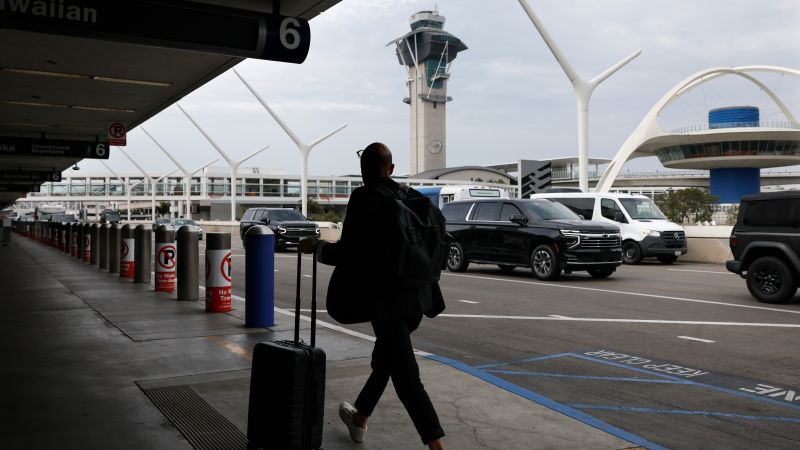
FAA Funding Request Amid Nationwide Flight Grounding Incident
On Friday, a significant disruption in U.S. air traffic control operations led to grounding all flights across the nation, prompting urgent calls for increased funding for the Federal Aviation Administration (FAA). Transportation Secretary Sean Duffy emphasized the need for Congress to approve an additional $50 billion for the FAA to upgrade its systems and infrastructure.
Current Funding Levels and Political Responses
Despite Duffy’s request for a substantial funding increase, Democratic lawmakers, who are poised to hold majority control in January, highlighted last year’s legislation that approved $12.5 billion for the FAA. They argue that this funding is sufficient to meet the agency’s operational and modernization needs.
However, Duffy disputed this assertion, stating, “I have no money in that $12.5 billion that I can use for a new architecture for telecom. I can’t build new software to manage our airplanes in the airspace because it dates back to the 1990s,” during an interview on CNN’s “State of the Union.”
Details of the Flight Grounding Incident
The grounding incident, which led to extensive travel delays, has been tentatively linked to a malfunction during a telecommunications upgrade by contractor L3Harris in El Dorado, Arkansas. Duffy noted that both faulty equipment and contractor error remain under investigation.
Future Infrastructure Needs
In his communications, Duffy outlined critical infrastructure requirements, emphasizing the urgency of modernizing the FAA’s aging systems. After the incident, he raised his funding request from around $30 billion to $50 billion. Additionally, President Donald Trump echoed this sentiment on social media, urging Congress to “give the money, FAST!”
Democratic Lawmakers’ Stance
The request for additional funding has encountered skepticism from Democratic representatives. Reps. Rick Larsen and André Carson, who oversee aviation-related congressional panels, have demanded clarification on the necessity of more funds if significant amounts from previous appropriations remain unspent. Their statement underscored the need for transparency and justification from the FAA.
Senator Brian Schatz from Hawaii pointed out the availability of excess funds that could be redirected from other government allocations, stating, “There is a pot of 60 billion extra dollars…we should use at least a portion of that money for the FAA.”
Meanwhile, Sen. Tammy Duckworth criticized the administration’s spending priorities, suggesting that funding has been available for less critical projects, questioning the allocation process in aviation safety.
Leadership Dynamics and Future Actions
Amidst the debates, some Democratic leaders, including Maryland Senator Chris Van Hollen, indicated a willingness to support additional FAA funding, contingent on clear justification from the administration. Van Hollen remarked, “I will support whatever level of money is necessary to fix this problem,” highlighting the need for bipartisanship in addressing aviation infrastructure challenges.
As the clock ticks towards a December 11 funding deadline, Republican leadership is also considering ways to expedite FAA funding approvals. Outgoing House Speaker Mike Johnson mentioned plans to include additional FAA funding in an upcoming legislative package.
The Road Ahead
With numerous stakeholders involved and a pressing deadline, the path to increased FAA funding remains uncertain. The need for modernization of air traffic control and infrastructure is crucial for ensuring safety and efficiency in the aviation sector.
