


HS 0209+0832: An Overview of Spectroscopic Observations and White Dwarf Characteristics
Spectroscopic Observations
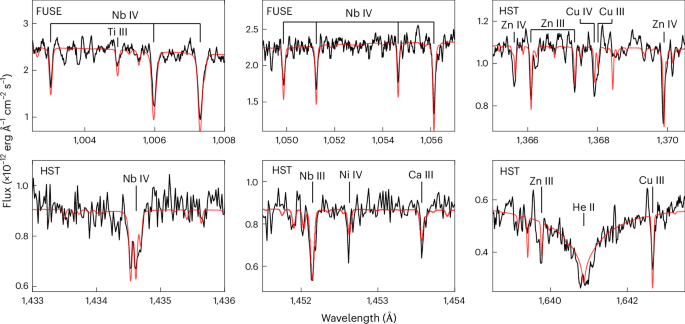
HS 0209+0832 underwent significant observational studies utilizing different instruments, including the Hubble Space Telescope’s Space Telescope Imaging Spectrograph (HST/STIS) and the Far Ultraviolet Spectroscopic Explorer (FUSE). The initial observations were conducted on January 10, 1994, employing the E140M grating to capture ultraviolet light between 1,150 and 1,710 Å. This setup achieved a high resolving power of approximately 45,800, resulting in a spectrum marked by over 200 metal absorption lines, as well as notable hydrogen and helium lines.
Subsequent exposures using less sensitive gratings, G230LB and G430L, recorded wavelengths ranging from 1,685 Å to 5,700 Å, although the low resolution limited the detection of metal lines which was crucial for analyzing the white dwarf’s physical parameters.
FUSE further analyzed HS 0209+0832 on December 11, 2002, gathering data over an impressive 4,986 seconds and yielding a spectrum showcasing numerous metal and hydrogen lines. Additionally, observations made with the Ultraviolet and Visual Echelle Spectrograph (UVES) between July 12 and 15, 2000, contributed valuable information despite not detecting metal lines due to the detectors’ limitations.
White Dwarf Parameters
For effective temperature (Teff) calculations, we employed a model atmosphere grid ranging from 30,000 K to 40,000 K, alongside surface gravities from log g = 7.50 to 8.50, keeping helium abundance constant. Initial models indicated a strong correlation to reddening, suggesting a Teff around 36,329 K under zero reddening conditions, while a minor reddening of E(B-V) = 0.01 suggested a higher temperature of 43,075 K. Given the challenges posed by the estimated photometric uncertainties, a hybrid approach was adopted to accurately deduce Teff and log g values.
Utilizing Balmer line fits from various spectra, the finalized parameters indicated Teff = 35,845 ± 535 K and log g = 7.904 ± 0.015, aligning well with the ultraviolet spectra analysis and reaffirming the negligible effect of reddening.
Photospheric Abundances
Through the fixed parameters of Teff, log g, and log(He/H), comprehensive models were developed for the analysis of metal abundances. This involved fitting the spectral data from both HST/STIS and FUSE observations against synthetic spectra grids. Significant interstellar medium lines were detected, which helped in masking misleading data during the fitting process to ensure accuracy.
Among the findings, HS 0209+0832 became the first known white dwarf to showcase photospheric zinc, with derived abundances indicating a notable increment due to advancements in atomic models. The discrepancies in abundances for elements like carbon and titanium between ionization states suggest the presence of atmospheric layers influenced by surrounding hot gas, hinting at complex physical processes in play.
Radiative Levitation Phenomena
The concept of radiative levitation emerged as a critical factor in determining the atmospheric composition of HS 0209+0832. Elements such as carbon, aluminum, and silicon may be subject to radiative support, contrasting with others like calcium and nickel. By examining equilibrium abundances and integrating atomic diffusion effects into the models, it was concluded that material accreted by HS 0209+0832 exhibits a wasteful composition compared to solar standards, particularly with elevated s-process elements.
Photometric Variability
HS 0209+0832’s light curve was monitored by TESS during specific observation sectors. Combined data led to the identification of a significant periodic signal at approximately 4.399 days, with a detection amplitude of 0.120%. This finding was consistent across various sectors despite minor variations in amplitude.
Further investigation into nearby celestial objects revealed no signs of contamination affecting the light signals, reinforcing the credibility of the observed periodicity within HS 0209+0832 itself. Thus, it was established that this white dwarf exhibits low-amplitude variability, an intriguing characteristic to explore in the study of stellar evolution.
