


The Cambrian Explosion: Tracing the Roots of Life on Earth
Understanding the Cambrian Explosion
Approximately 538.8 million years ago, Earth experienced a remarkable event known as the Cambrian Explosion, characterized by a rapid increase in the diversity of complex life forms. This significant period lasted between 13 and 25 million years, during which nearly all major animal phyla emerged. Key groups included mollusks, arthropods, echinoderms, and the early chordates, which are animals possessing notochords—elements that would eventually lead to the vertebrates, including humans.
The Pre-Cambrian World: Early Animal Life
Before the Cambrian Explosion, simple animal life existed, with evidence suggesting that the first animals may have arisen as far back as 800 million years ago. During the period labeled ‘Snowball Earth,’ many early life forms, resembling modern sponges and comb jellies, thrived in a largely frozen world.
These primitive animals were typically soft-bodied and anchored to the ocean floor, utilizing unique structures to extract food from passing water. For instance, Dickinsonia is notable as a mobile creature of this era that utilized muscular contractions for movement, while others, like Kimberella, employed scraping mechanisms to consume algae.
The organisms from this time are known as Ediacaran biota, and while they were once thought to be evolutionary dead ends, contemporary views acknowledge their importance in the lineage leading to more complex animals.
The Cambrian Ecosystem: A Burst of Complexity
As the Ediacaran period transitioned into the Cambrian, marine ecosystems transformed dramatically. This shift gave rise to a diverse array of active animals exhibiting advanced features such as defined body plans, complex musculature, and predatory behaviors. The Cambrian saw the development of hard body parts, which drastically improved the fossil record and marked an evolutionary milestone.
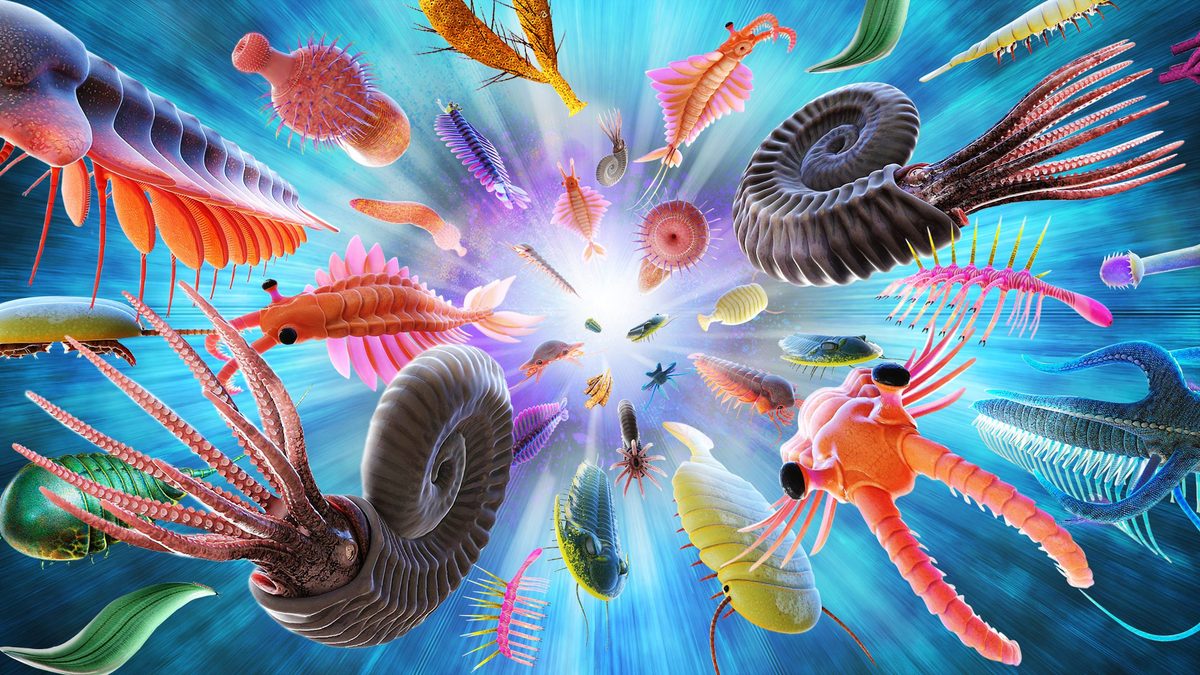
Among the notable Cambrian fauna were trilobites, hard-shell creatures resembling woodlice, and Anomalocaris, a formidable predator known for its unique hunting appendages. Other peculiar species included Hallucigenia, Opabinia, and Wiwaxia, each showcasing the radical experimentation with body forms during this period.
This era also marked the emergence of early chordates, specifically Pikaia, which possessed the defining traits of future vertebrates and played a crucial role in the evolutionary lineage that would lead to humans.
Investigating the Catalysts of the Cambrian Explosion
Numerous hypotheses have been proposed regarding the triggers behind the Cambrian Explosion. These include environmental factors like increases in oxygen levels, nutrient availability in the oceans due to volcanic activities, and the complex interactions among organisms within ecosystems.
One significant factor was the increase in free oxygen resulting from photosynthesis, enabling the emergence of more complex life forms. Similarly, the rise in essential minerals such as calcium and phosphorus supported the development of hard body structures among early animals.
The dynamic interplay between predator and prey during this time also instigated rapid evolutionary changes, leading to enhanced defenses and diverse adaptations among species.
The Fecal Revolution Theory
In a recent study published by palaeontologists Julien Kimmig and Russell Bicknell, a novel explanation suggests that the Cambrian Explosion may have been catalyzed by increased fecal matter in the oceans, termed the ‘fecal revolution’. Their research points to the vital role that waste produced by larger organisms played in enriching marine environments with essential nutrients, thereby fostering the development of complex ecosystems.
This theory posits that as animals grew in size and complexity, their waste products contributed to a nutrient-rich environment, enabling further biological development and diversity. Kimmig and Bicknell’s ongoing research aims to investigate the composition of these fecal deposits to understand their impact on early marine life.
