Close Menu
Newsward
  • World
  • US
    • Politics
  • Tech
    • Science/Tech
  • Money
    • Business and Market Watch
    • Crypto
    • Career
  • Health
    • Fitness
  • State of Women
  • Opinion
  • Sports
    • NFL
    • MLB

Subscribe to Updates

Get the latest creative news from FooBar about art, design and business.

What's Hot

Apple’s official DIY repair guides for the iPhone Duo now available

October 24, 2026

DOJ demands that California counties help identify noncitizen voters

October 24, 2026

Ripple news: Franklin Templeton adds $150 million of money-market shares to XRP Ledger

October 24, 2026
Newsward
  • World
  • US
    • Politics
  • Tech
    • Science/Tech
  • Money
    • Business and Market Watch
    • Crypto
    • Career
  • Health
    • Fitness
  • State of Women
  • Opinion
  • Sports
    • NFL
    • MLB
Subscribe
Newsward
Home » Eland protein found in 60,000-year-old ochre layer offers clues to early human practices in South Africa
Science/Tech

Eland protein found in 60,000-year-old ochre layer offers clues to early human practices in South Africa

Kabil Bendress<span class="bp-verified-badge"></span>By Kabil BendressOctober 24, 2026No Comments3 Mins Read
Facebook Twitter Pinterest LinkedIn Tumblr WhatsApp VKontakte Email
Eland protein found in 60,000 year old ochre layer offers clues to
Share
Facebook Twitter LinkedIn Pinterest Email

Ancient Eland Protein Linked to Early Human Practices in South Africa

Researchers have identified traces of animal protein from the common eland, a sizeable antelope indigenous to southern Africa, within a 60,000-year-old layer of red ochre. This groundbreaking discovery was made at Klipdrift Shelter, a significant archaeological site located in the De Hoop Nature Reserve, by an international team of scientists from Kyushu University, the University of Bergen, and the University of Copenhagen. Their findings were published in the journal Proceedings of the Royal Society B.

Research Site Overview

The ochre layer at Klipdrift Shelter, part of the Howiesons Poort archaeological culture, features a flat surface approximately one meter long, 40 centimeters wide, and up to one centimeter thick, rich in ochre pigment. Archaeologists have long associated the use of ochre with modern human behaviors, noting its practical and symbolic applications across various cultures.

Methodology of the Study

To investigate the ochre’s composition, the research team employed a technique known as palaeoproteomics, which focuses on analyzing ancient proteins. The scientists extracted sediment samples from the ochre layer and processed them using mass spectrometry, a method that breaks proteins into smaller fragments and quantifies them. The resulting fragments were then compared to extensive protein databases to identify their origin.

Findings and Implications

Two sediment samples yielded a consistent match, identifying type I collagen originating from the common eland, scientifically known as Taurotragus oryx. This discovery suggests two potential scenarios: early humans may have intentionally mixed eland protein with ochre, or they might have treated eland hides with ochre at the site. The complex structure of the examined ochre layer supports the first theory.

This finding is particularly significant as direct evidence of organic materials combined with ochre is scarce in African archaeological contexts. Proteins, unlike DNA, tend to have better preservation properties in warmer climates, making them invaluable for understanding past human behaviors.

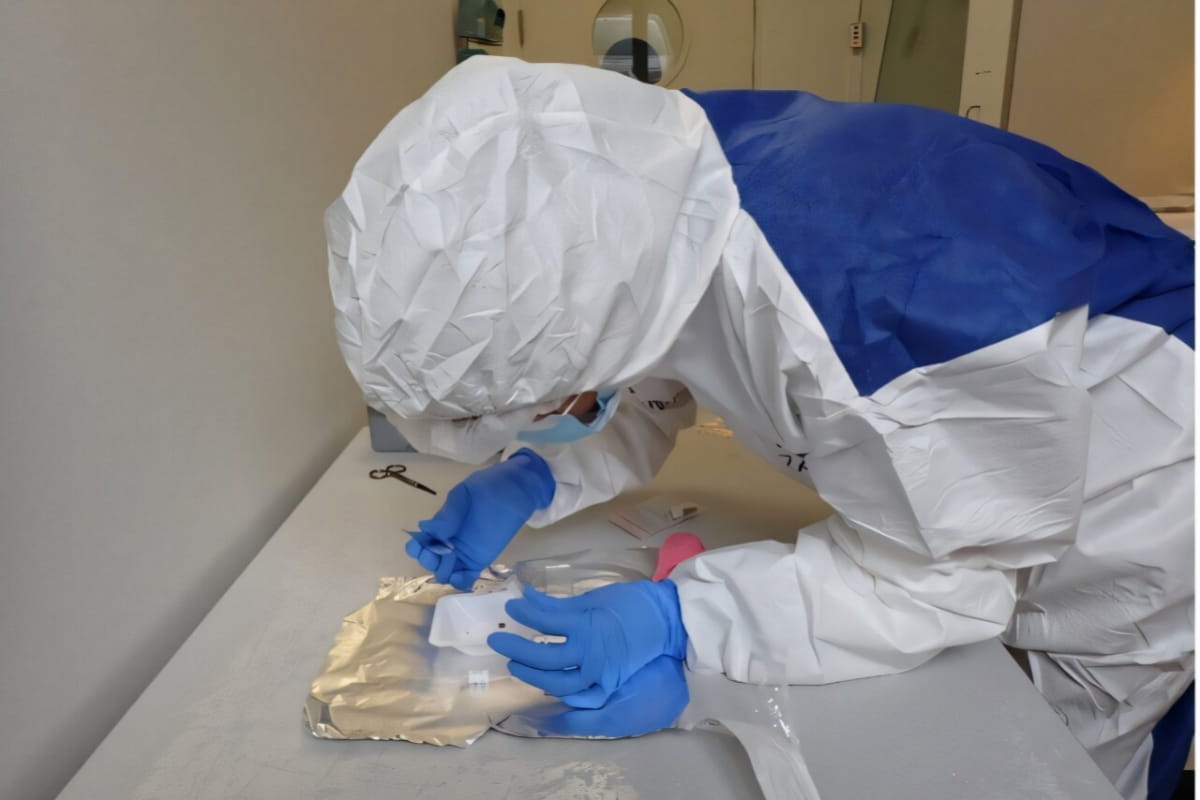
First author Zahra Haghighi preparing a sediment sample for palaeoproteomic analysis. Credit: Takumi Tsutaya/Kyushu University.

Symbolic Significance

The eland holds a prominent place in San mythology, further adding depth to this discovery. While this single example can’t definitively prove that the eland was symbolically significant during the Middle Stone Age, the researchers aim to extend their work to other sites of similar age to gather more evidence on this aspect.

Advancements in palaeoproteomic methodologies are broadening the scope of archaeological studies. By analyzing sediments and various materials, scientists hope to uncover the origins of protein residues and better understand the interactions between early humans and ochre deposits.

This research emphasizes the potential for recovering ancient proteins from soil samples, which may help rewrite our understanding of human activities during the Middle Stone Age.

Publication: Haghighi, Z., Tsutaya, T., Velliky, E. C., Armitage, S., Miller, C., Mackie, M., … Cappellini, E. (2026). Palaeoproteomic investigation of archaeological sediments associated with ochre use in the Middle Stone Age of southern Africa. Proceedings. Biological Sciences, 293(2081), 20253300. doi:10.1098/rspb.2025.3300

60000yearold Africa clues early Eland Human Layer ochre Offers Practices Protein South
Share. Facebook Twitter Pinterest LinkedIn Tumblr WhatsApp Email
Previous ArticleXbox Asked Netflix for $800 Million for 7-Year Movie and TV Exclusivity
Next Article Ripple news: Franklin Templeton adds $150 million of money-market shares to XRP Ledger
Kabilbendress0
Kabil Bendress

Related Posts

World Series 2026: Brewers jump ahead of Rays early, Jacob Misiorowski and bullpen secure 1-0 series lead

October 24, 2026

NASA’s Freeze-Resistant Moon Battery Could Eventually Reach EVs

October 24, 2026

The US west has lost nearly 300 glaciers since the 1960s. Climate crisis is drastically shrinking what’s left | Climate crisis

October 23, 2026

Scientists Just Cracked a Quantum Mystery That’s Puzzled Physicists For Decades : ScienceAlert

October 23, 2026

Top Articles

If you invested $1,000 in Bitcoin, the S&P 500 or gold 10 years ago, here’s which one made the most money

October 6, 2026

Bryter: Women Gamers in 2026

October 2, 2026

Can You Actually Make Money as an Indie AI Filmmaker in 2026?

October 22, 2026

MOFCOM’s New Rules and the Future of Chinese AI

October 22, 2026

Don't Miss

Technology

Apple’s official DIY repair guides for the iPhone Duo now available

By October 24, 20260

In conjunction with the launch of the new iPhone Duo, Apple has made available a…

DOJ demands that California counties help identify noncitizen voters

October 24, 2026

Ripple news: Franklin Templeton adds $150 million of money-market shares to XRP Ledger

October 24, 2026

Eland protein found in 60,000-year-old ochre layer offers clues to early human practices in South Africa

October 24, 2026

Subscribe to Updates

Subscribe to our newsletter and stay updated with the latest news and exclusive offers.

About Us
About Us

NEWSWARD is an independent news and media company covering the economy, politics, international affairs, and a changing world. Through articles, podcasts, video, and candid conversations, we connect major events to their impact on your life, your livelihood, and your future.

Our purpose is simple: help you understand what matters, think critically, and make informed decisions.

See what’s happening now. Know what’s next.

Don't Miss

Apple’s official DIY repair guides for the iPhone Duo now available

October 24, 2026

DOJ demands that California counties help identify noncitizen voters

October 24, 2026

Ripple news: Franklin Templeton adds $150 million of money-market shares to XRP Ledger

October 24, 2026
Most Viewed

If you invested $1,000 in Bitcoin, the S&P 500 or gold 10 years ago, here’s which one made the most money

October 6, 2026

Bryter: Women Gamers in 2026

October 2, 2026

Can You Actually Make Money as an Indie AI Filmmaker in 2026?

October 22, 2026
  • About Us
  • Contact Us
  • Privacy Policy
  • Terms and Conditions
  • Disclaimer
© 2026 Newsward. All Rights Reserved.

Type above and press Enter to search. Press Esc to cancel.