


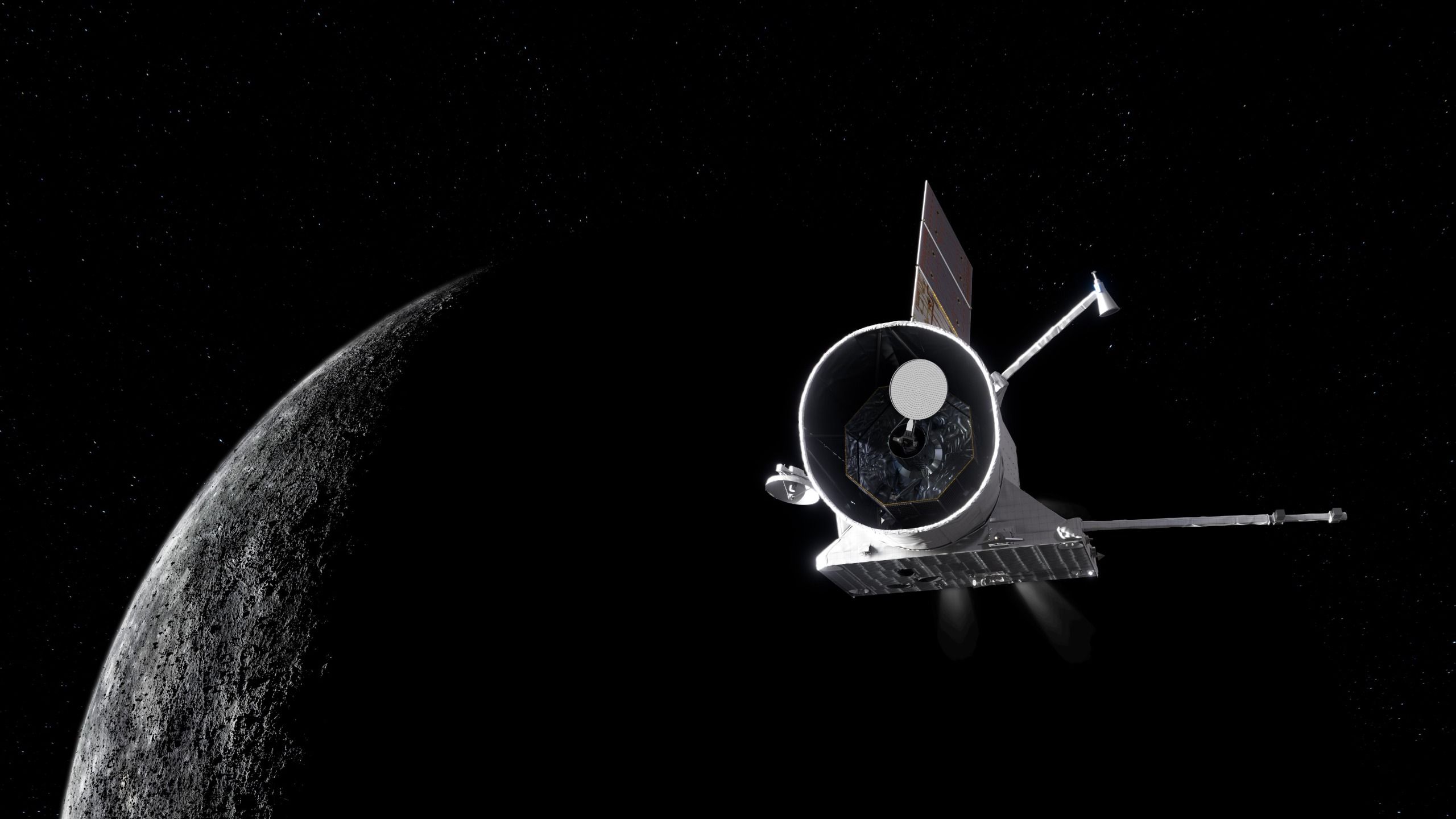
BepiColombo Mission: A Robotic Journey to Mercury
Today’s milestone in space exploration marks the arrival of BepiColombo, a collaborative mission between the European Space Agency (ESA) and the Japan Aerospace Exploration Agency (JAXA), which is set to enter orbit around Mercury after a journey spanning over eight years.
Key Event: Orbit-Insertion
The orbit-insertion process is scheduled to commence at 1:24 PM EST (1824 GMT) and will last 37 minutes. This critical maneuver is essential for BepiColombo to transition from its long trajectory into a stable orbit around the innermost planet of our solar system.
Mission Overview
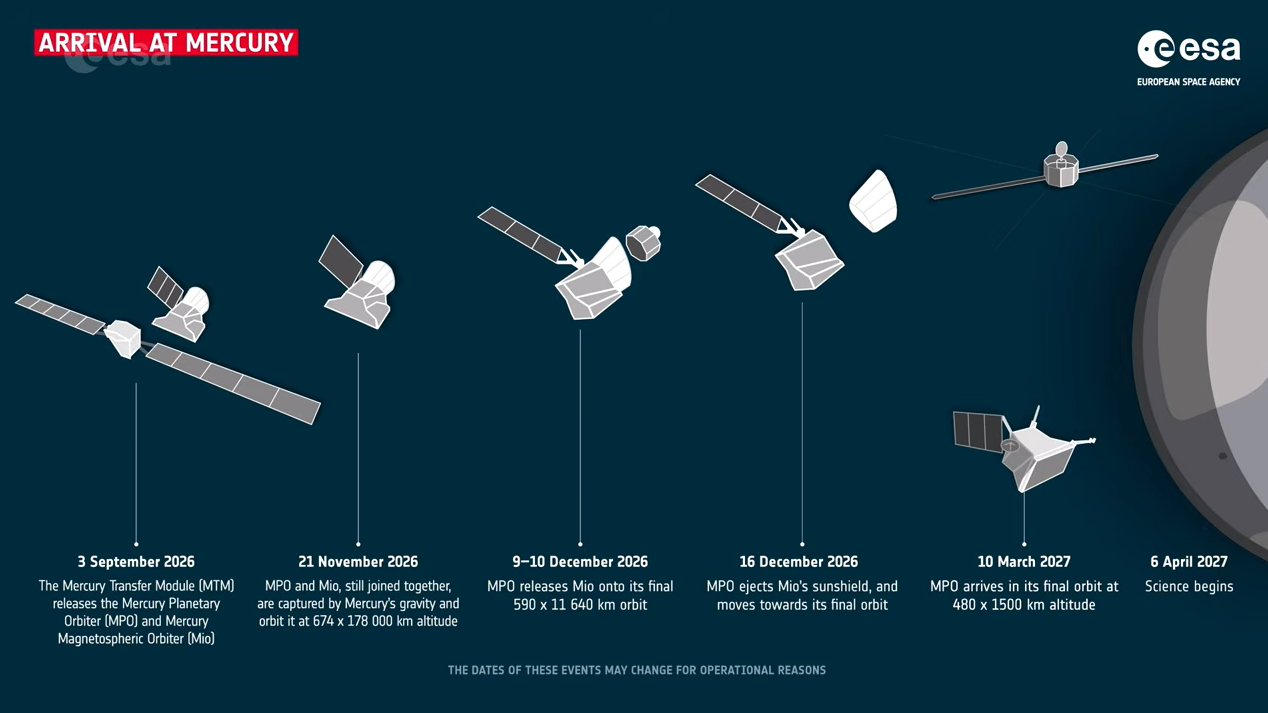
BepiColombo consists of two primary spacecraft: the Mercury Planetary Orbiter (MPO) developed by ESA and the Mercury Magnetospheric Orbiter (MMO), designated as Mio by JAXA. These orbiters launched in October 2018 aboard an Ariane 5 rocket from French Guiana, beginning an intricate journey through the inner solar system.
The Journey to Mercury
Reaching Mercury poses significant challenges due to its proximity to the sun. The spacecraft must navigate high speeds induced by the Sun’s gravitational force while simultaneously reducing kinetic energy to enter Mercury’s weaker gravitational field. To achieve this, BepiColombo engaged in a complex flight path, including a flyby of Earth, two encounters with Venus, and multiple flybys of Mercury itself over approximately seven years. A complication involving solar panels prolonged the journey by an additional year.
Arrival Phase
The arrival phase commenced on September 3, when the Mercury Transfer Module (MTM) released MPO and Mio. The two orbiters are still connected and will not separate until approximately December 9. Subsequently, Mio will engage in a final approach to its intended orbit, characterized by a highly elliptical path over Mercury’s poles. Meanwhile, MPO will also transition to a polar orbit, though less elliptical than Mio’s, with its final position achieved by March 10, 2027.
Scientific Objectives
The scientific endeavors of BepiColombo will officially begin on April 6, 2027. The dual probes will conduct complementary observations from their unique viewpoints, offering valuable insights into Mercury’s characteristics. According to ESA officials, the mission aims to explore various aspects of Mercury, including:
- The structure and dynamics of its magnetosphere
- Interactions with solar wind
- Internal composition related to its significant iron core
- Origins of Mercury’s magnetic field
Insights gained from this mission will help scientists better understand the evolutionary processes of planets close to their stars and contribute to broader knowledge about our solar system’s development.
