



Quantum Tautochrone: A Modern Twist on a Historical Physics Challenge
The concept of the tautochrone has intrigued scientists since its solution by Christiaan Huygens in 1659. This classical physics problem posits that a ball, regardless of its release height on a ramp, will always take the same time to reach the bottom, given the absence of friction. Huygens determined that the curve facilitating this property is a cycloid—the path traced by a point on a rolling circle. However, recent explorations have adapted this problem to the quantum realm, offering fresh insights.
Exploring Quantum Dynamics
A recent study led by physicist Georgios K. Simopoulos of the University of Crete investigates how quantum particles behave when interacting within various photonic and atomic lattices. Notably, the researchers found that under specific conditions, these particles can exhibit a behavior analogous to Huygens’s tautochrone, albeit without involving gravity, cycloids, or even classic balls.
The Mechanism Behind Quantum Tautochrone
While Huygens’s original tautochrone utilized gravitational forces, the new investigation developed a similar effect using light beams. The crux of both the classical and quantum tautochrones lies in managing how readily particles can transition between adjacent locations. In classical physics, this is executed through arrangements such as waveguides, while in quantum systems, it’s achieved via laser-generated optical traps allowing atoms to move through quantum tunneling.
Findings on Particle Convergence
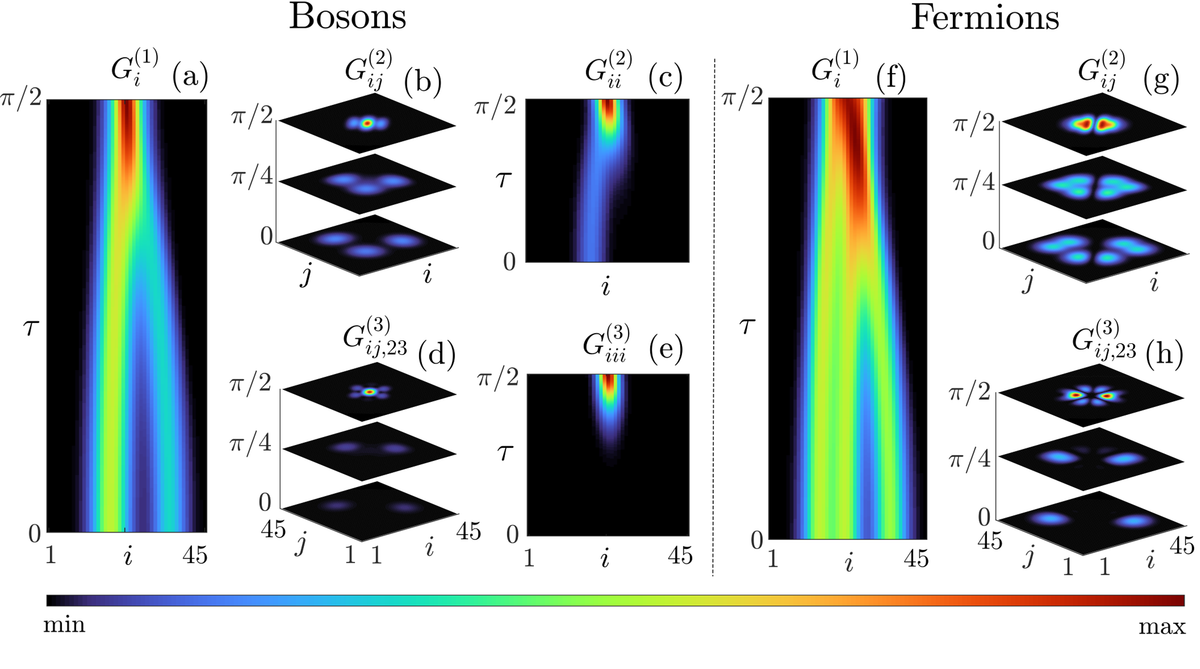
In their simulations, the researchers demonstrated that particles originating from diverse locations within the lattice converged at the center simultaneously. This behavior mirrors that of balls rolling down a cycloid but distinguishes itself based on the nature of the particles involved.
Bosons vs. Fermions
Quantum particles categorize into two main types: bosons and fermions. Bosons can share the same quantum state, while fermions adhere to the Pauli exclusion principle, which prohibits multiple identical fermions from occupying the same state. This fundamental difference was prominently reflected in their findings, where bosons could occupy the same site, but fermions, while arriving simultaneously at a similar region, maintained separate sites.
The Role of Particle Interactions
The study also scrutinized interactions among bosonic atoms. It was observed that a weak attraction prompted earlier convergence, while repulsive forces delayed it. Interestingly, strong interactions, whether attractive or repulsive, led to a decreased tendency of atoms to cluster at the same positions, influenced by conservation of energy principles.
Implications and Future Research
While Huygens’s original tautochrone served to enhance pendulum clock accuracy, the quantum tautochrone remains theoretical. Nonetheless, the precise manipulation of quantum particle convergence could significantly impact quantum technology applications, particularly those utilizing light-based information processing.
The findings also prompt further questions regarding the quantum tautochrone’s persistence in more complex systems involving larger groups of interacting particles. The researchers suggest that phenomena corresponding to this quantum effect may also be observable in many-body dynamics within optical traps that lack a foundational lattice.
This study, although not yet peer-reviewed, is available for public access on arXiv and paves the way for exciting advancements in quantum mechanics.
This article was fact-checked by Rebecca Dyer and edited by Rebecca Dyer. If you identify any discrepancies, please reach out to us.
