


AI Technology Leverages Facial Images to Predict Health Outcomes in Cancer Patients
A recent breakthrough in artificial intelligence research reveals that a simple facial photograph can provide significant insights into the health and longevity of cancer patients. This innovative approach, developed by researchers at Mass General Brigham in Boston, holds the potential to assist doctors in evaluating survival probabilities and tailoring treatment methods.
Innovative Facial Analysis Using AI
In a study published in the journal The Lancet Digital Health, researchers unveiled AI models that can estimate a cancer patient’s biological age and predict survival rates merely from an image of their face. According to Dr. Raymond Mak, a radiation oncologist involved in the research, the findings were surprising. “I was pretty surprised to find out that we could pick up signs of mortality risk from just a facial photograph,” he remarked.
Understanding Biological Age versus Chronological Age
The AI models utilized in this research, trained on over 40 million facial images, analyze specific features of the face to infer both health status and biological age. Unlike chronological age, which counts the years since birth, biological age refers to the physiological state of a person’s body at the cellular level.
Facial Features Linked to Survival Predictions
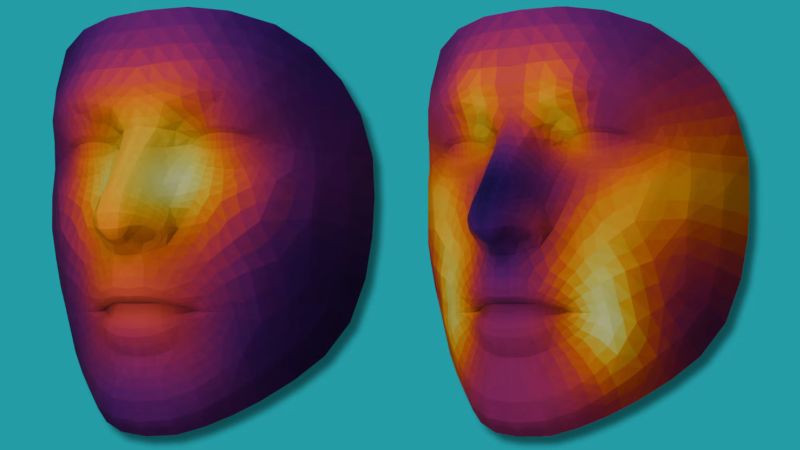
Dr. Mak described the areas of the face assessed by the AI: “The age estimation algorithm is looking at the area around the temples, the area on the forehead, above the eyes, and the nasolabial fold, the line connecting the nose to the mouth’s corners.” Meanwhile, features associated with mortality risk include the bridge of the nose and the area under the eyes.
Historical Parallels and AI Insights
Coincidentally, the facial regions identified as indicators of health have been referenced since ancient times. Hippocrates, the renowned Greek physician, noted similar traits in his 400 B.C. text Book of Prognostics, where signs such as “the nose sharp, the eyes sunken” were considered indicators of poor health and imminent mortality. Dr. Mak expressed amazement at the idea that modern algorithms might echo ancient wisdom, noting, “To think that our algorithms might be replicating that wisdom of Hippocrates from millennia ago was mind-blowing to us.”
Development of AI Models and Their Applications
The initial AI framework, known as the Foundation Artificial Intelligence for Health Recognition-Face (FAHR-Face), was further refined to create two specialized models: the FAHR-FaceAge model for estimating biological age and the FAHR-FaceSurvival model for predicting survival chances based on facial features and clinical information.
In trials involving 122 cancer patients, the FAHR-FaceSurvival model indicated a high risk of death for over half (52.5%) of those assessed, who died within 90 days. In stark contrast, only about 2% of the 975 patients classified in the lowest risk group experienced similar outcomes. Similarly, the FAHR-FaceAge model revealed that 21% of patients with a biological age exceeding their chronological age by more than 20 years died within 90 days, compared to just 6% of those whose biological age was at least 10 years younger than their chronological age.
Non-influence of Cosmetic Alterations
Notably, the AI models remained unaffected by cosmetic changes such as surgery, injectable treatments, or makeup, proving their robustness in delivering consistent predictions based solely on facial structure.
A Complementary Tool for Clinicians
The study’s authors emphasize that these AI-driven tools are not designed to replace clinical assessments but to serve as supplementary aids for healthcare providers. Dr. Mak highlighted, “If we can pick up accelerated aging or higher mortality scores early, we might be able to screen for those or identify patients who may benefit from further testing for serious conditions earlier.”
Future Directions and Clinical Considerations
While this research is primarily focused on cancer patients, there is potential for expansion into broader health contexts. The applicability of the findings to other populations, such as individuals without known health conditions, remains to be explored.
Dr. Wilbur Lam, a professor at Emory University, acknowledged the study’s compelling nature but urged that its clinical utility must be tested comprehensively. He noted the need for further research to determine how effectively this technology can be implemented across diverse populations and clinical scenarios.
Miroslaw Bober, a professor of video processing and machine intelligence, described the study as providing compelling evidence linking facial appearance to survival rates among cancer patients. However, he cautioned that while predictions are valuable, they do not replace the necessity for thorough medical assessments and a complete understanding of underlying biological processes.
Conclusion
As this transformative research unfolds, it opens avenues for innovative diagnostic measures based on facial analysis. Continued exploration in this realm could revolutionize how physicians assess patient health and tailor interventions, potentially leading to improved outcomes for various patient populations.
