


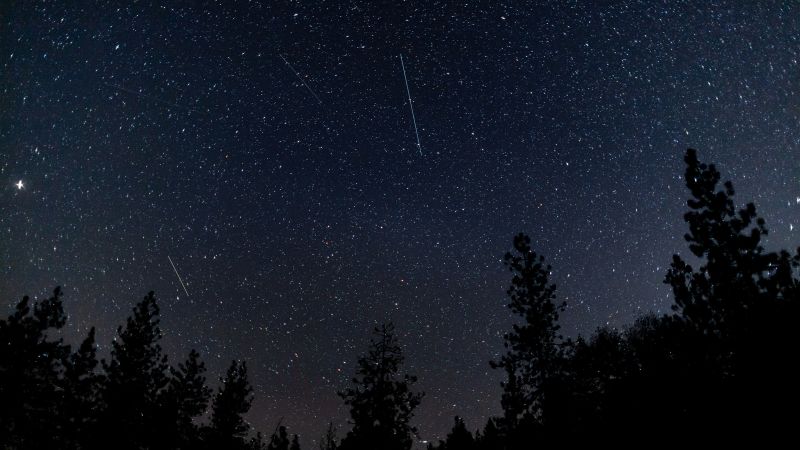
Northern Taurids Meteor Shower: Peak Viewing Times and Insights
The much-anticipated Northern Taurids meteor shower is set to peak, providing another chance for skywatchers to observe bright fireballs after the Southern Taurids event last week. This celestial display is expected to be especially mesmerizing in the coming days.
Optimal Viewing Conditions
As we approach Wednesday night into Thursday morning, conditions for meteor viewing will be ideal due to dark skies following the recent new moon. Skywatchers can expect brief flashes of light from meteors streaking across the night sky—often lasting just a few seconds.
Mark Boslough, a research professor at the University of New Mexico, noted, “The observing conditions should be very good. There’s no moonlight to really interfere with getting to see these.” Thus, Wednesday night promises premium conditions for enthusiasts and casual observers alike.
Understanding Meteor Showers
Meteor showers occur as the Earth travels through debris trails left by comets and asteroids in their orbits around the Sun. When tiny fragments of rock and ice contact the Earth’s atmosphere, they ignite, creating brilliant streaks of light.
The Taurid meteor showers are particularly renowned for producing spectacular fireballs. These can be brighter than Venus and originate from larger pieces of debris, often ranging from the size of a marble to that of a small boulder. Some meteors may leave behind glowing trails of ionized air for seconds at a time, while others produce lingering smoke trails that can last for minutes.
Viewing Tips for the Taurid Meteor Shower
- Find a dark location with minimal light pollution.
- Allow your eyes to adapt to the darkness for at least 30 minutes.
- Avoid looking at bright screens during this period.
With a waxing crescent moon at just 4% visibility, Wednesday night will be one of the best opportunities for meteor observation, although peak activity is expected on Thursday at approximately 1 p.m. ET. Observers should look toward the Taurus constellation, where the meteors will seem to radiate from.
Characteristics of the Northern Taurids
The Northern Taurids, in activity from October 20 to December 10, typically yield about five meteors per hour. This number can double when they coincide with the Southern Taurids, which conclude on November 12.
Research on meteor showers, including the Taurids, also plays a role in measuring potential threats from celestial objects that could impact Earth. In a 2025 study, researchers scrutinized the Taurid meteor stream, which is believed to conceivably contain more potentially hazardous objects than other meteor showers.
The Origin of the Taurids
The annual Northern Taurids originate from debris released by an asteroid named 2004 TG10, discovered in 2004. This asteroid is thought to have been part of a larger body that disintegrated approximately 20,000 years ago, creating what is known as the Encke Complex. Another object in this cluster is Comet Encke, associated with the Southern Taurids.
Recent studies have suggested that 2004 TG10 may be just one of ten asteroids that contribute to the Northern Taurids, indicating complexity across these meteoric events. Boslough remarked, “It’s not a simple meteor stream,” emphasizing that the Taurid shower comprises various components, unlike the more straightforward Perseids meteor shower in August.
Future Monitoring and Observations
Looking ahead, scientists are preparing for a notably dense Taurid meteor shower anticipated in 2032. They aim to identify and track any potentially dangerous debris through advanced telescopic technologies that can detect the heat emitted by small objects.
While monitoring efforts focus on assessing risk, Boslough clarifies that concerns are largely theoretical at this point, stating, “The idea that there is a dense swarm of dangerous objects, that’s completely hypothetical. But we can’t eliminate the chance that the risk during those times is extremely elevated.”
Upcoming Meteor Showers to Witness
As the year draws to a close, several notable meteor showers are coming up. Here are key dates for future observations:
- Leonids: November 16-17
- Geminids: December 13-14
- Ursids: December 21-22
Prepare for an exciting season of skywatching and make sure to utilize the optimal conditions to witness these celestial wonders!
