


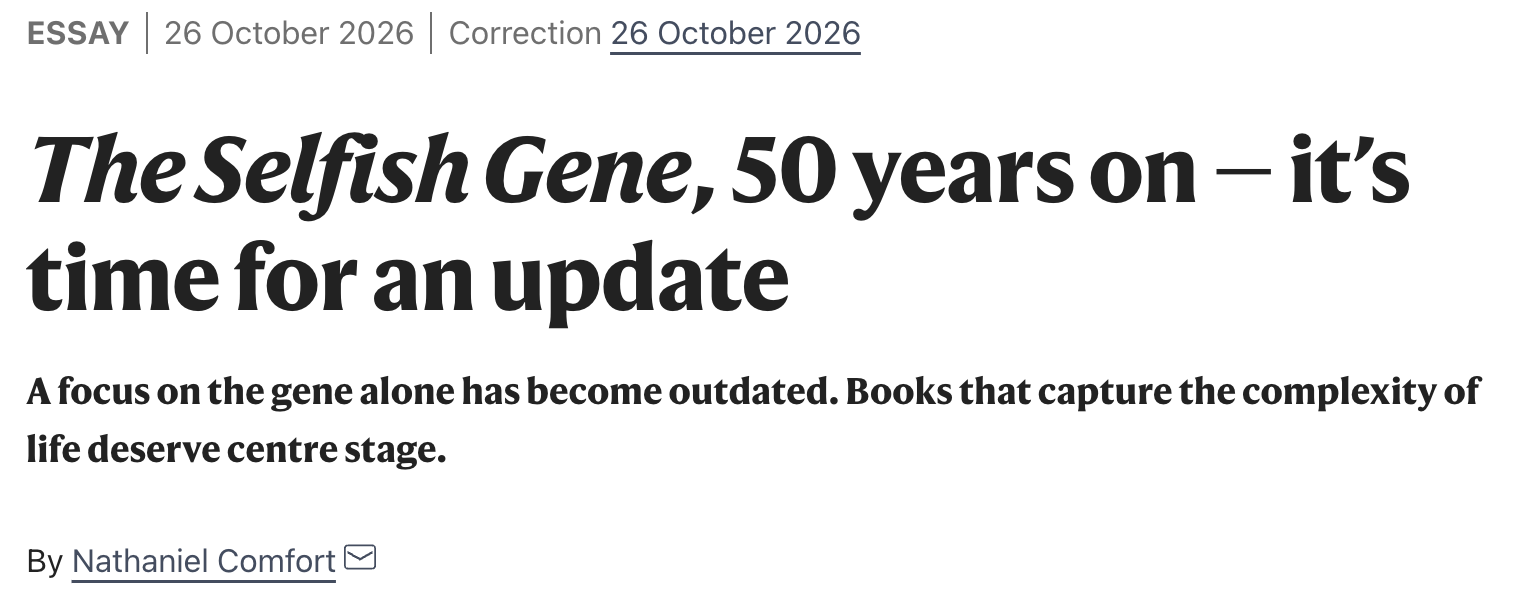
The Evolution of Evolutionary Theory: A Critique of Nathaniel Comfort’s View on ‘The Selfish Gene’
Nathaniel Comfort, an American historian and associate professor at the Institute of the History of Medicine at Johns Hopkins University, has significantly contributed to the field of biology history, particularly genetics. His works include a biography of the renowned scientist Barbara McClintock and he is currently nearing completion of a comprehensive biography of James D. Watson.
Comfort’s Critique of ‘The Selfish Gene’
In a recent article published in Nature, Comfort challenges Richard Dawkins’s seminal work, The Selfish Gene, claiming it is outdated and less relevant when compared to literature that supports his preferred framework known as the Extended Evolutionary Synthesis (EES). Comfort asserts that the traditional neo-Darwinian synthesis—which integrates natural selection with Mendelian genetics—requires a significant overhaul.
Understanding the Selfish Gene Concept
Dawkins’s primary assertion in The Selfish Gene is that genes, rather than individuals or species, serve as the fundamental units of evolution, effectively acting as “replicators.” This perspective suggests that genes that replicate more successfully will be more prevalent in future generations. This “gene’s-eye view” extends beyond mere survival of the fittest by considering mechanisms like kin selection, where genes can spread even if they diminish the reproductive success of the individual carrying them.
Comfort’s Perspective: Extended Evolutionary Synthesis
“Re-reading it now, with decades of scholarship in the history of biology under my belt, it seems less benign. The determinism baked into the ‘gene’s-eye view’ in the book troubles me, as does the passivity of the organism in Dawkins’s telling…”
Comfort argues that Dawkins’s portrayal of organisms as passive vehicles for gene replication simplifies the complexities involved in evolutionary biology. He posits that the EES—a theoretical framework emphasizing concepts like epigenetics, niche construction, and phenotypic plasticity—offers a more nuanced understanding of evolutionary processes.
The Debate Over Evolutionary Directionality
One of Comfort’s critiques involves the perceived directionality within evolution. He cites contemporary scholars who argue against the idea of evolution as a random process, suggesting instead that certain trajectories toward complexity have inherently emerged. Research by biochemist Nick Lane posits that life became more complex as a means of dissipating energy more efficiently, supporting the notion that evolution skews toward increased complexity under specific conditions.
Counterarguments to Comfort’s Claims
However, this claim does not fundamentally undermine Dawkins’s theory. Evolution can be seen as a process where the efficiency of replication improves over time, which may not necessarily correlate with the overall complexity of organisms. Historical shifts in lineages demonstrate that while some organisms may evolve to become more complex, others, like parasites, exhibit reduced complexity as they adapt to new environments and niches.
Conclusions on the State of Evolutionary Theory
Comfort advocates for the EES, suggesting a departure from Dawkins’s viewpoints. Yet, many aspects of his criticisms can still be reconciled within the current evolutionary framework. The tenets established in the modern synthesis remain robust, accommodating new discoveries such as epigenetics without necessitating a complete reconstruction of evolutionary theory.
As the field of evolutionary biology continues to evolve, it remains essential to revisit foundational texts like The Selfish Gene, which have shaped not only public consciousness but also scientific inquiry into the mechanisms of evolution.
For those interested in a contemporary perspective on evolution, the textbook Evolution (Fifth Edition) by Doug Futuyma and Mark Kirkpatrick may provide significant insights into these ongoing discussions.
