


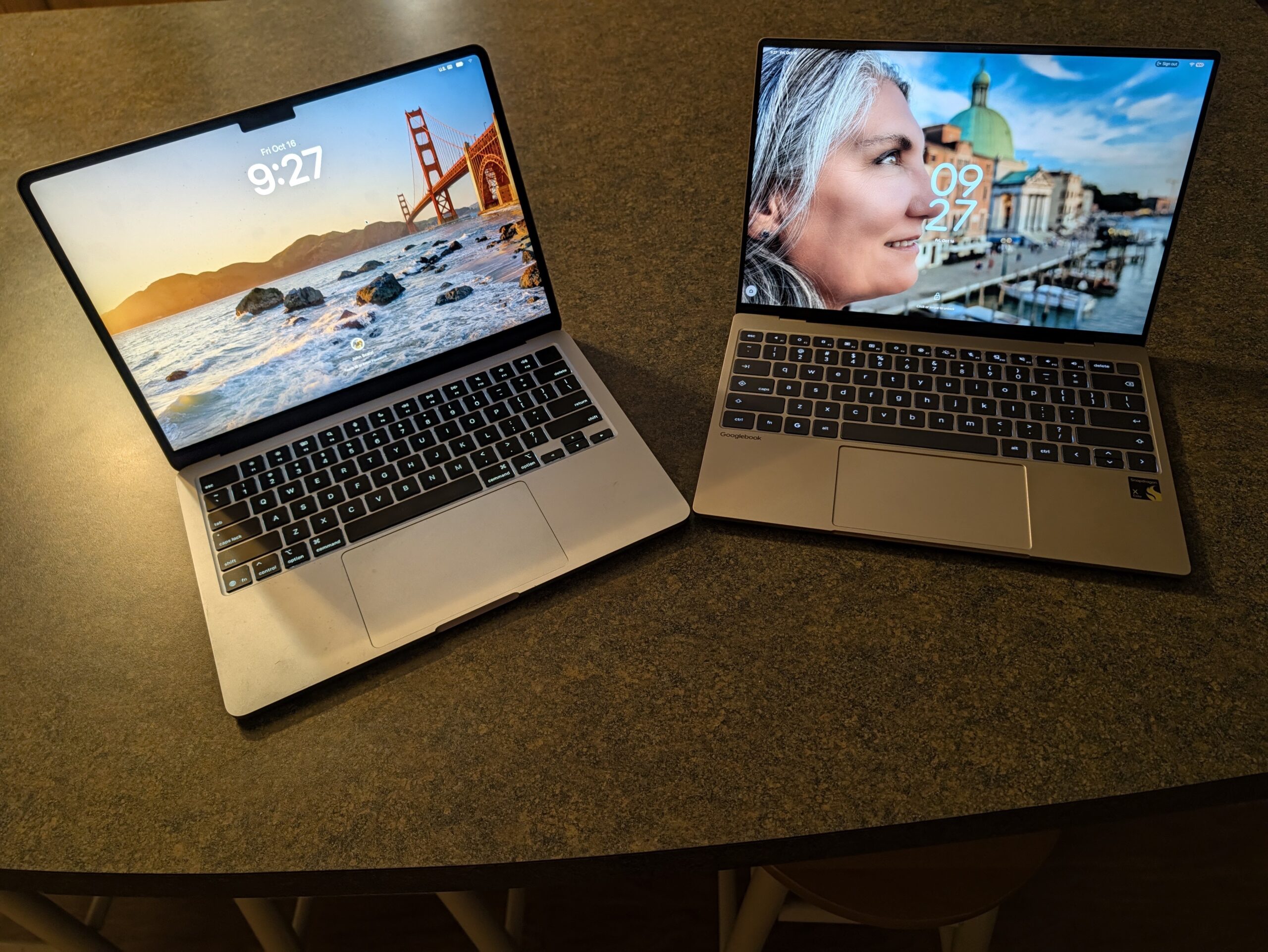
Googlebook vs. MacBook Air: A Comprehensive Comparison
Posted on October 27, 2026 by John Scalzi

I have recently spent a couple of weeks using the Googlebook, a device I compared against my current MacBook Air, equipped with an M4 processor. My primary objective was to determine which laptop would emerge as my go-to option for everyday tasks.
Overall Preference
In summary, my experience leads me to prefer the MacBook Air over the Googlebook. This preference stems from various software and hardware considerations. Although the Googlebook performs adequately, it exhibits a few shortcomings that detract from its overall usability.
Real-World Usage Scenario
During a recent convention in Denver, I initially considered taking the Googlebook with me. However, my decision to opt for the MacBook Air was influenced by connectivity concerns and the need for specific applications. In fact, I only pulled the Googlebook from my bag just before leaving and ultimately exchanged it for the MacBook Air, a choice I do not regret.
Key Comparisons
Keyboard and Form Factor
The keyboard of the Dell XPS version of the Googlebook is notably superior in feel compared to that of the MacBook Air, which I found to be overly soft. The XPS also features a slightly smaller design, which makes it more convenient in tight spaces like airplane seats.
Voice-to-Text Feature
The Rambler feature, derived from the latest version of Android, stands out as a highly effective voice-to-text tool. Its efficiency in text conversion is impressive and would make it a significant point in favor of the Googlebook, if not for its other limitations.
Trackpad and Screen
When it comes to hardware, the MacBook Air’s trackpad is noticeably smoother, a benchmark few laptops can equate to. Both laptops feature high-quality displays, with the Googlebook offering a 120 Hz refresh rate—though this is mainly beneficial for gaming scenarios.
Audio Performance Issues
A significant hardware flaw in the Googlebook pertains to its audio. Users have reported erratic volume fluctuations, which have been acknowledged as a known issue by Dell, with a fix anticipated no sooner than December. Additionally, the sound quality deteriorates at higher volumes, creating an unsatisfactory listening experience.
Software Limitations
The Googlebook relies heavily on the Android versions of software, which lack the comprehensive features found in their desktop counterparts. For my work, particularly with applications like Microsoft Word and Adobe Photoshop, this limitation proves to be a significant drawback. While simpler tasks can be handled adequately, I require fully functional software for more complex projects.
Future Outlook
It’s important to recognize that comparing a new operating system like Googlebook’s to the mature MacBook Air is inherently unequal. Google has promised a decade of updates for the Googlebook, and it is reasonable to expect meaningful improvements in the coming years. It may eventually develop into a more reliable option for business use.
Conclusion
For any travel or work that requires more than basic email and document management, the MacBook Air remains my preferred choice due to its established functionality and reliability.
— JS
