


New Discovery: A Giant Dwarf Planet Candidate Beyond Pluto
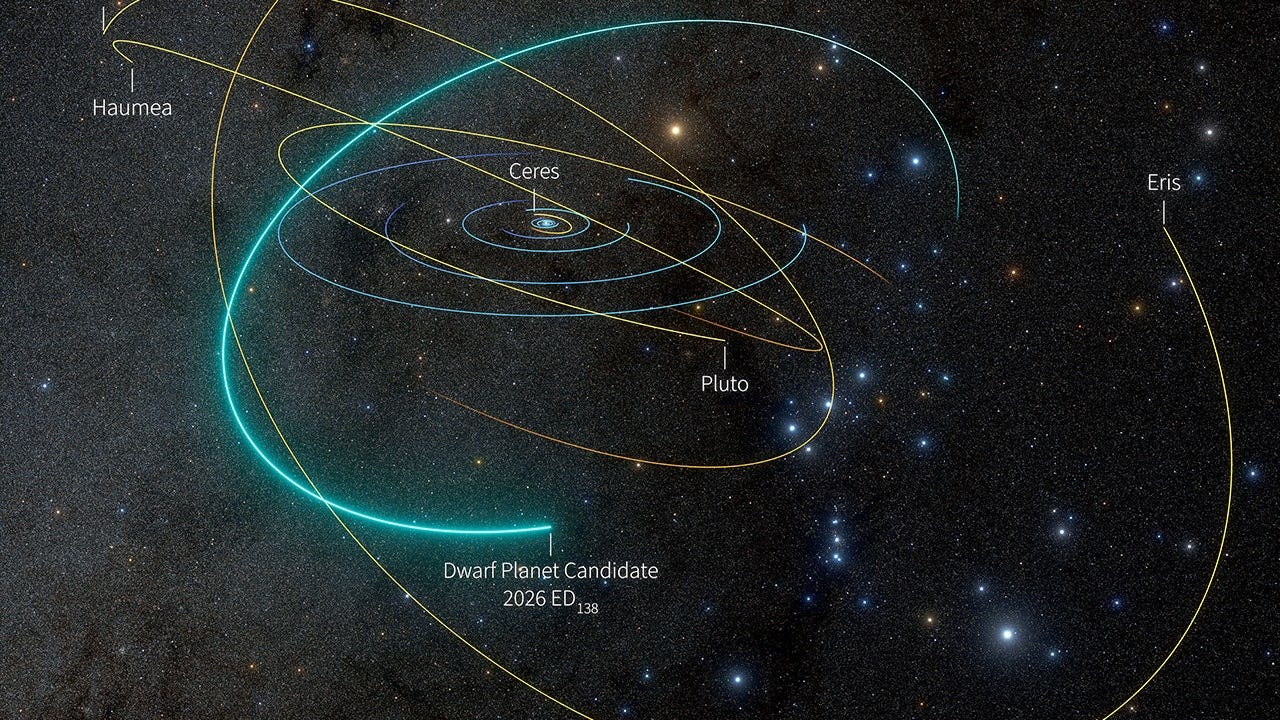
A groundbreaking discovery was made by astronomers at the Vera C. Rubin Observatory, revealing a dwarf planet candidate located beyond Pluto. Announced on October 27, this celestial body, designated 2026 ED138, could represent one of the largest dwarf planets identified so far in our solar system.
The Vera C. Rubin Observatory
This observatory, situated atop a mountain in Chile, operates with advanced technology funded by the U.S. National Science Foundation and the Department of Energy’s Office of Science. Since commencing operations and launching a 10-year sky survey in June 2026, the facility has utilized the world’s most extensive digital camera to uncover unseen astronomical objects.
The Discovery of 2026 ED138
During recent observations, astronomer Matthew Holman noticed the object while analyzing telescope data. Utilizing custom software he developed with colleague Kevin Napier, Holman detected that ED138 appeared unusually bright and distanced, suggesting a considerable size.
“Using this method, Holman uncovered ED138, and he immediately noticed that its brightness and distance indicated that it is unusually large,” the observatory stated.
Holman described his reaction to the find as one of “excited disbelief,” expressing initial concern over whether the results were accurate.
Size and Characteristics
Estimates suggest that ED138 has a diameter ranging from 370 to 930 miles. Currently, it orbits the sun at a distance of approximately 4.3 billion miles—further than Pluto, which orbits the sun from about 3.7 billion miles away.
Understanding Trans-Neptunian Objects
Classified as a trans-Neptunian object, ED138 occupies a category of celestial bodies that orbit the sun beyond Neptune. The discovery emphasizes the importance of continuous sky monitoring, as ED138 was concealed in a densely packed region near the Milky Way, which can hinder detection efforts with earlier telescopes. Recent advancements in imaging technology and analysis algorithms have helped in identifying such elusive objects.
Future Research and Implications
Looking ahead, scientists aim to conduct additional observations of ED138 to confirm its size definitively and determine if it meets the criteria to be classified as a dwarf planet. Holman noted the potential significance of this findings:
“If confirmed as a dwarf planet, ED138 would join a very small family of worlds,” Holman said.
The Definition of a Dwarf Planet
Dwarf planets are celestial bodies that orbit the sun and possess enough mass for their shape to be nearly round. However, unlike traditional planets, they do not clear their orbital paths of other debris. Pluto, once considered the ninth planet, was reclassified as a dwarf planet in 2006.
Broader Context and Recent Discoveries
The discovery of ED138 adds to a growing list of significant astronomical findings, highlighting the ongoing exploration and understanding of our solar system. For instance, in a separate incident earlier this year, a meteorite containing potential building blocks of life crashed into a home in New Jersey, dating back over 4.5 billion years.
Conclusion
The identification of ED138 not only enhances our understanding of the distant regions of our solar system but also demonstrates the capabilities of modern astronomical tools and techniques. As the Vera C. Rubin Observatory continues its expansive survey, the potential for further discoveries remains promising.
