


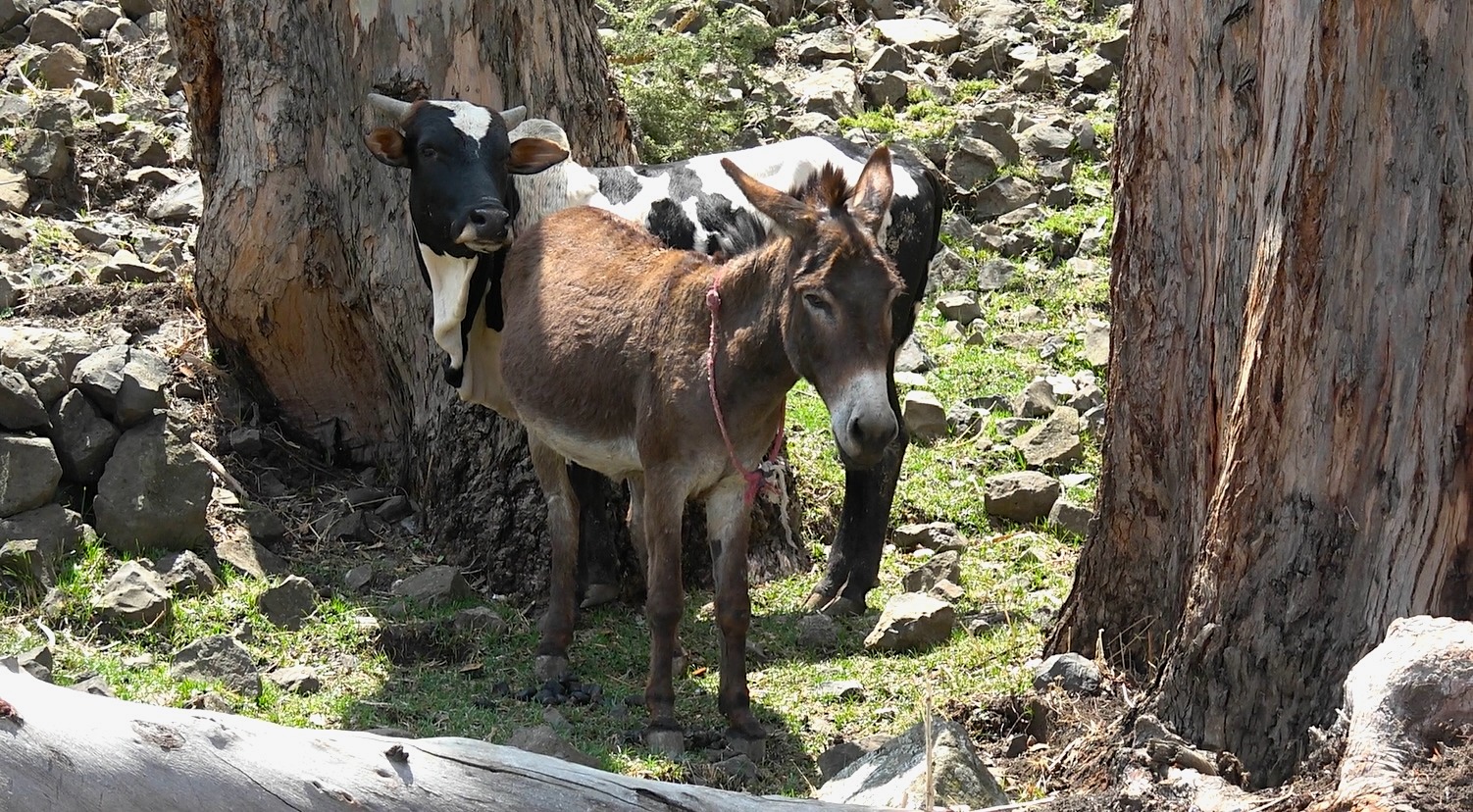
Unconventional Bonds: The Unlikely Relationship Between Achille and Patroclo
In a groundbreaking study conducted by a team at the University of Pisa, led by evolutionary biologist Elisabetta Palagi, researchers have documented a fascinating case of interspecies interaction in Ethiopia. Their findings center on a bull named Achille and a donkey named Patroclo, whose relationship challenges conventional understandings of animal behavior.
Surprising Discoveries in the Field
The research team initially set out to study the geladas, a type of monkey known for their distinctive heart-shaped chest markings. However, while observing these monkeys in their natural grazing environment, the students noticed a peculiar mating behavior between Achille and Patroclo. This unexpected interaction captured the researchers’ attention, prompting them to seek Palagi’s insight on whether it warranted further investigation. Palagi affirmed the significance of this observation in an email, stating her eagerness to explore the dynamics of the pair’s relationship.
A Mutual Connection
Upon closer scrutiny, the researchers found that Achille and Patroclo shared a consistent, mutual sexual relationship that had been largely unnoticed by the wider scientific community. The local herders, familiar with the pair’s behavior, found it humorous rather than shocking, indicating a stark contrast between local perceptions and scientific interpretations.
While research into same-sex behavior in animals has existed for centuries, many instances have historically gone unreported, leading to a misunderstanding of their frequency and significance. Recent studies have emphasized that such behaviors are prevalent and not merely aberrations, suggesting that they have been part of animal interactions throughout history.
Understanding Reproductive Interference
The behavior exhibited by Achille and Patroclo is classified as an example of “reproductive interference,” where individuals from different species engage in sexual behaviors that do not lead to reproduction. This phenomenon typically occurs in closely related species or those introduced to new environments. It is often perceived as a mistake, with numerous instances recorded across various animal behaviors, such as frogs attempting to mate with inanimate objects.
Unique Observations of Interspecies Behavior
Research has found few documented cases of same-sex sexual behavior between species as distantly related as donkeys and cattle. Although male-male mounting has been observed within domestic cattle populations, the researchers did not find any recorded instances of such behavior in donkeys prior to this study. While the authors of the new paper take care not to claim it as a definitive first, they provide significant documentation of Achille and Patroclo’s interactions over time.
Interpersonal Dynamics
Despite belonging to different owners, Achille and Patroclo spent a significant amount of time together on the plateau. Their interactions included licking, rubbing, and mounting, with researchers documenting 51 instances of mounting over four days, 34 of which resulted in penetration. Throughout these events, Patroclo exhibited no signs of distress or avoidance. Notably, he often positioned himself to encourage further interaction.
During one notable encounter, when Achille mounted another donkey, Patroclo approached and redirected the bull’s attention. This behavior showcased Patroclo’s agency in their relationship, leading researchers to ponder the nature of their bond without ascribing human emotions like jealousy or possessiveness to the interaction.
Future Research and Implications
While many questions remain about the origins and nature of Achille and Patroclo’s relationship, Palagi emphasizes the importance of acknowledging the complexity of social bonds in animals. The data collected not only adds to the current understanding of interspecies relationships but also serves as a reminder of the need for further research into animal behaviors that extend beyond traditional reproductive frameworks.
The researchers have plans to reunite the pair to observe any changes in their interactions after a period of separation. Whether their bond remains as strong as before will be a compelling question for future investigations, with the pair now symbolizing an extraordinary narrative in the study of animal behavior.
Conclusion
As scientists continue to explore the intricacies of animal relationships, the compelling case of Achille and Patroclo stands as a testament to the unexpected bonds that can form in the animal kingdom—challenging preconceived notions and enriching our understanding of wildlife behavior.
