


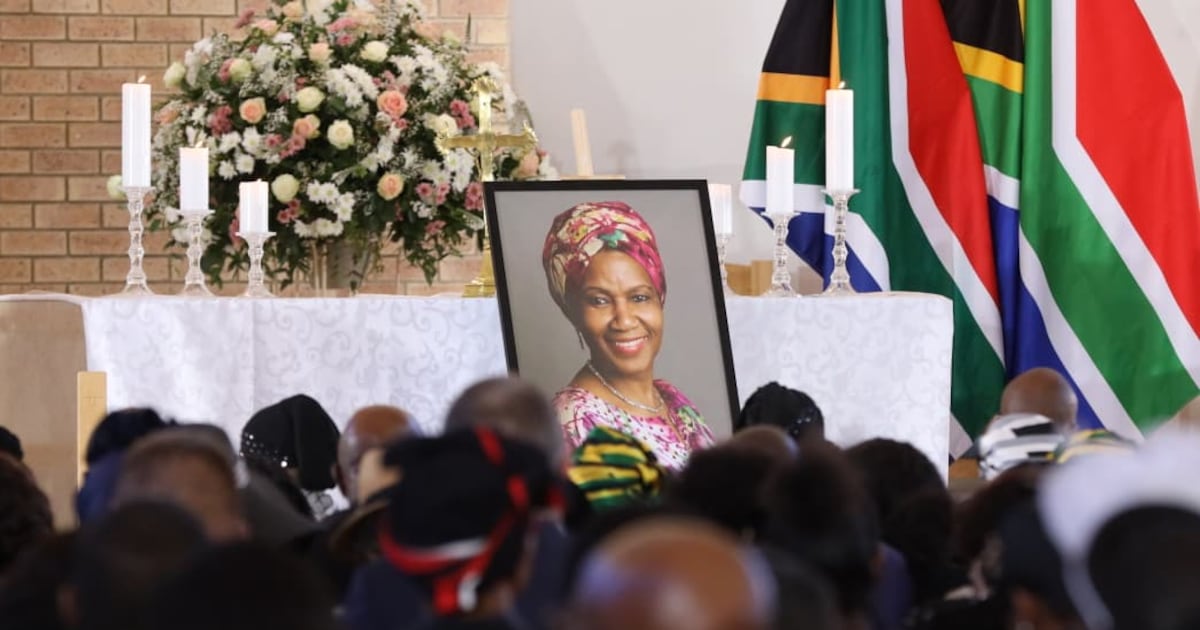
Honoring Dr. Phumzile Mlambo-Ngcuka: A Legacy of Women’s Empowerment
South Africa mourns the passing of Dr. Phumzile Mlambo-Ngcuka, the nation’s first female deputy president, who
passed away on November 20 at the age of 71.
A Lifelong Champion for Women
Dr. Mlambo-Ngcuka dedicated her life to advocating for women’s rights, dignity, and advancement. This pivotal
mission now falls to those she inspired, as she recognized that true freedom for women encompasses both
economic and political dimensions.
Inspiration and Action
Having witnessed her commitment firsthand, I recall a significant event in July 2006, when I joined her at
the Johannesburg Stock Exchange for the launch of ABSIP Women in Focus, aimed at enhancing women’s
leadership in the financial sector. Years later, I had the privilege of collaborating with her on the
HeForShe movement during her tenure at UN Women.
Dr. Mlambo-Ngcuka embraced a broad interpretation of inclusion. Her vision encompassed women’s ability to
learn, earn, own, lead, and make independent decisions, all within a safety framework. Financial
inclusion, in her eyes, represents empowering women to participate in the economy on equitable grounds.
Challenges and Solutions
Dr. Mlambo-Ngcuka’s approach to promoting meaningful change went beyond paving pathways for individuals.
She pushed for systemic alterations that would redefine access to opportunities, decision-making, and
equitable benefits from economic advancements.
During her tenure as Minister of Minerals and Energy, she advocated for women’s involvement in the mining
sector. As deputy president, she supported initiatives like Jobs for Growth, targeting skill development
and inclusive growth, particularly assisting women-led enterprises.
A Global Advocate
On the international platform as the executive director of UN Women from 2013 to 2021, Dr. Mlambo-Ngcuka
highlighted gender equality as a crucial global issue, contributing to the 2030 Agenda for Sustainable
Development.
Despite her extensive contributions, the challenge remains stark. Statistics South Africa reported that as
of early 2026, nearly 40% of young women aged 15 to 24 were not engaged in work, education, or training,
a statistic notably higher than that of young men. Furthermore, in 2023, only 4.9% of women operating
informal businesses secured formal start-up financing, in contrast to 12.7% of their male counterparts.
These figures prompt a critical question: how can we cultivate an economy that recognizes and nurtures
women’s work and potential?
Building Foundations for the Future
Empowerment occurs long before a woman enters the workforce. Through initiatives like the Umlambo Foundation,
Dr. Mlambo-Ngcuka supported both educators and students, emphasizing the importance of education as a
gateway to opportunity and the role of financial literacy and life skills in fostering confidence among
young women.
Behind these gaps lies a bigger question: how do we build an economy in which women’s work, enterprise and potential are recognised and supported?
Urgency for Action
Dr. Mlambo-Ngcuka warned that, at the existing rate of progress, gender equality may not be achieved until
the year 2094—a timeline that underscores the necessity for accelerated efforts.
What does this demand from contemporary leaders? A call to action through collaboration:
- Business leaders must foster equitable pay and create apprenticeships, effective pathways to leadership,
and fair contract opportunities for women-owned businesses. - Government must prioritize keeping girls in school, enhancing safety in homes, streets, and workplaces,
and designing job programs with young women in mind. - Education systems, families, and communities should educate girls about financial literacy, work rights,
and encourage their aspirations. - Financial institutions need to broaden their assessment criteria for loans and support, acknowledging
the diverse ways women contribute to their households and communities. - Each individual should engage in mentorship, sponsorship, or provide employment opportunities for
young women, amplifying their voices.
Continuing the Legacy
Dr. Mlambo-Ngcuka’s legacy must be viewed not simply as a historical tribute but as an active mandate for
the present. It is our shared responsibility to extend the hand of support, ensuring that women, girls,
and all marginalized groups do not navigate their journeys alone.
I accept this responsibility personally. In every organization I engage with, I will inquire about those who
continue to be excluded, measuring progress through actual outcomes rather than mere intentions. I urge
fellow leaders to do likewise.
Dr. Mlambo-Ngcuka didn’t wait for change; she actively participated in shaping it while bringing others into
the effort. The best tribute we can offer her is a relentless commitment to continue her work hand in
hand with one another, aiming for a society where a woman’s potential is unhindered by her circumstances.
