


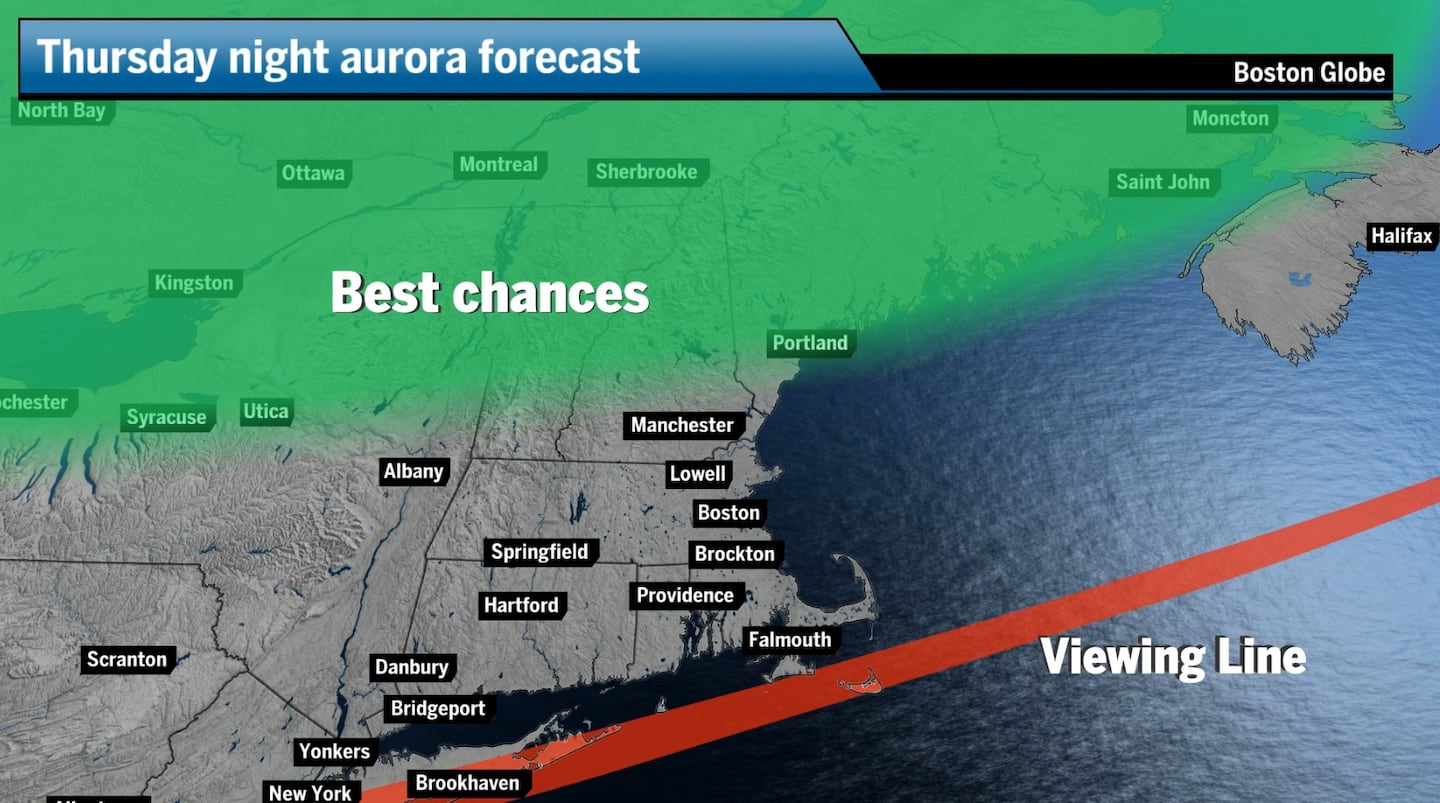
Experience the Northern Lights in New England Tonight
If you’re ready to embrace a sleepless night, step outside and gaze towards the north. The Northern Lights may be visible across New England due to an event known as a coronal mass ejection (CME). This occurrence, which involves a burst of magnetized solar particles traveling towards Earth, is expected to trigger a moderate geomagnetic storm tonight.
Geomagnetic Storm Forecast
According to the NOAA’s Space Weather Prediction Center, a level G2 geomagnetic storm is predicted from Thursday night into the early hours of Friday. Typically, such storms allow the northern lights to be seen as far south as Massachusetts, with some forecasts suggesting visibility extending to New Jersey.
The Nature of Coronal Mass Ejections
However, the prediction of a strong geomagnetic storm is inherently variable. The complexity of forecasting space weather from such a distance—between 91 to 93 million miles away—adds to the uncertainty.
“This CME is forecasted to be a glancing blow,” explained Vincent Ledvina, a space physics Ph.D. student known as the “Aurora Guy.” “The cloud is a partial halo aimed mostly north of Earth, so the models have its flank sweeping over us rather than its core, and a flank hit can underperform or miss us entirely.”
Optimal Viewing Conditions
This event represents one of the best opportunities in a while to witness the aurora borealis, as we are currently in the aftermath of Solar Maximum, a period of heightened solar activity.
Tonight’s weather conditions are favorable for viewing, with high pressure anticipated to keep skies generally clear. Additionally, the moon phase being close to new should minimize light interference.
When to Look for the Northern Lights
Forecasters predict that the prime time for capturing the aurora may be between 3:00 AM and 5:30 AM. Signs of increasing geomagnetic activity are expected to peak around dawn. However, it’s advised to check the skies starting from 11 PM to midnight for potential early activity.
Tips for Observing the Aurora Borealis
- Seek out dark areas away from city lights to enhance visibility.
- Be aware that while this event may not be extraordinary, viewing a faint glow on the northern horizon is still possible.
- Even if you don’t see much with the naked eye, use your smartphone to take photos, as they can capture wavelengths the human eye might miss.
Real-Time Tracking of the Aurora
You can monitor the status of the northern lights in real time through various apps or directly from NOAA’s Space Weather Prediction Center website. Key metrics to observe include:
- Bz (red): Indicates the orientation of Earth’s magnetic field.
- Bt (white): Shows the strength of the magnetic field.
- Solar Wind Speed (yellow): Monitored to predict geomagnetic activity.
A sharp increase in Bt intensity, a shift to a negative Bz orientation, and a rise in solar wind speed are indicative signs that it may be time to look skyward.
Future Implications for Aurora Viewing
As we move past Solar Maximum, the frequency of geomagnetic storms conducive to aurora viewing is expected to decline. This means that while the aurora will not completely vanish, opportunities for widespread displays may become less common over the next several years.
In summary, tonight presents a unique chance to witness the northern lights. Whether your experience is minimal or spectacular, setting an alarm could lead to a memorable evening.
