Close Menu
Newsward
  • World
  • US
    • Politics
  • Tech
    • Science/Tech
  • Money
    • Business and Market Watch
    • Crypto
    • Career
  • Health
    • Fitness
  • State of Women
  • Opinion
  • Sports
    • NFL
    • MLB

Subscribe to Updates

Get the latest creative news from FooBar about art, design and business.

What's Hot

GTA VI will be available on Xbox Cloud Gaming for Xbox One consoles

November 10, 2026

Astronomers Spot Backward-Orbiting Object Beyond Neptune

November 10, 2026

Congress live updates as GOP elects leaders, Hegseth faces impeachment vote

November 10, 2026
Newsward
  • World
  • US
    • Politics
  • Tech
    • Science/Tech
  • Money
    • Business and Market Watch
    • Crypto
    • Career
  • Health
    • Fitness
  • State of Women
  • Opinion
  • Sports
    • NFL
    • MLB
Subscribe
Newsward
Home » Physicists Gave Up on This Fusion Technique in the 1980s. Now It’s Working
Technology

Physicists Gave Up on This Fusion Technique in the 1980s. Now It’s Working

By November 10, 2026No Comments3 Mins Read
Facebook Twitter Pinterest LinkedIn Tumblr WhatsApp VKontakte Email
Physicists Gave Up on This Fusion Technique in the 1980s.
Share
Facebook Twitter LinkedIn Pinterest Email

Advancements in Fusion Energy: The Helicon Current Drive Experiment at DIII-D

Fusion energy has long been considered a key solution to sustainable energy needs, yet challenges persist in its practical application. Researchers are now revisiting older concepts with the help of modern technology, particularly at the DIII-D National Fusion Facility.

Helicon Current Drive: A Revived Concept

The helicon current drive, a method first proposed in the 1980s, has gained renewed attention following recent successful experimental tests. This technique employs high-frequency radio waves to energize the plasma within a fusion reactor, generating an internal electric current crucial for stabilizing the fusion process. The technique had previously remained unexplored due to limitations in technology and reactor capabilities.

Physicists Bob Pinsker, Jeff Lestz, and Bart Van Compernolle from General Atomics co-authored a paper detailing these findings, published in Physical Review Letters.

Enhancing Tokamak Operations

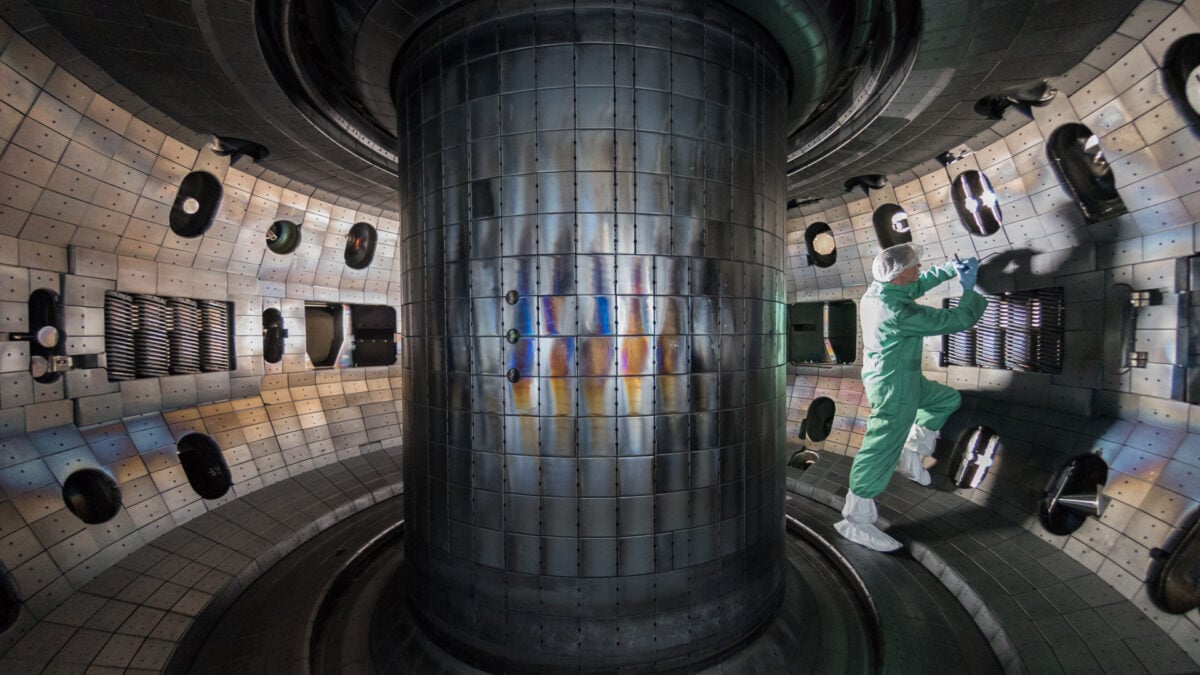
The tokamak, a doughnut-shaped apparatus, currently represents the leading design for fusion reactors. It employs magnetic fields to confine plasma for energy production. A combination of toroidal and solenoidal magnetic fields stabilizes and sustains plasma; however, this setup faces intrinsic limitations on operation duration or “pulse length.” As explained by Pinsker, the plasma current’s reliance on a transformer-like mechanism means that the system can only operate effectively for a limited time before needing to be reset. In practice, this limitation results in operational periods of approximately 10 seconds at DIII-D, while larger reactors may achieve 500 to 1,000 seconds.

To generate continuous, commercial-grade fusion reactions, alternative “non-inductive” methods for driving plasma current have been researched. The helicon current drive is one such technology that can enhance existing tokamak systems.

Historical Context of Helicon Waves

The underlying principle behind this current drive involves introducing radiofrequency energy that resonates with electrons in the plasma to produce an electric current. Prior attempts to implement this approach failed for three main reasons:

  • The plasma was not sufficiently reactor-like to absorb the helicon waves effectively.
  • The efficiency of wave-launching technology was inadequate.
  • Diagnostic methods to measure non-inductive currents were not sophisticated enough.

As remarked by Pinsker, those early efforts were overly optimistic, with hopes for unexpected breakthroughs. However, the absence of appropriate reactor conditions hindered practical testing.

Reviving the Theory

With significant advancements in technology, particularly regarding plasmatic conditions and measurement precision, researchers began a renewed focus on helicon waves as early as 2014. The DIII-D facility has since equipped a specialized “comb-line” antenna designed to launch helicon waves into high-temperature plasmas, substantially improving the ability to absorb these waves and generate current.

The specialized antenna used to launch helicon waves at DIII-D. © Lestz et al., 2026

Outcomes and Future Directions

The recent results from the DIII-D facility demonstrate effective heating of plasma due to helicon wave absorption, as confirmed by a rigorous statistical analysis to ensure accuracy in the measurements. However, Pinsker emphasizes that while the results are promising, there is still much work to be done. DIII-D’s experimental conditions do not fully replicate the reactor environments necessary for optimal helicon current drive performance.

Looking forward, increasing the power coupled to helicon waves in the plasma is identified as a vital avenue for further research. While the findings are significant, the path to practical and steady-state fusion power remains lengthy and complex. As Pinsker notes, progress in fusion technology is often gradual, reliant on careful validation and continual refinement.

As scientists continue to explore these promising developments, the hope is that such innovations will ultimately lead to the realization of a viable fusion energy source.

1980s Fusion gave Physicists Technique Working
Share. Facebook Twitter Pinterest LinkedIn Tumblr WhatsApp Email
Previous ArticleA Haitian 8-year-old was taken by ICE at routine check-in, rattling a San Diego school district
Next Article After meeting Qatar PM, Trump calls Iran war ‘effectively over’ militarily | US-Israel war on Iran News

Related Posts

GTA VI will be available on Xbox Cloud Gaming for Xbox One consoles

November 10, 2026

Khazalite Holds make their Battle Report debut

November 10, 2026

iPhone 20 Pro: Ten Big Changes That Could Redefine Apple’s Flagship

November 10, 2026

GTA 6 Is Now Available For Preload If You Have A Spare 212GB

November 10, 2026

Top Articles

AI translation sounds convincing, but it can be riddled with hidden errors

November 2, 2026

Drones Hit St. Petersburg Oil Terminals, VK Data Center, and Bridge

October 18, 2026

The Fight for the Future of Democratic Foreign Policy

November 3, 2026

Bitcoin Price Prediction for November 2026

November 2, 2026

Don't Miss

Technology

GTA VI will be available on Xbox Cloud Gaming for Xbox One consoles

By November 10, 20260

Grand Theft Auto VI Launching on Xbox Cloud Gaming Streaming Availability Rockstar Games has officially…

Astronomers Spot Backward-Orbiting Object Beyond Neptune

November 10, 2026

Congress live updates as GOP elects leaders, Hegseth faces impeachment vote

November 10, 2026

Over $10 billion in leveraged Bitcoin shorts stack up near $83K, raising squeeze risk — TradingView News

November 10, 2026

Subscribe to Updates

Subscribe to our newsletter and stay updated with the latest news and exclusive offers.

About Us
About Us

NEWSWARD is an independent news and media company covering the economy, politics, international affairs, and a changing world. Through articles, podcasts, video, and candid conversations, we connect major events to their impact on your life, your livelihood, and your future.

Our purpose is simple: help you understand what matters, think critically, and make informed decisions.

See what’s happening now. Know what’s next.

Don't Miss

GTA VI will be available on Xbox Cloud Gaming for Xbox One consoles

November 10, 2026

Astronomers Spot Backward-Orbiting Object Beyond Neptune

November 10, 2026

Congress live updates as GOP elects leaders, Hegseth faces impeachment vote

November 10, 2026
Most Viewed

AI translation sounds convincing, but it can be riddled with hidden errors

November 2, 2026

Drones Hit St. Petersburg Oil Terminals, VK Data Center, and Bridge

October 18, 2026

The Fight for the Future of Democratic Foreign Policy

November 3, 2026
  • About Us
  • Contact Us
  • Privacy Policy
  • Terms and Conditions
  • Disclaimer
© 2026 Newsward. All Rights Reserved.

Type above and press Enter to search. Press Esc to cancel.