


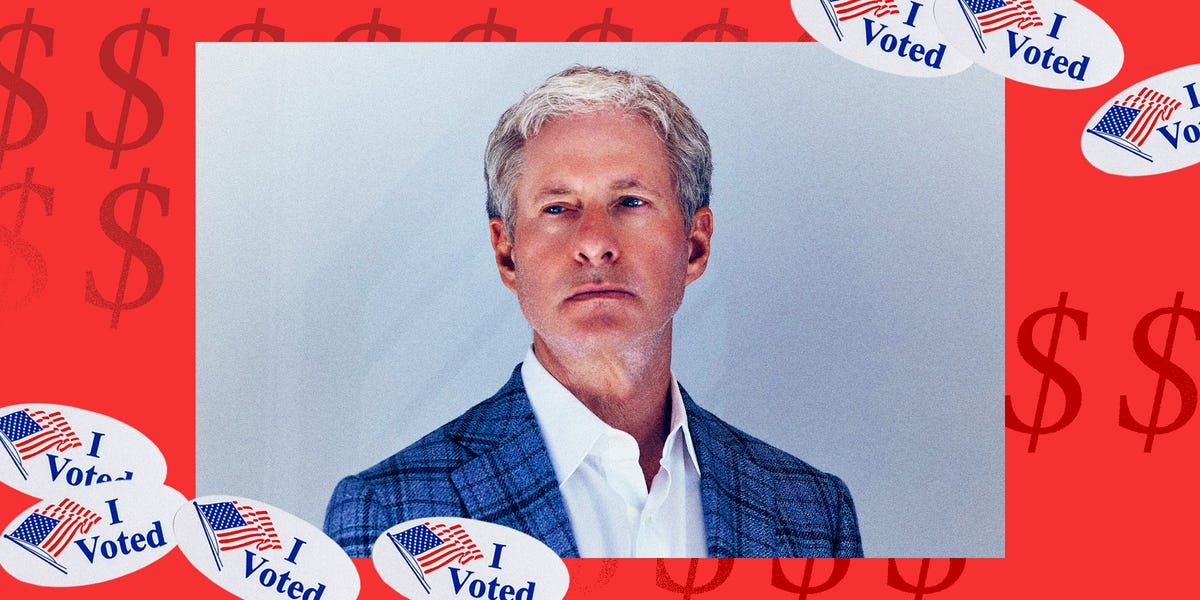
Chris Larsen: Ripple Co-Founder and Influential Political Donor
Chris Larsen, known for his role in founding the cryptocurrency company Ripple, has utilized his substantial wealth to become a significant political donor in the current election cycle. Despite his concerns over the excessive influence of money in politics, Larsen has contributed over $22.5 million to federal candidates and super PACs, focusing particularly on clean energy initiatives and artificial intelligence (AI) regulation.
The Financial Landscape of Political Donations
With an estimated net worth of $8.4 billion, Larsen is among the largest individual donors from the tech sector during this election. His philanthropic approach stands in contrast to many conservative tech leaders who dominate the financial landscape, such as Elon Musk and Marc Andreessen.
Larsen has publicly acknowledged the paradox of leveraging his wealth to influence the political arena. In a recent podcast with Kara Swisher, he referred to the Supreme Court’s Citizens United decision as a “huge mistake.” He emphasized the need to participate in the political process to counter the heavy financial backing from opposing parties.
“If you want to get involved in policy, you have to play that game,” Larsen stated, emphasizing that politics is not a “pillow fight.”
Larsen’s Political Advocacy
Having co-founded OpenCoin, which later became Ripple in 2012, Larsen envisions leveraging blockchain technology to enhance global payment systems. Although he stepped down as CEO in 2016, he continues to serve as the executive chairman. Recently, Ripple was valued at approximately $50 billion following a stock buyback.
In a notable political move, Larsen declared a $10 million XRP donation toward Kamala Harris’s presidential campaign for 2024. He characterizes himself not strictly as a centrist but rather as a supporter of “problem solvers”—candidates dedicated to addressing practical issues like housing, energy rates, and educational expenses.
“We need to be there all the time and backing people that are going to solve the basic problems in California,” he noted, criticizing business leaders for their infrequent engagement in Sacramento for issues outside their own interests.
Climate Advocacy and AI Regulation Efforts
Larsen believes that climate change should not be viewed as a partisan issue, encouraging advocates for clean energy to promote it with a focus on economic benefits and affordability. “We’ve got to reach out across to our Republican friends and stop vilifying them,” he remarked, advocating for a broader coalition.
Earlier this year, he contributed $6 million to the Tomorrow Coalition PAC, a super PAC advocating for renewable energy. His engagement has also extended into the realm of AI regulation amidst concerns over AI companies influencing political decisions on restrictions.
“There is an AI arms race that’s completely out of control,” he stated, expressing his concern that the industry lacks proper regulatory oversight.
Given the potential dangers of AI, Larsen has called for halting new developments until comprehensive regulations are established. He specifically highlighted the risks posed to jobs, youth, and overall public safety, urging for immediate action by governments.
The Challenge of Political Influence
Despite his substantial financial contributions, Larsen has faced challenges in his political endeavors due to opposition funding. Notably, he contributed over $4 million to support Assemblymember Alex Bores’ campaign, aimed at furthering AI safety legislation. Unfortunately, Bores lost his race amidst significant spending from opponents.
“Unfortunately, some folks in the AI industry are really trying to make an example of Alex for daring to come up with reasonable guardrails to the arms race that we’re all unfortunately in right now,” Larsen commented.
Reflecting on his experiences, Larsen acknowledged that “money doesn’t always buy results when you have that much opposition.”
