


Euclid Telescope Discovers Most Distant Quasar, Providing Insights into Early Universe
Significant Discovery by the ESA
The European Space Agency’s Euclid telescope has made a groundbreaking discovery by identifying the most distant known quasar, formed just 630 million years after the Big Bang. This finding significantly contributes to our understanding of the universe’s early history, which spans approximately 13.8 billion years.
Understanding Quasars
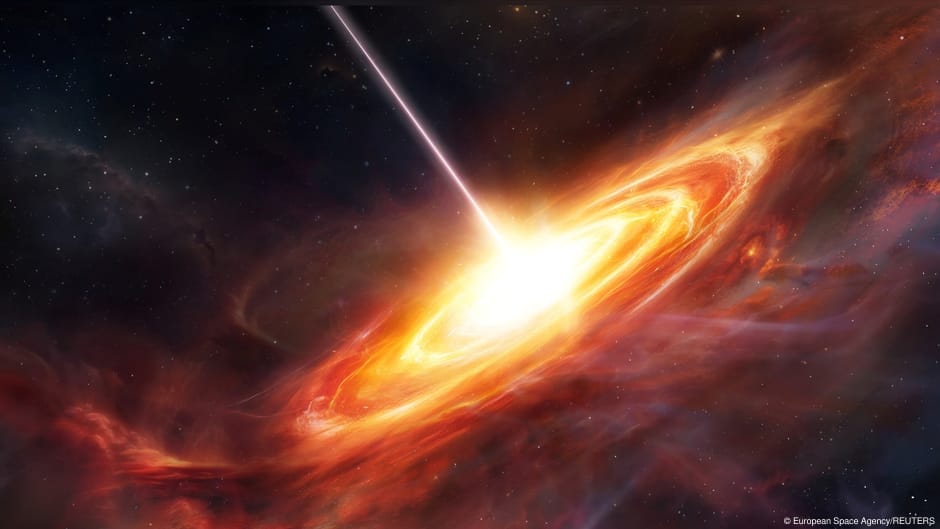
A quasar is an incredibly bright and energetic core of an active galaxy, where gas spirals into a supermassive black hole. This process creates a swirling accretion disk that heats up and emits vast amounts of energy. According to Silvia Belladitta, an astronomer from the Max Planck Institute for Astronomy, “As enormous amounts of gas, dust and matter fall toward the black hole, they form a swirling accretion disk that heats up to extreme temperatures and radiates tremendous amounts of energy.”
The Quasar’s Characteristics
The newly identified quasar, designated J1504+6252 and nicknamed Dún Aonghas, is observed as it existed roughly 13.1 billion years ago, making it one of the earliest structures in the universe. Astronomer Julien Wolf from the European Southern Observatory remarked, “I think it adds to the evidence that some objects in the early universe developed remarkably quickly. Just 630 million years after the Big Bang, this black hole had already grown to about 360 million times the mass of the sun and was shining as a quasar.”
Implications for Black Hole Research
This discovery strengthens the hypothesis that supermassive black holes can form rapidly through the direct collapse of large gas clouds, followed by the accumulation of additional matter. The findings challenge previous notions of black hole growth and indicate that they can achieve significant mass much earlier than previously thought.
Technological Innovations in Astronomy
Euclid’s observations were made possible through advanced imaging, combining data from both ground-based and space-based telescopes. The ESA’s Euclid mission aims to unravel the mysteries surrounding dark matter and dark energy, critical components influencing the universe’s structure and expansion.
