


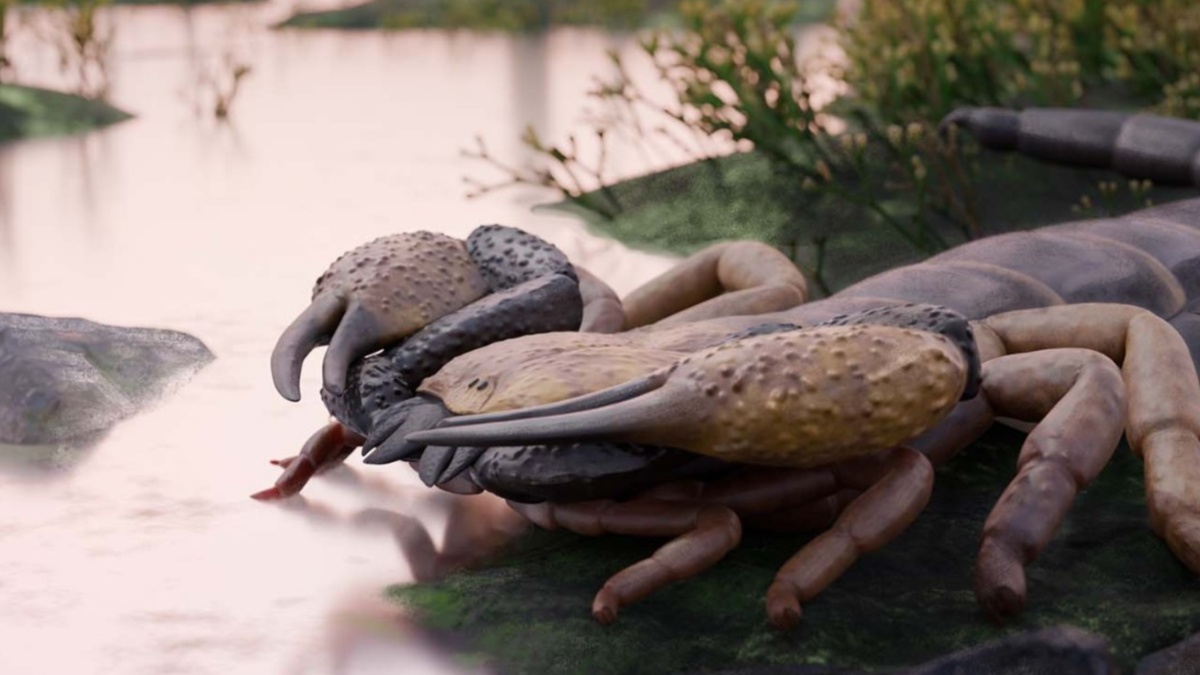
The Giant Scorpion That Roamed Earth Before Dinosaurs
Long before mammals, birds, and reptiles made their marks on land, a formidable predator stalked the ancient floodplains: not a dinosaur, but an enormous scorpion.
Praearcturus gigas: The Largest Scorpion Known to Date
Known as Praearcturus gigas, this scorpion is believed to be the largest of its kind to have existed. Fossil evidence dating back approximately 415 million years was first documented in the 1870s, yet the specifics surrounding this creature have generated debate among scientists for decades.
Recent research published in the journal Palaeontology has brought clarity to its classification. Through advanced CT scans and traditional drawing techniques, researchers have concluded that this impressive arachnid had pincers measuring 16 centimeters (about 6.3 inches) long, surpassing the overall length of many modern scorpions.
“This species might have grown so big because there weren’t any other large predators, allowing it to dominate its environment,” said paleontologist Richie Howard.
Physical Characteristics and Behavior
Estimates suggest that P. gigas reached lengths exceeding one meter (approximately 3.3 feet), comparable to the size of a medium-sized dog. This anatomical size disparity indicates that it filled a significant ecological role in the early land environments.
Lead researcher Richie Howard notes, “Praearcturus lived when life on land was just starting out, and the ancestors of reptiles, mammals, and birds were yet to leave the water.” This suggests that the absence of large competitors enabled this species to flourish.
The paleontologists also uncovered unique ridge patterns on its limbs, indicating that P. gigas may have engaged in stridulation—an act of producing sound by rubbing parts of its body together—similar to some modern scorpions.
Habitat and Adaptation
While the ecosystem was still developing on land, P. gigas likely adapted by exploiting both terrestrial and aquatic environments to enhance its hunting strategies.
Fossils from Wales reveal epimera—flap-like structures on its body—that align with characteristics found in contemporary lobsters and crabs. This feature further emphasizes the adaptations that P. gigas had to thrive in multiple environments.
The Extinction of the Giant Scorpion
Despite its reign, P. gigas eventually faced extinction, likely due to increasing competition for resources as ecosystems evolved. Researchers hypothesize that it might have survived for another 40 million years following the fossil record discovered, which provides insights into its eventual decline.
In later geological periods, land fauna expanded, introducing formidable competitors like massive millipedes and large dragonflies that appeared in forests yet to evolve during the time of P. gigas.
Understanding Evolutionary History
A pivotal question in evolutionary biology remains: how did such air-breathing creatures transition back to aquatic habitats? Greg Edgecombe, a paleontologist at the Natural History Museum, explains, “Our best family trees from DNA sequences suggest that scorpions are closely related to other arachnids like spiders, which share book lungs.” This implies a lineage that once thrived on land may have returned to water, with P. gigas serving as a case study in this intriguing evolutionary dynamic.
