


New Linux Kernel Vulnerabilities Unveiled
In a surprising turn of events, multiple Linux kernel vulnerability reports have been disclosed on the public Linux kernel mailing list (LKML) instead of the standard private security mailing list. This incident, seemingly unintentional, caught the attention of Linux developers and security professionals alike, with notable responses coming from Greg Kroah-Hartman, Linux’s second-in-command.
Overview of the Vulnerabilities
The vulnerabilities range in severity, with Common Vulnerability Scoring System (CVSS) scores reaching as high as 9.0, indicating significant security risks. Some of these vulnerabilities are already receiving attention, with active patch development underway in various branches. Key vulnerabilities identified include:
- ZDI-CAN-33549: This vulnerability pertains to SMB Direct, identified as a remote code execution flaw resulting from an integer underflow. A patch is anticipated to be prioritized for inclusion in the upcoming Linux version 7.5.
- ZDI-CAN-33774: This vulnerability involves a race condition in KSMBD, also rated at CVSS 9.0, which poses a risk of remote code execution.
- ZDI-CAN-33367: Affects the skbuff skb_zerocopy function within the network module. This flaw could lead to local privilege escalation and has recently been reported through another channel as well, with a patch expected shortly.
- ZDI-CAN-34068: Concerns an out-of-bounds write in the VMware graphics driver (VMWGFX) resulting in local privilege escalation.
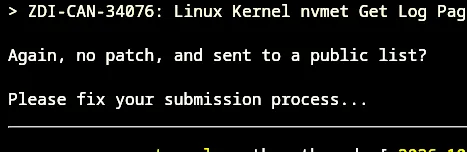
- ZDI-CAN-34076: An uninitialized resource in the NVMET code leading to potential information disclosure.
- ZDI-CAN-32005: A buffer overflow vulnerability in the TCP query stack for search domains, which could facilitate local privilege escalation.
Community Response and Next Steps
The public sharing of these vulnerabilities has sparked concern among developers and users due to the potential implications for system security. As ongoing discussions take place on how best to address these issues, developers are actively working on patches. The urgency to integrate these changes into the mainline kernel grows, particularly given the extensive implications these vulnerabilities could have in an increasingly AI-driven environment.
As the situation evolves, it remains critical for users and administrators to stay informed and apply updates as they become available to mitigate these newly identified risks effectively.
