


Magnetic Tunnel Junctions: Advancements in Magnetoresistance and Spintronics
The field of spintronics has witnessed significant progress in recent decades, driven by innovations related to magnetic tunnel junctions (MTJs). This article delves into the evolution and importance of MTJs, particularly highlighting breakthroughs in magnetoresistance.
Understanding Magnetic Tunnel Junctions
Magnetic tunnel junctions consist of two ferromagnetic layers separated by a thin insulating barrier, typically an oxide. The conductance of the junction is highly spin-dependent, allowing for varied electrical resistance based on the relative orientations of the magnetizations of the ferromagnetic layers.
The fundamental principle behind MTJs is the tunneling magnetoresistance (TMR) effect, which indicates a variation in electrical resistance depending on the alignment of the magnetizations. A notable discovery was made by Moodera et al., who identified significant room-temperature magnetoresistance in ferromagnetic thin film tunnel junctions, setting the stage for future research in this area.
Significant Contributions to the Field
- Miyazaki and Tezuka (1995): Demonstrated the giant magnetic tunneling effect in Fe/Al2O3/Fe structures, further establishing the practical applications of MTJs in spintronics.
- Parkin et al. (2004): Reported giant tunneling magnetoresistance at room temperature using MgO as a barrier material, which had a profound impact on the development of spintronic devices.
- Yuasa et al. (2004): Achieved remarkable room-temperature magnetoresistance in single-crystal Fe/MgO/Fe junctions, contributing to both theoretical and practical advancements in the field.
- Tsymbal et al. (2003): Worked on the principles of spin-dependent tunneling, providing essential insights into the operational mechanics of MTJs.
Recent Advances and Research Directions
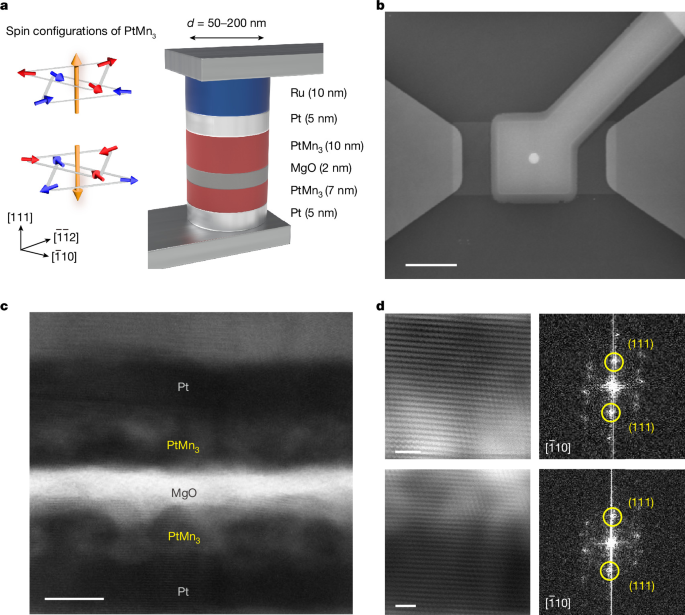
The exploration of antiferromagnetic materials represents the latest frontier in spintronics. Research published in recent years has demonstrated promising results in magnetoresistance and spin transport using antiferromagnetic tunnel junctions, which may surpass the capabilities of their ferromagnetic counterparts. Notable publications include:
- Qin et al. (2023): Investigated room-temperature magnetoresistance in all-antiferromagnetic tunnel junctions.
- Chen et al. (2023): Explored octupole-driven magnetoresistance in antiferromagnetic tunnel junctions, highlighting the multifaceted nature of magneto-transport phenomena.
- Shi et al. (2024): Reported on electrically controlled all-antiferromagnetic tunnel junctions, marking a significant step toward advanced spintronic applications.
Implications for Future Technologies
The advancements in magnetic tunnel junction technology have vast implications for various sectors, including data storage, memory systems, and beyond. As the field of spintronics evolves, the integration of novel materials and junction designs will likely lead to devices with enhanced performance, lower energy consumption, and new functionalities. Exploring antiferromagnetic systems further exemplifies the innovation possibilities that lie ahead in the realm of spintronics.
