


Ethical Approval and Methodologies in Human Coronary Artery Research
Ethical Approval for Human Specimens
The research conducted adheres to all pertinent ethical regulations and has received approval from the Washington University School of Medicine Institutional Review Board (IRB No. 201104172). Informed consent was strictly secured from each participant prior to tissue collection, with no monetary compensation offered. Participants also consented to the publication of the research findings. All demographic details have been anonymized and are outlined in Supplementary Table 1. This study aimed to include participants of diverse races, ages, and sexes to ensure a comprehensive trans-ethnic population sample.
Inclusion Criteria
Prior to tissue collection, specific criteria were established to ensure well-defined study groups. Patients with human immunodeficiency virus (HIV), hepatitis, or known genetic cardiomyopathies were excluded. The left anterior descending coronary artery was obtained from donor hearts—those with stable ejection fractions who died from non-cardiac causes—and from patients suffering from chronic heart failure (both ischemic and non-ischemic cardiomyopathy) at the time of heart transplantation. All specimens were taken from the proximal left anterior descending artery. The selection of participants was dependent on the availability of donor and transplantation tissues, in addition to clinical indications, which may affect the broader applicability of results to the general coronary artery disease (CAD) population.
Nuclei Isolation for Multi-Omics Sequencing
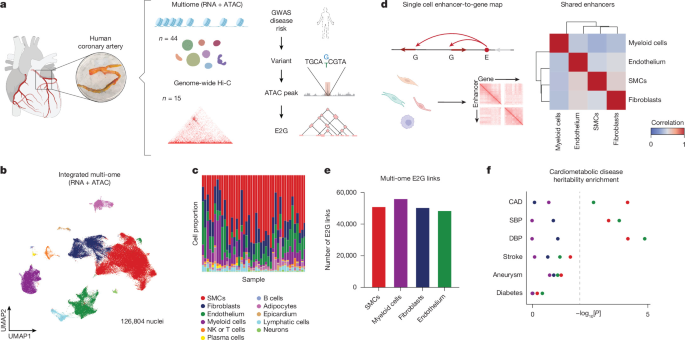
Extracted coronary arteries were carefully processed; epicardial fat was removed, and the arteries were flash-frozen in liquid nitrogen. Consistent regions from the proximal left anterior descending artery were analyzed across all patient samples. Following established protocols, single-nuclei suspensions were prepared and nuclei were isolated using the 10x Genomics protocol, incorporating flow cytometry for 7-AAD positive nuclei for sorting using a BD FACS Melody. The Chromium Next GEM Single Cell Multi-ome ATAC + Gene Expression protocol was employed for subsequent analyses. Gene expression and ATAC libraries were sequenced using a NovaSeq 6000 platform, with specific read depths assigned for each library.
Multi-Omics Data Processing
Raw fastq files were aligned to the human GRCh38 genome reference using CellRanger ARC, with ATAC data processed in ArchR and RNA data analyzed through Seurat. Following quality control, doublet removal, normalization, integration, and clustering, RNA-based cell-type annotations were transferred to the corresponding ATAC profiles. Detailed quality thresholds and clustering methodologies are presented in Supplementary Figure 1.
scE2G Model Predictions
The scE2GMulti-ome model was used to establish enhancer-gene connections across 11 distinct cell types, utilizing multi-ome data from 10x Genomics. In each cell type, candidate element-gene pair scores were calculated, specifically focusing on elements that are ATAC peaks situated within 5 Mb of gene transcription start sites. Regulatory interactions were recorded when scores exceeded the threshold of 0.171, determined to yield 70% recall in evaluative predictions.
Genotyping and Analysis
A high-quality genetic analysis was conducted on DNA obtained from 39 participants, employing the Illumina GSA-24-V3 SNP array. Following initial processing, stringent criteria based on minor allele frequency and call rates ensured robust variant selection for further analyses, culminating in a final dataset comprising over 7 million variants. This data underwent combined analysis with previously published datasets, leading to the identification of local ancestries and significant QTL analyses.
Hi-C Processing and Analysis
High-throughput in situ Hi-C libraries were constructed from 15 coronary artery samples within a multi-ethnic cohort. Utilizing specific restriction enzyme motifs, processed reads were subjected to quality assessment, normalization, and subsequent analysis at a 5-kb resolution to derive chromatin structure insights in conjunction with noted GWAS variants.
