


A Remarkable Discovery Challenges the Status of Westlothiana Fossil
Introduction to Westlothiana
The fossil of Westlothiana lizziae, unearthed in 1984 in Scotland, has long been considered among the earliest reptiles in evolutionary history. However, a groundbreaking study published in Nature led by scientists from the American Museum of Natural History and the University of Oxford reveals a strikingly different reality about this ancient creature.
In-Depth Analysis of the Fossil
This 345-million-year-old specimen, affectionately known as “Lizzie” due to its lizard-like appearance, comprises a nearly complete skeleton housed within two flattened rock slabs. Initial evaluations identified key anatomical features such as four limbs, each with finger-like projections resembling claws. These distinctions were crucial, as they set Westlothiana apart from contemporary animals whose limbs were more fin-like.
Reassessing Lizzie’s Identity
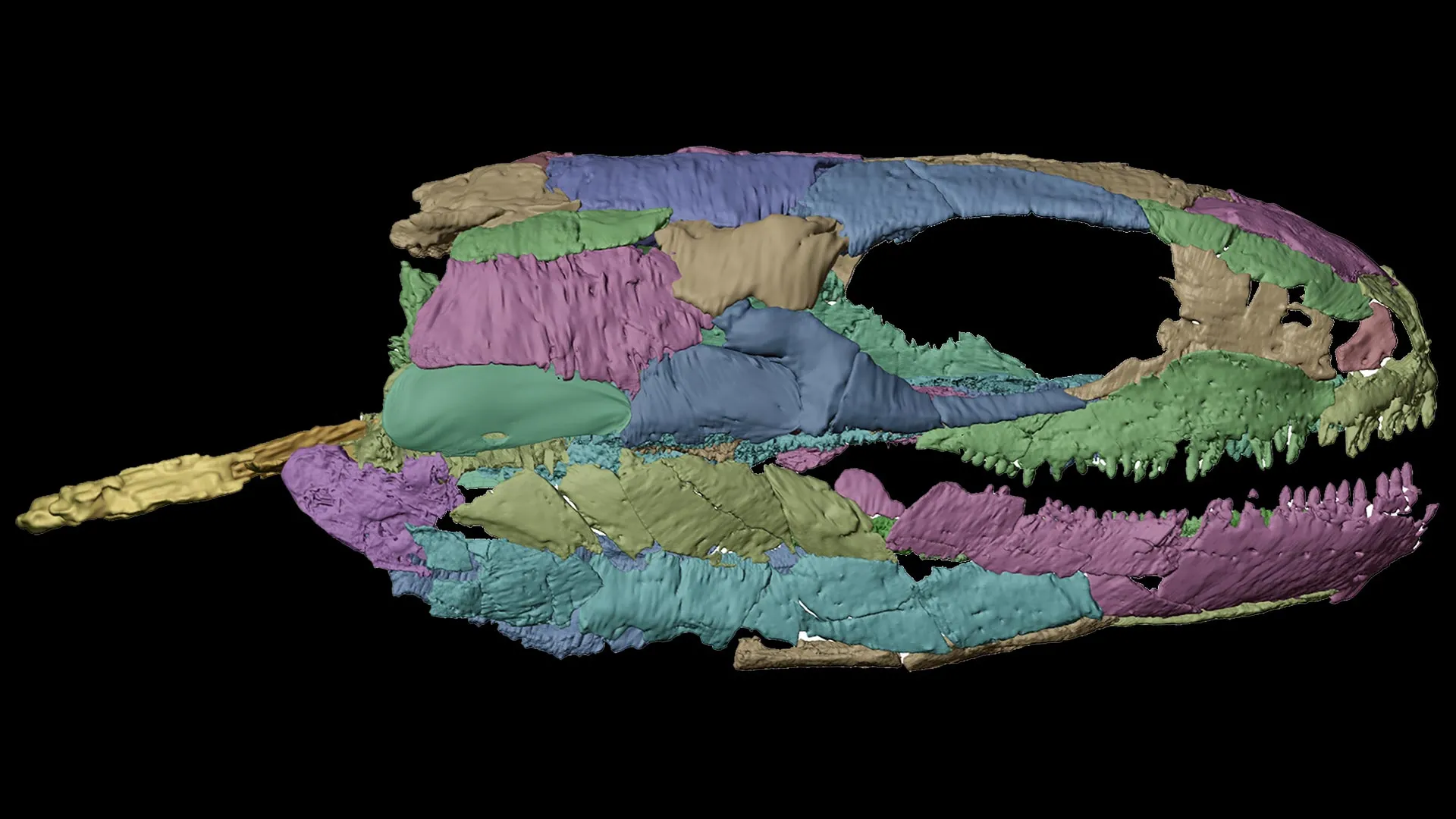
For decades, this fossil was celebrated as a milestone in the evolution of amniotes—vertebrates that adapted to terrestrial environments, including reptiles, birds, and mammals. However, advanced X-ray imaging techniques at the European Synchrotron Radiation Facility allowed researchers to investigate the fossil’s inner structures. What they uncovered contradicted previous assumptions: Lizzie possessed a primitive skull and features akin to those of fish, including internal gills and numerous tiny teeth.
“Lizzie has been an icon for the early evolution of amniotes for decades,” commented Xavier Jenkins, a postdoctoral fellow and co-lead author of the study. “But when we were finally able to see inside the fossil, we found an animal that looked very different from what we expected.”
New Insights into Evolutionary Lineage
This new information positions Westlothiana within a more ancient lineage rather than the previously assumed reptilian lineage. The findings suggest that this creature was likely an aquatic or semi-aquatic animal rather than predominantly terrestrial.
“The surprisingly primitive features of the skull show us that Lizzie was not only not a reptile but belonged to a much more ancient lineage,” explained Ben Igielman, co-lead author of the study.
Implications for Evolutionary Biology
This study also prompts a reevaluation of various anatomical traits traditionally associated with terrestrial vertebrates. The research indicates that characteristics such as claws and distinctive toe arrangements were present in earlier aquatic ancestors of tetrapods, which include both amphibians and amniotes.
“This is a big surprise,” remarked Roger Benson, the Museum’s Macaulay Curator of Paleontology. “It shows that, although we think of amphibians as being more ‘primitive’ than reptiles today, some of the traits of reptiles were already there in the ancestor of both amphibians and reptiles.”
Reevaluating Prehistoric Trackways
The research findings could also affect interpretations of ancient footprints. Recent trackways attributed to amniotes may need reassessment if earlier tetrapod relatives like Westlothiana were capable of leaving clawed traces. Consequently, these trackways may not exclusively indicate the presence of amniotes, but rather of more primitive amphibious species.
As Jenkins summarized, “The broader lesson is that terrestrial-looking traits… were not unique features of tetrapods, but rather accumulated piecemeal in their close relatives, in animals that were still living in and out of the water.”
