


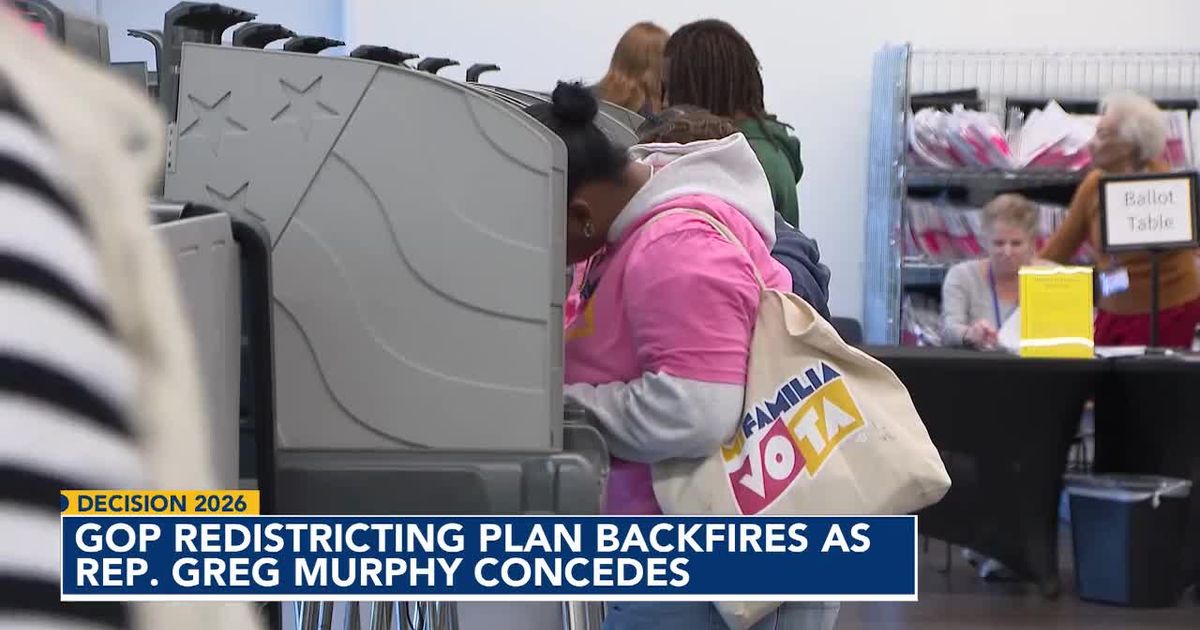
Greg Murphy Concedes Defeat in North Carolina’s 3rd Congressional District Election
In a significant shift for North Carolina’s political landscape, U.S. Representative Greg Murphy has conceded his seat in the 3rd Congressional District to challenger Raymond Smith. Announced on Wednesday, Murphy’s concession marks another victory for North Carolina Democrats, who have successfully unseated multiple Republican incumbents during the midterm elections.
Election Overview and Results
Prior to Election Day, Republicans held 10 out of North Carolina’s 14 congressional districts. However, Democrats have managed to flip at least six of these seats, while also retaining the four they previously held. Currently, two congressional races remain unresolved and may require recounts.
During the final vote count, provisional ballots were reviewed, revealing that Smith had approximately 300 more votes than Murphy across the district, which spans from Fayetteville to the coastal areas including Wilson, Kinston, Greenville, and Jacksonville. In a statement on Wednesday morning, Murphy formally acknowledged his defeat.
Statement from Greg Murphy
“I want to congratulate Representative-Elect Raymond Smith on his successful election for the Third District Congressional seat,” Murphy remarked. “I am sure he will serve the next two years with honor and integrity. I would be remiss if I did not express personal disappointment in not being able to continue what I believe was good and diligent work on behalf of the people of eastern North Carolina.”
Raymond Smith’s Vision and Priorities
Raymond Smith learned of his victory while en route to Washington, D.C., for freshman orientation. Expressing his excitement, he shared with WRAL that there is an uplifting atmosphere around the Capitol. “There’s an air of excitement. There’s an air of anticipation. There’s an air of enthusiasm. For me, it’s always been about the work, though,” he noted.
Smith aims to tackle numerous pressing issues, drawing on his experience as a state legislator and school board member. He highlighted key concerns such as:
- The rising cost of living
- The affordability of gas
- The ongoing military conflicts
- Lack of access to healthcare for uninsured constituents
“There are a veritable plethora of things that need to be done. All of them are a priority,” Smith emphasized.
The Impact of Redistricting
The elections served as a setback for Republican redistricting efforts intended to consolidate their political power. In recent cycles, they attempted to fortify their hold on congressional seats through strategic map redraws. This strategy backfired when Democratic Rep. Don Davis retained his position despite the adjusted district configurations designed to favor Republicans.
The redistricting notably altered the demographics of Murphy’s district, making it more competitive. Smith and Davis, both African American, argued that these efforts attempted to dilute the Black vote.
“It was clearly an attempt to dilute the Black vote. Full stop,” Smith asserted.
Potential Future Races
As the North Carolina election landscape continues to evolve, there are indications that additional Democratic victories could occur. Tensions remain in the race for the 5th Congressional District, where Republican Virginia Foxx trails Democrat Chuck Hubbard by approximately 330 votes, suggesting a possible recount ahead.
This election cycle may lead to a significant shift in North Carolina’s congressional representation, potentially adjusting the current Republican majority of 10-4 to a more balanced 10-4 or even an 11-3 Democratic advantage, depending on future outcomes.
Overall Republican Challenges
Numerous other Republican incumbents faced defeat this election season including:
- Brad Kott, who lost to Paul Barringer in the 13th Congressional District.
- Richard Hudson, who fell to Richard Ojeda in the 7th District.
- Tim Moore, who was unseated by LaKesha Womack in the 14th District.
- Addison McDowell, defeated by Cyril Jefferson in the 6th District.
- Chuck Edwards, who lost to Jamie Ager in the 11th District.
Looking Ahead
Though early forecasts by the National Republican Congressional Committee suggested that Democrats would struggle to flip many seats, the election results demonstrated a clear shift in voter sentiment. As Smith prepares for his new role in Congress, he expresses a commitment to advocating for healthcare equity and reinforcing voting rights prior to the 2028 elections.
“One of the things that we definitely need to focus on, prior to the 2028 election, is making sure that voting rights are solidified and codified in the Constitution,” he stated.
As the dust settles from this election cycle, both parties will assess strategies and focus areas leading into future races.
