


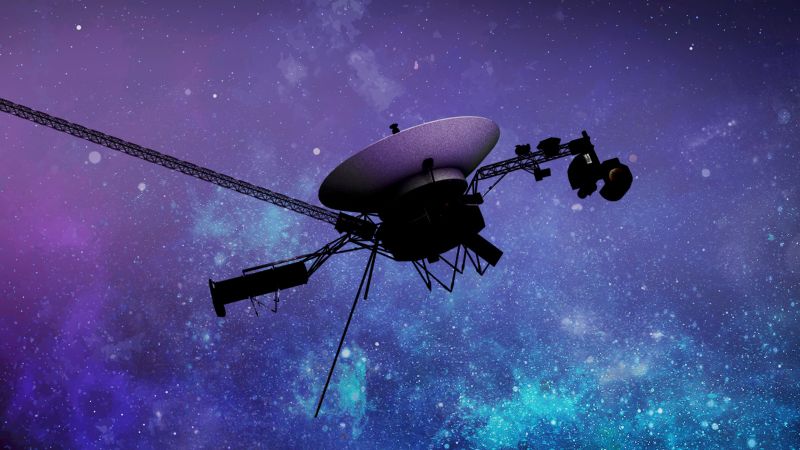
Voyager 1 Experiences Communication Breakdown Ahead of Historic Milestone
A Milestone Delay
NASA’s iconic Voyager 1 spacecraft, nearing a monumental milestone in its journey through space, has encountered another setback. Just days before it was poised to become the first human-made object to travel one light-day from Earth, communication with the spacecraft ceased, leaving experts at NASA concerned.
Current Status of Voyager 1
As of November 14, the deep-space probe is only transmitting an empty “carrier signal,” a continuous radio signal that is typically accompanied by valuable scientific and engineering data. This breakdown in data transmission raises alarm bells regarding the status of the nearly 49-year-old spacecraft, which launched from Florida in September 1977.
Despite the lack of data, engineers determined that Voyager 1 has indeed reached the light-day distance, approximately 16 billion miles (26 billion kilometers), using trajectory calculations alongside the received carrier signal.
Understanding the Problem
NAVIGATIONAL systems seem to be functioning as Voyager 1 maintains its antenna pointed towards Earth. However, the loss of data suggests an issue may exist with the onboard computer designated for collecting and transmitting scientific information. Of the ten instruments onboard, only two are still operational; the rest have been deactivated to conserve power.
The Voyager 1 team at NASA is actively working to diagnose the issue, but the immense distance poses a significant challenge. Commands sent to the spacecraft require 24 hours to arrive, with another full day needed for responses to be received back on Earth.
Pervasive Issues
This recent communication failure mirrors a similar incident from three years prior when Voyager 1 again halted scientific data transmission on the same date. At that time, a problem was traced to the flight data subsystem (FDS), a critical component of the spacecraft’s computing system.
Engineers focused on a malfunctioning chip within the FDS that was bypassed to prevent further issues. Unfortunately, this workaround resulted in a memory shortfall for the remaining operational chips, complicating the programming further.
Although NASA has yet to confirm that the FDS is the current source of problems, there is reason to suspect a potential connection.
Future Prospects
Voyager 1, along with its twin Voyager 2, was initially designed for a five-year mission to explore the outer planets. Remarkably, its mission has extended well over a decade longer than anticipated. Nevertheless, predictions about how much longer Voyager 1 can operate remain uncertain. Current estimates suggest it could last for another three to five years, a timeline that continues to be adjusted as engineers find innovative methods to prolong its lifespan.
In late October, Voyager 1 had a complete communication blackout lasting two days—a situation that was ultimately resolved but underscored the age and fragility of the probe. NASA is investigating whether this incident is related to the present data challenge.
A Legacy of Exploration
Since its launch, Voyager 1 has achieved remarkable scientific milestones and has transitioned into interstellar space, having left the protective heliosphere in 2012. The ongoing data it transmits continues to enrich our understanding of the cosmos far beyond its original mission parameters.
