


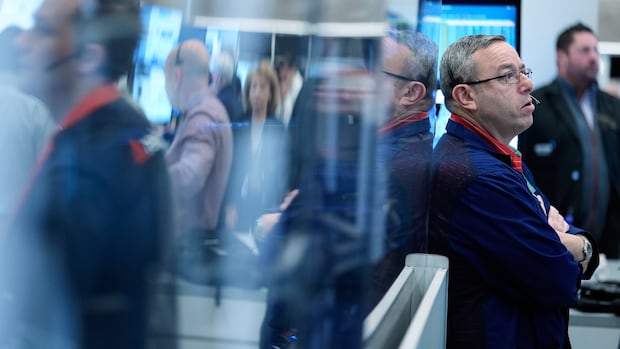
Wall Street Recovery Amid AI Stocks Pullback and Trade War Concerns
U.S. stock markets demonstrated a notable recovery after initially experiencing significant losses, particularly as fears surrounding artificial intelligence (AI) stocks began to ease. The S&P 500 index decreased by 0.3%, having previously been down as much as 3.2% earlier in the trading session. Conversely, the Dow Jones Industrial Average gained 164 points, translating to a 0.3% increase, while the Nasdaq composite index fell by 0.6%.
Canadian Markets Show Resilience
In Canada, the S&P/TSX composite index closed up by 217 points, representing a 0.64% increase, marking a contrast to the challenges faced by U.S. markets.
Factors Influencing Market Fluctuations
The market’s recovery occurred amidst rising concerns about persistent inflation, further exacerbated by U.S. President Donald Trump’s announcement of new tariffs aimed at foreign trading partners. Greg Taylor, a portfolio manager at PenderFund Capital Management, stated, “The trade wars aren’t over yet,” highlighting a sense of uncertainty regarding trade relations.
Despite earlier indications that Trump might ease trade tensions, the latest proposal for tariffs against China and several other nations has reignited worries about inflation and consumer strain, with Taylor emphasizing the potential impact on consumer costs.
The Tech Sector’s Impact
The notable retreat in AI stocks, continuing after a previous rally following the reinstatement of Jensen Huang as CEO of Nvidia, contributed to the overall market dynamic. Nvidia shares, which earlier plummeted by over 9%, concluded the day with a 3.9% loss. Other major tech players such as Broadcom, which saw a decline of over 6%, ended marginally lower by 0.1%. Microsoft also displayed some recovery, closing down 1.2% after initially dipping over 3%.
Gains Among Financial Services
Positive contributions from the financial services sector helped mitigate losses, with Visa rising 1.8%, Mastercard by 1.9%, and American Express gaining 1.2%. Notably, after an initial downturn, Anthropic was able to achieve a 1.1% increase, though its shares have since seen a decline of 28% since peaking at $115 on its public debut.
Broader Market Trends
While approximately three-quarters of S&P 500 stocks rose, the tech sector’s performance, especially among AI-focused companies, influenced the index negatively. The S&P 500 index is currently down 5.2% for the month of November following declines in previous months.
Future Outlook Amid Rising Inflation
Chris Zaccarelli, chief investment officer for Northlight Asset Management, noted the challenges ahead, suggesting, “At this point, between the AI angst and the newly announced tariffs, it doesn’t look like the Santa Claus Rally is in store for us this year.” This pessimistic outlook is further fueled by concerns over Nvidia’s corporate governance and the broader AI sector as it struggles with profitability justifications in the face of inflated stock values.
Inflation and its Economic Ramifications
Inflation continues to pose a challenge, with recent data revealing a 3.8% increase in October compared to the previous year, following a 3.6% rate in September. This is concerning for policymakers as high inflation may lead the Federal Reserve to raise benchmark interest rates during its forthcoming December meeting, moving away from their target of 2%.
Resilient Economy Amidst Challenges
Despite rising inflation, the economy exhibits resilience, with the latest growth figures for the July-September quarter revised upwards to a 4.3% annual rate—the fastest growth in three years. However, this expansion has been heavily influenced by increased spending on AI infrastructure by large tech companies, with signs indicating that lower-income households are increasingly reliant on credit to maintain their spending levels.
Oil Prices and Global Tensions
Heightened oil prices, largely attributed to tensions in the Middle East, have contributed to inflationary pressures, with Brent crude oil prices reaching $94.61 after a 3.5% increase. Meanwhile, U.S. Treasury yields fell, with the yield on the 10-year Treasury note dropping to 4.87% from 4.91%.
Conclusion
The intricate interplay of stock market performance, inflation concerns, and ongoing trade conflicts underscores a complex economic landscape as investors navigate these challenges while seeking stability in their investment strategies.
