


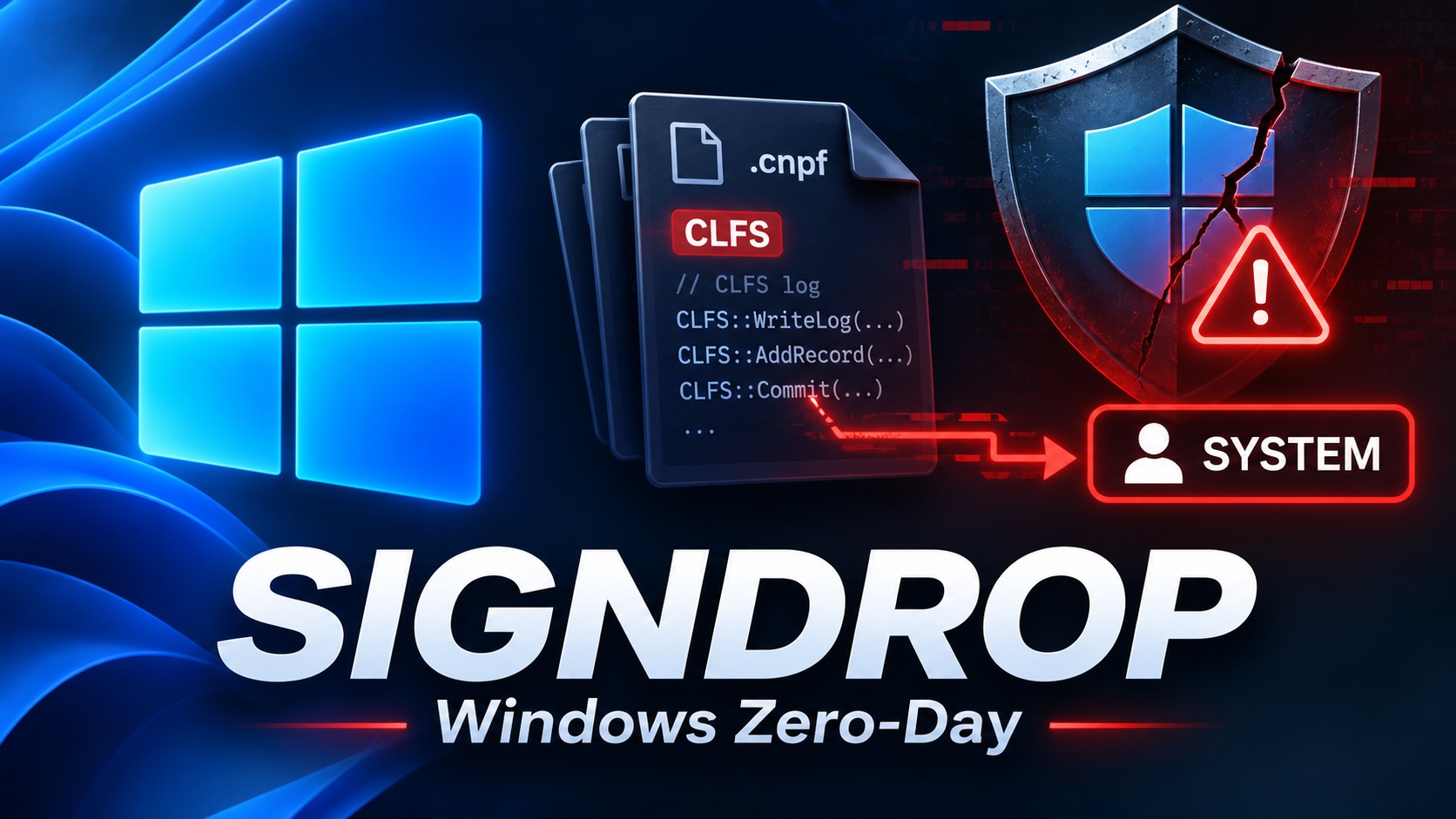
New Windows Zero-Day Vulnerability: SignDrop Exploit Uncovered
Recent findings have revealed a critical zero-day vulnerability in Windows, known as SignDrop. This security flaw enables attackers with standard user permissions to elevate their privileges to SYSTEM level, thereby circumventing built-in protective measures that Microsoft had implemented to thwart such exploits.
Details of the SignDrop Vulnerability
Security researcher Abdelhamid Naceri, widely recognized online as Nightmare Eclipse, published a proof-of-concept (PoC) for the SignDrop exploit on GitHub on November 10, 2026. The vulnerability specifically affects Microsoft’s Common Log File System (CLFS) driver, a component responsible for logging operations across various Windows applications and services.
Mechanics of the Exploit
The vulnerability exploits a flaw introduced during the enhancement of CLFS authentication mechanisms in October 2025, which aimed to bolster security through cryptographic authentication codes. Naceri discovered that this authentication framework could be manipulated to create files that grant elevated privileges inadvertently.
Specifically, the clfs.sys driver’s handling of .cnpf authentication files is where the weakness lies. An attacker can craft a specially formatted log file and trick a privileged Windows process, such as Microsoft Defender, into accessing it. This interaction forces the CLFS to generate an authentication file with SYSTEM-level privileges, even as the access rights are maintained from the attacker’s file.

This exploit not only assures privilege escalation for the attacker but also has the potential to bypass common security measures like antivirus programs and endpoint detection systems, as it masquerades the illegitimate activities under regular security processes.
Widespread Vulnerability Concerns
According to Naceri, tests conducted on platforms including Windows 11 26H2 and Windows Server 2025 have suggested that about 80% of Windows installations might be at risk. This claim, however, requires further validation by the security community.
To check if the CLFS authentication is potentially vulnerable, users can navigate to the following Windows Registry path:
HKEY_LOCAL_MACHINE\SYSTEM\CurrentControlSet\Services\CLFS\Authentication\Mode

A setting of 0 (enforcement mode) or 1 (learning mode) indicates an active CLFS authentication, which might expose systems to the SignDrop attack. However, simply changing these settings is not advisable, as this may expose systems to earlier vulnerabilities related to memory corruption.
Ongoing Investigations and Recommendations
Microsoft is currently investigating this vulnerability and has acknowledged Naceri’s findings. They indicated that Microsoft Defender is designed to detect and prevent exploitation attempts. As of now, there are no confirmed cases of active exploitation detected in the wild.
As a precaution, Microsoft advises users to continue installing updates related to Windows and Defender while waiting for further information regarding the SignDrop vulnerability. Notably, the exploit has yet to receive a Common Vulnerabilities and Exposures (CVE) designation or an official patch.
For further details on the issue, you can refer to the SignDrop proof-of-concept GitHub repository.
About the Author

Sebastian Castellanos is a data scientist with a strong passion for PC gaming hardware and software. He writes technical articles and guides on Wccftech about PC hardware, games, and modifications.
